

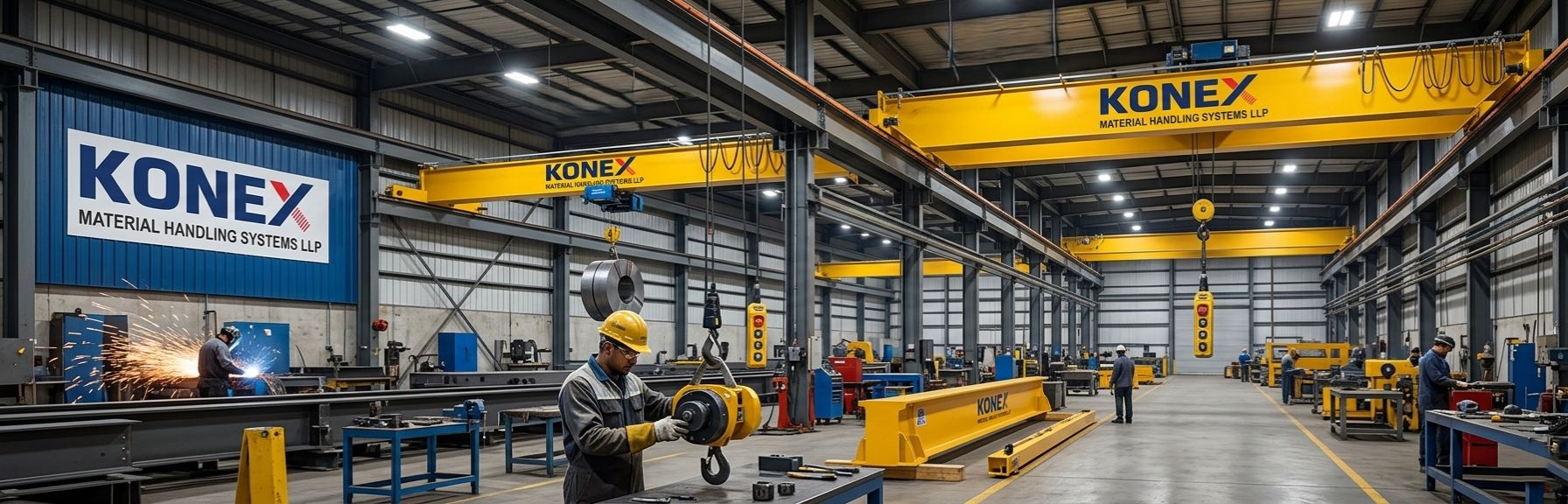
What Are the Signs Your EOT Crane Needs Repair or Replacement?
In the fast-paced world of industrial manufacturing, an EOT Crane (Electric Overhead Travelling Crane) is the heartbeat of your production line. Whether you are managing a local workshop in Ahmedabad or a heavy-duty steel plant with global operations, a malfunctioning crane isn’t just a technical glitch—it is a significant risk to your ROI, worker safety, and operational uptime.
As a leading EOT Crane Manufacturer, Konex Material Handling System LLP understands that the decision to repair or replace a crane is a critical financial crossroads for plant heads and maintenance managers.
How do you know when a simple part replacement is enough, or when it is time to invest in a new Single Girder EOT Crane or a heavy-duty Double Girder EOT Crane?
In this comprehensive guide, we break down the critical signs that your lifting equipment is nearing its end-of-life and how to make the right call for your facility.
Why Monitoring Your EOT Crane Is Critical
An EOT Crane Manufacturer designs cranes to deliver long-term durability, but real-world conditions—such as heavy loads, continuous operations, and environmental exposure—can reduce lifespan.
Regular monitoring helps you:
- Prevent unexpected breakdowns
- Maintain operational efficiency
- Ensure worker safety
- Avoid expensive emergency repairs
- Extend equipment life
Whether you use a Single Girder EOT Crane, Double Girder EOT Crane, early detection of issues is essential.
1. Unusual Noises and Vibrations: The First Warning
A healthy EOT crane should operate with a consistent, predictable hum. If your operators report grinding, squealing, or clunking sounds, it is an immediate red flag.
- Grinding Sounds: Often indicate worn-out gears or a lack of lubrication in the gearbox.
- Squealing during Travel: This usually suggests that the wheels are misaligned or the bearings in the end carriage are failing.
- Excessive Vibration: This could be a sign of structural fatigue or a misaligned bridge.
If you are using an SG EOT Crane (Single Girder) and notice these signs, immediate inspection of the hoist trolley and bridge wheels is mandatory to prevent a total breakdown.
2. Visible Structural Wear and Corrosion
As a trusted EOT Crane Manufacturer in India, we often see cranes operating in humid or chemically aggressive environments. Corrosion is a silent killer of structural integrity.
- Cracks in Welds: Inspect the joints between the girder and the end carriage. Even hairline cracks can lead to catastrophic structural failure.
- Corrosion/Rust: Surface rust is common, but deep pitting on the main girder reduces the load-bearing capacity of the steel.
- Bent Hooks or Flattened Wire Ropes: These are clear indicators of frequent overloading, which compromises the safety factor of the entire system.
3. Frequent Electrical Failures and “Ghost” Movements
Electrical components often have a shorter lifespan than the mechanical structure. If your maintenance team is constantly replacing contactors, fuses, or pendants, your system is “bleeding” money.
- Intermittent Controls: If the crane hesitates or moves after the button is released, the control logic or braking system is compromised.
- Overheating Motors: A motor that runs hot is often undersized for the current duty cycle or has internal winding damage.
- Obsolete Parts: If you are finding it difficult to source spares for your old electrical panel, it is a strong sign that a modern upgrade or a full replacement is more cost-effective.
4. Uneven Wheel Wear and Rail Misalignment
Does your crane seem to “drift” or “crab” as it moves along the runway? This is a symptom of misalignment that can destroy your gantry rails and crane wheels simultaneously.
A Double Girder EOT Crane Manufacturer will tell you that alignment is even more critical for heavy-duty, high-capacity cranes. If the wheels are wearing out faster on one side, your crane is fighting against itself, consuming more power and risking a derailment.
5. Performance Lag and Reduced Precision
In precision manufacturing, “close enough” isn’t good enough. If your hoist struggles to hold a load steady or the braking distance has increased, your productivity is at stake.
- Brake Slippage: If the load “drifts” downward after the hoist stops, the brake linings are either worn out or need urgent adjustment.
- Slow Lifting Speeds: This often points to a failing motor or a mechanical bind in the hoist drum.
Repair vs. Replacement: The ROI Decision Matrix
As a decision-maker, you must weigh the cost of a one-time repair against the long-term ROI of a new installation.
Factor | Consider REPAIR if… | Consider REPLACEMENT if… |
Safety | Minor wear on replaceable parts (ropes, hooks). | Structural cracks or frame deformation are found. |
Technology | The structure is solid and only needs a VFD or Remote update. | The crane uses outdated tech with no available spares. |
Frequency | Repairs happen once or twice a year. | Downtime is occurring weekly, halting production. |
Cost | Repair cost is < 20% of a new crane. | Cumulative repair costs exceed 50% of a new crane’s price. |
Compliance | Meets current IS 3177 / IS 807 standards. | Fails modern safety audits or requires more capacity. |
Why Choose Konex Material Handling System LLP?
At Konex, we don’t just sell cranes; we provide engineered solutions that maximise your factory’s floor-to-hook efficiency.
- Compliance: All our cranes are designed strictly according to IS 3177 and IS 807 standards, ensuring maximum safety and longevity.
- Customisation: From a 10-ton Single Girder EOT Crane for a small workshop to a 10 tons up to 100-ton Double Girder EOT Crane for heavy industry, we tailor every component to your specific duty cycle.
- Global Quality, Local Support: Based in India with a focus on global export standards, we ensure that our material handling systems offer the lowest “Total Cost of Ownership.”
- Safety First: Our cranes come equipped with advanced limit switches, overload protection, and emergency stop features as standard.
Don’t Wait for a Breakdown to Happen
The cost of an accident or an unplanned shutdown far outweighs the investment in a high-quality, reliable crane system. If your current equipment is showing any of the signs mentioned above, it is time for a professional audit.
Contact Konex Material Handling System LLP today. Let our expert engineers assess your current setup and provide a high-performing, cost-effective lifting solution that grows with your business.
Looking to Upgrade or Repair Your EOT Crane?
If your crane is showing any of the signs mentioned above, now is the time to act. Invest in performance, safety, and long-term ROI with a trusted industry expert.
Contact Konex Material Handling System LLP today for expert consultation and customized EOT Crane solutions.
Contact Us : +91 9824011164 | +91 90999 02956
FAQs
Early signs include unusual noises (grinding or squealing), excessive vibrations, uneven movement, and minor electrical issues. Regular inspection of your Single Girder EOT Crane or Double Girder EOT Crane helps detect these problems before they escalate into major failures.
If repair costs are less than 20% of a new crane and issues are minor, repair is ideal. However, if downtime is frequent, parts are obsolete, or structural damage exists, replacement with a modern EOT Crane India solution is the smarter long-term investment.
No. Unusual sounds or vibrations indicate internal wear, misalignment, or mechanical failure. Continuing operation without inspection can lead to accidents, making immediate servicing by an EOT Crane Manufacturer essential.
Frequent breakdowns are usually caused by worn-out components, poor maintenance, electrical faults, overloading, or misalignment. Older cranes, especially outdated SG EOT Crane systems, are more prone to repeated failures.
EOT cranes should undergo daily visual checks, monthly maintenance inspections, and annual professional audits. Regular inspections ensure compliance with safety standards and extend the life of your Single Girder EOT Crane Manufacturer equipment.
Signs include cracks in weld joints, corrosion on girders, bent hooks, and worn wire ropes. Structural damage significantly reduces load capacity and requires immediate attention from a Double Girder EOT Crane Manufacturer.
You should upgrade when your crane has outdated technology, high maintenance costs, frequent downtime, or cannot meet current load requirements. Investing in a modern Double Girder EOT Crane improves efficiency and safety.
Yes. Frequent electrical failures, overheating motors, and difficulty sourcing spare parts are strong indicators that your crane system is outdated and may need replacement rather than repeated repairs.
Misalignment causes uneven wheel wear, increased power consumption, and unsafe crane movement (crabbing). This reduces operational efficiency and can damage rails, especially in heavy-duty EOT Crane Manufacturer in India systems.
Konex Material Handling System LLP, a leading EOT Crane Manufacturer in Ahmedabad, India, offers customized Single Girder EOT Crane and Double Girder EOT Crane solutions designed as per IS standards. Their focus on safety, durability, and cost-efficiency ensures maximum ROI for industrial operations.