

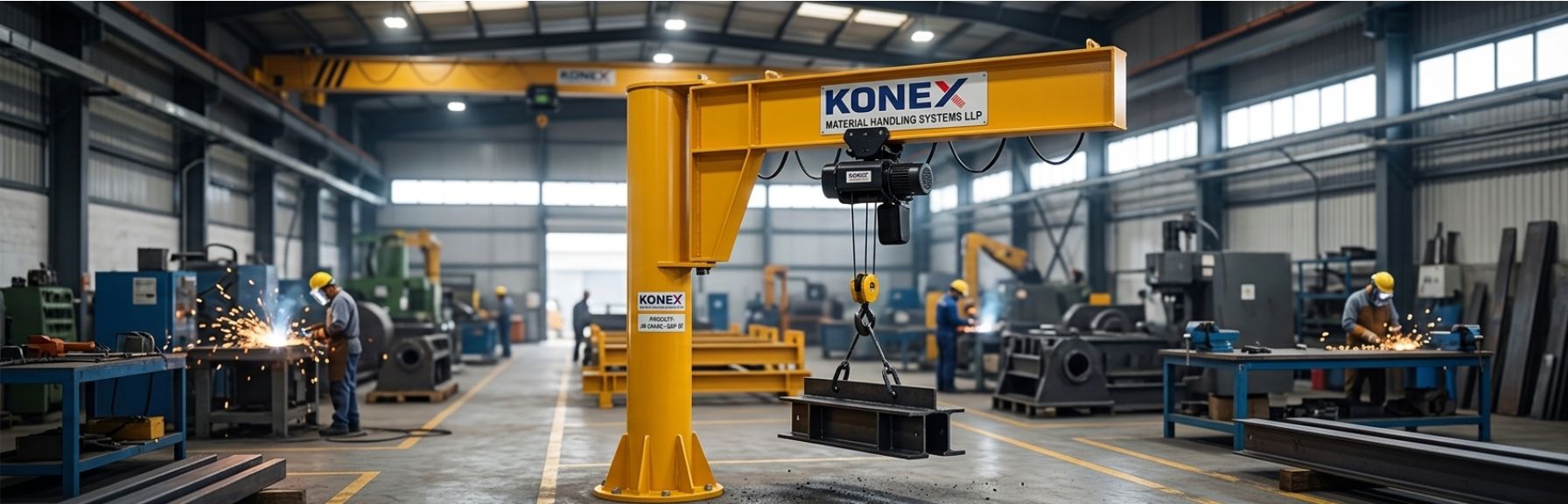
JIB Cranes for Factories: Benefits, Uses, and Installation Guide
In modern manufacturing, efficient material flow is the backbone of profitability. For plant heads, maintenance managers, and factory owners, eliminating bottlenecks at individual workstations is a constant priority. While large overhead bridge cranes are excellent for moving heavy loads across entire bays, they are often overkill—and inefficient—for localized, repetitive lifting tasks.
This is where JIB Cranes become indispensable.
As a highly efficient, space-saving lifting solution, a material handling JIB crane is designed to handle localized load manipulation safely and swiftly. Whether you are outfitting a new machining center or upgrading an existing assembly line, understanding the right type of jib crane and its proper installation can drastically improve your factory’s throughput and worker ergonomics.
In this comprehensive guide, we will explore the engineering benefits, common industrial uses, and a technical overview of JIB crane installation to help you make an informed procurement decision.
What is an Industrial JIB Crane?
At its core, a JIB crane is a type of crane where a horizontal member (known as the jib or boom) supports a moveable hoist fixed to a wall or a floor-mounted pillar. Used predominantly in industrial settings, these cranes provide localized lifting and horizontal load movement.
Unlike massive gantry or EOT (Electric Overhead Traveling) cranes that cover massive spans, Industrial JIB Cranes are designed for high-cycle, targeted operations. They typically offer lifting capacities ranging from 250 kg up to 10 tons, with a rotation arc (swivel) that can range from 180 degrees to a full 360 degrees, depending on the mounting configuration.
Types of JIB Cranes: Which is Right for Your Factory?
Selecting the correct JIB Crane for factory operations depends entirely on your available floor space, structural building integrity, and the required arc of rotation. The two most common configurations for industrial applications are:
1. Pillar Mounted JIB Crane (Free-Standing)
The Pillar Mounted JIB Crane is the most versatile and widely used type in heavy manufacturing. It consists of a robust tubular steel pillar securely anchored to a concrete foundation, supporting a rotating boom.
- Rotation: Up to 360 degrees of continuous rotation.
- Best For: Open factory floors, outdoor loading docks, and heavy-duty machining stations where maximum reach is required without relying on the building’s support columns.
- Key Advantage: It operates completely independently of your building’s structure, allowing for higher lifting capacities and longer spans.
2. Wall Mounted JIB Crane
A Wall Mounted JIB Crane (or column-mounted jib crane) utilizes the existing structural columns or reinforced walls of your factory facility to support the boom and hoist.
- Rotation: Typically 180 to 200 degrees.
- Best For: Facilities with limited floor space, or assembly lines located directly adjacent to structural walls.
- Key Advantage: It requires zero floor footprint. By eliminating the vertical mast, it frees up critical ground space for forklift traffic and machinery placement.
Note for plant engineers: Before opting for a wall-mounted unit, a thorough structural analysis of your building’s columns is mandatory to ensure they can handle the dynamic rotational torque and load limits.
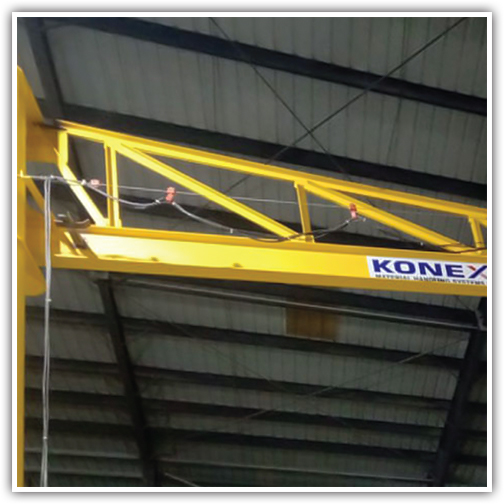
The Strategic Benefits of JIB Cranes in Manufacturing
Why do leading manufacturing facilities continuously invest in localized jib systems? The ROI goes far beyond simple lifting.
1. Optimization of Floor Space and Workflow
Factory real estate is expensive. A primary benefit of a jib crane is its minimal footprint. By strategically placing these cranes at individual workstations, operators do not have to wait for the main overhead crane to become available. This eliminates idle time and keeps the material flow uninterrupted.
2. Enhanced Worker Safety and Ergonomics
Manual lifting is one of the leading causes of workplace injuries, leading to costly downtime and workers’ compensation claims. By implementing an ergonomic material handling jib crane, operators can lift, maneuver, and position heavy castings, tools, or components with precision. Push-button hoist controls take the physical strain out of the equation, drastically improving workplace safety.
3. Highly Cost-Effective Lifting Solution
Compared to the structural steelwork and runway beams required for bridge cranes, jib cranes offer a highly favorable cost-to-benefit ratio. They are relatively inexpensive to procure, easier to maintain, and consume far less energy, making them a preferred choice for purchase managers looking to optimize capital expenditure.
4. Seamless Integration with Existing Systems
Jib cranes do not compete with your existing material handling infrastructure; they complement it. A common and highly efficient setup involves using a large overhead crane to deliver raw materials to a general area, while the localized jib crane handles the specific, repetitive machine-loading tasks.
Common Industrial Uses and Applications
The versatility of industrial jib cranes makes them suitable for a wide array of B2B sectors, including automotive manufacturing, steel fabrication, injection molding, and heavy equipment assembly. Common applications include:
- Machine Tool Loading: Lifting heavy raw steel billets or castings into CNC lathes and milling machines.
- Welding and Fabrication Stations: Holding heavy metal plates in suspension while a welder safely joins them.
- Assembly Lines: Moving heavy sub-assemblies (like engines or transmissions) from one workstation to the next.
- Loading Docks: Transferring palletized goods or heavy crates from the factory floor onto transport trucks.
- Maintenance Workshops: Assisting in the dismantling and repair of heavy electric motors, pumps, and gearboxes.
Expert JIB Crane Installation Guide: A Technical Overview
Proper JIB Crane installation is not just about functionality; it is a critical safety requirement. A poorly installed crane poses severe risks of catastrophic failure. Whether you are installing a pillar or wall-mounted unit, the process must be executed by qualified engineers following strict industrial guidelines.
Phase 1: Site Assessment and Structural Engineering
For a pillar-mounted crane, the foundation is everything. A structural engineer must assess the existing concrete slab. Standard factory floors (typically 4 to 6 inches thick) are rarely sufficient to handle the overturning moment (the leverage force) of a fully loaded jib crane.
For wall-mounted cranes, the building’s I-beam or column must be evaluated to ensure it can withstand the lateral pull and weight of the crane plus the maximum load.
Phase 2: Foundation and Base Plate Casting (For Pillar Mounted)
If the existing floor is insufficient, a new foundation must be poured.
- A pit is excavated to the specified depth (often 4 to 5 feet deep, depending on the crane’s capacity).
- Heavy-duty anchor bolts are precisely aligned using a customized template.
- High-strength concrete is poured and allowed to cure completely (typically 28 days for full strength) before any weight is applied.
Phase 3: Erecting the Pillar and Boom Assembly
Once the foundation or structural column is ready:
- The mast/pillar is hoisted into place using a mobile crane and carefully lowered onto the anchor bolts.
- The mast is levelled using levelling nuts or shims. Plumbness is critical; a mast that is even slightly off-vertical will cause the boom to drift under load.
- The boom (jib arm) is attached to the pivot points on the mast or wall bracket.
- The electrical festooning, trolley, and chain or wire rope hoist are installed onto the boom.
Phase 4: Load Testing and Safety Commissioning
Before the crane is handed over to the warehouse operators, it must undergo rigorous load testing. This typically involves testing the crane with a load equivalent to 125% of its rated Safe Working Load (SWL). The rotation, hoist brakes, and structural deflections are carefully monitored. Only after passing these tests is a safety certificate issued.
Partnering with the Right Manufacturer
The reliability of your lifting equipment heavily depends on the expertise of your chosen JIB Crane Supplier. For factory owners and purchase managers, selecting a partner who understands industrial metallurgy, precise engineering, and safety compliance is non-negotiable.
This is why industry leaders turn to Konex Material Handling System LLP Best JIB Crane Manufacturer in India. Renowned for their stringent quality control and adherence to international design standards, Konex provides robust, custom-engineered lifting solutions that guarantee longevity and safety in the harshest industrial environments. From initial site assessment and bespoke design to flawless installation and prompt after-sales support, partnering with a trusted manufacturer like Konex ensures your factory minimizes downtime and maximizes productivity.
Final Thoughts
Investing in the right material handling equipment is a direct investment in your factory’s efficiency and your workforce’s safety. Whether you opt for a versatile Pillar Mounted JIB Crane for a high-traffic machining center or a Wall Mounted JIB Crane to optimize floor space on an assembly line, the operational benefits are immediate and long-lasting.
By understanding your specific load requirements, ensuring proper, code-compliant installation, and sourcing from a reputable, high-quality JIB Crane Manufacturer, you can build a safer, faster, and more profitable manufacturing facility.
Are you looking to upgrade your factory’s material handling capabilities? Evaluate your floor space, assess your lifting requirements, and consult with a leading crane engineer today to find the perfect jib crane configuration for your operations.
Contact us : info@konex.co.in , +91 98240 11164 | +91 90999 02956
FAQs
An industrial JIB crane is a specialised lifting solution featuring a horizontal member (the boom or jib) that supports a moveable hoist. It is either fixed to a floor-mounted pillar or a structural wall. Unlike overhead cranes that cover an entire facility, a JIB crane provides localized lifting within a specific circular or semi-circular area, allowing operators to lift and position loads precisely at individual workstations.
The two primary configurations used in modern factories are:
- Pillar Mounted (Free-Standing): A self-supporting crane anchored to a concrete foundation, offering up to 360-degree rotation.
- Wall Mounted (Column-Mounted): A space-saving unit attached to existing structural beams or walls, typically providing 180 to 200-degree rotation without taking up floor space.
>Industrial JIB cranes are designed for high-cycle, targeted tasks. Their lifting capacities generally range from 250 kg up to 10 tons. The specific capacity depends on the mounting type, boom length, and the structural integrity of the factory floor or support columns.
JIB cranes boost profitability by:
- Eliminating Bottlenecks: Operators no longer have to wait for large overhead cranes for small, repetitive tasks.
- Optimizing Floor Space: Wall-mounted units free up ground area for forklift traffic and machinery.
- Cost-Effectiveness: They are less expensive to install and maintain than full-scale bridge crane systems.
Yes. Implementing an ergonomic material handling JIB crane drastically reduces workplace injuries related to manual lifting. By using push-button hoist controls, workers can maneuver heavy castings and sub-assemblies with minimal physical strain, leading to fewer compensation claims and less downtime.
Generally, no. Standard factory floors (4–6 inches thick) are often insufficient to handle the overturning moment of a fully loaded pillar-mounted crane. A structural engineer must assess the site; often, a reinforced concrete foundation (4–5 feet deep) is required to ensure the crane remains stable under maximum load.
JIB cranes are versatile tools used across several B2B sectors for:
- Machine Tool Loading: Placing raw materials into CNC machines.
- Welding Stations: Holding heavy plates during fabrication.
- Assembly Lines: Moving engines or transmissions between stations.
- Loading Docks: Transferring goods from the floor to transport trucks.
Before a JIB crane is commissioned, it must undergo a load test, typically at 125% of its rated Safe Working Load (SWL). This ensures that the hoist brakes, rotation, and structural components can safely handle the stress of daily operations.
The most critical factor is a structural analysis of the building’s I-beams or columns. These supports must be able to withstand the lateral pull and rotational torque exerted by the crane and its load. If the building structure is not reinforced, a pillar-mounted crane is the safer alternative.
Konex Material Handling System LLP is recognised as a premier manufacturer in India. They specialize in custom-engineered lifting solutions that adhere to international design standards, providing everything from initial site assessment to professional installation and safety certification.