
How Can a Transfer Trolley Improve Material Handling Efficiency in Your Industry?
In the modern industrial landscape, the difference between a profitable facility and one struggling with overheads often comes down to internal logistics. As production scales, the manual or forklift-based movement of heavy loads becomes a bottleneck, a safety hazard, and a drain on operational budgets.
For factory owners and plant managers, the search for robust material handling solutions leads to one critical piece of equipment: the Transfer Trolley.
At Konex Material Handling System LLP, a premier material handling equipment manufacturer based in Ahmedabad, India, we have seen firsthand how integrating the right industrial transfer trolley can revolutionize a shop floor. This guide explores the technical depth, ROI, and strategic benefits of implementing transfer trolleys in your facility.
Why Traditional Material Handling Fails at Scale
Many industrial units rely heavily on EOT cranes or forklifts for all internal movements. While these are essential components of material handling equipment, they have limitations:
- Crane Dependency: Over-reliance on EOT cranes creates “hooks waits.” Production stops because the crane is busy at the other end of the bay.
- Safety Risks: Moving heavy dies, coils, or structures via forklifts in narrow aisles increases the risk of tipping and collisions.
- Floor Damage: Constant heavy forklift traffic degrades industrial flooring, leading to expensive repairs.
- Operational Costs: Fuel, high maintenance, and the need for certified operators for multiple forklifts inflate the cost per ton moved.
The Real Problems in Material Handling (And Why They Cost You Money)
Before we discuss the solution, let’s look at the most common pain points faced by industrial businesses:
1. Inefficient Material Movement
Manual handling or outdated systems slow down production lines, leading to bottlenecks and delays.
2. High Labor Dependency
Relying heavily on manpower increases operational costs and introduces human error.
3. Safety Risks
Handling heavy loads manually or with improper equipment leads to workplace accidents and compliance issues.
4. Equipment Downtime
Traditional systems often lack reliability, resulting in frequent breakdowns and production loss.
5. Poor Workflow Integration
Disconnected material movement systems disrupt the entire manufacturing process.
These issues don’t just affect productivity—they directly impact your bottom line.
What is a Transfer Trolley?
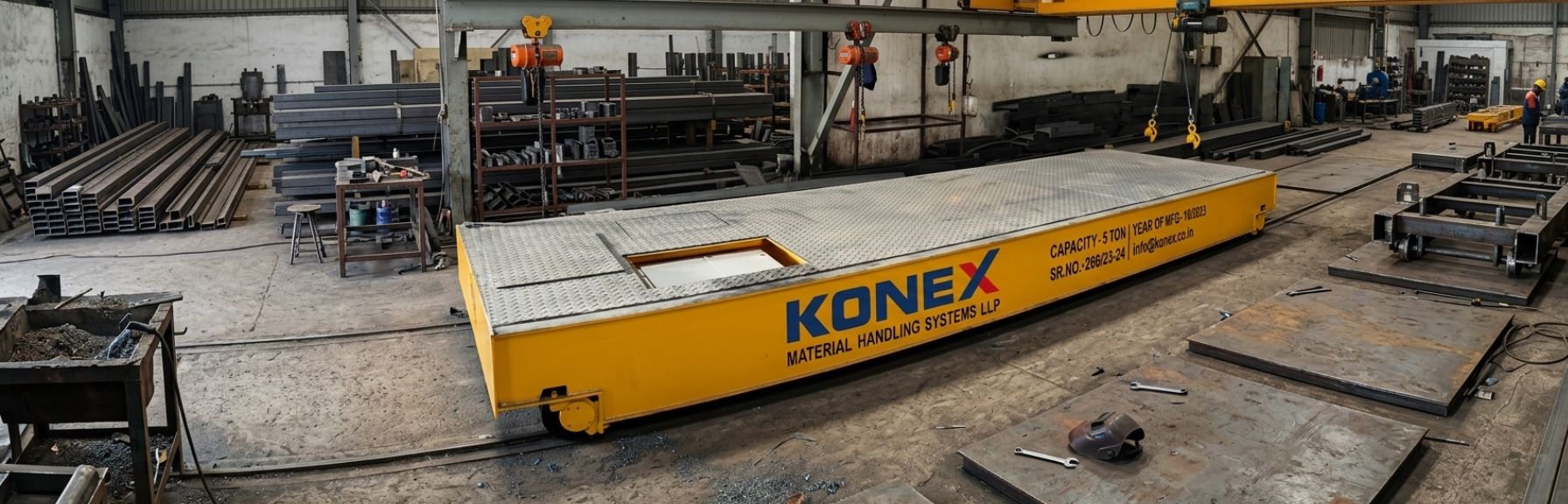
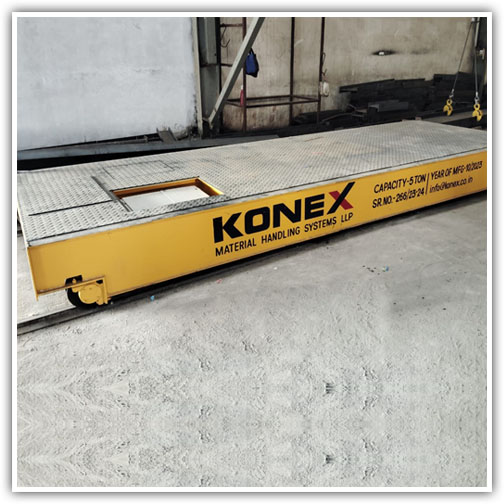
A transfer trolley (also known as a material transfer trolley or bogie) is a wheeled platform designed to move heavy raw materials, semi-finished goods, or finished products across a factory floor. Unlike forklifts, these are designed for heavy-duty applications, often reaching capacities that other mobile equipment simply cannot handle.
At Konex Material Handling System LLP, we design and manufacture Industrial Transfer Trolleys with capacities ranging up to 40 Tons, ensuring that even the most massive industrial components are moved with precision and ease.
5 Ways a Transfer Trolley Enhances Industrial Efficiency
1. Optimized Floor Space & Versatility
One of the primary advantages of an Industrial Transfer Trolley is its compact footprint. Modern manufacturing layouts are increasingly dense. While forklifts need significant turning radii, a rail-guided transfer trolley follows a fixed path, allowing for narrower aisles and more space for production machinery. For facilities requiring more flexibility, our trackless variants offer 360-degree maneuverability, navigating tight corners that traditional equipment simply cannot.
2. Significant ROI through Automation
When you evaluate Material Handling Solutions, the focus should always be on the “Cost Per Move.”
- Reduced Labor: Automating heavy load transport reduces the number of personnel required for a single move.
- Low Maintenance: Compared to the complex engine components of a forklift, an electric Material Transfer Trolley has fewer moving parts, leading to lower annual maintenance contracts (AMC).
- Energy Efficiency: Battery-operated models are far more cost-effective and eco-friendly than diesel-powered alternatives.
3. Enhanced Safety Protocols
Safety is non-negotiable in B2B industrial environments. Konex Transfer Trolleys are equipped with advanced safety features:
- Collision Avoidance Sensors: Automatically stops the trolley if an obstacle or person is detected in its path.
- Emergency Stop Buttons: Located at multiple accessible points.
- Load Control: Variable Frequency Drives (VFDs) ensure “Soft Start” and “Soft Stop” functions, preventing the load from shifting or tipping.
4. Integration with Existing Systems (EOT Cranes & More)
A common misconception is that you need either an EOT Crane or a Transfer Trolley. In reality, they are most efficient when used in tandem. Use your EOT crane for precise vertical positioning and loading, while the transfer trolley handles the long-distance horizontal transit. This “Multi-Modal” approach ensures your high-cost crane isn’t “tied up” in simple transport tasks, effectively doubling your handling capacity.
5. Ahmedabad’s Manufacturing Advantage
Choosing industrial transfer trolley manufacturers in India involves looking at the supply chain. Being headquartered in Ahmedabad, Konex Material Handling System LLP leverages the local ecosystem of high-grade steel, precision electronics, and skilled engineering labor. This allows us to provide international-standard equipment at competitive Indian price points, with faster delivery lead times for domestic and global clients.
Industry Applications: Who Needs a Transfer Trolley?
- Steel Industry: Moving heavy coils, billets, and plates between rolling mills and storage yards.
- Automotive Sector: Transporting vehicle chassis or heavy stamping dies across assembly lines.
- Foundries: Safely moving ladles of molten metal or heavy castings.
- Warehousing: High-density pallet movement for oversized goods.
- Wind Energy: Transporting massive turbine blades and nacelles during fabrication.
Why Choose Konex Material Handling System LLP?
When it comes to selecting the right Transfer Trolley Manufacturers in India, experience and engineering expertise matter.
Konex Material Handling System LLP, based in Ahmedabad—India’s leading manufacturing hub—offers:
1. Engineering Excellence
Precision-designed Industrial Transfer Trolley systems built for heavy-duty performance.
2. Custom Solutions
Tailor-made designs to match your plant layout and operational needs.
3. Quality Assurance
Use of high-grade materials and strict quality control processes.
4. End-to-End Support
From design and manufacturing to installation and after-sales service.
5. Proven Industry Experience
Trusted by industries across India and global markets.
Key Factors to Consider Before Investing
Before selecting a Material Transfer Trolley, evaluate:
- Load capacity requirements
- Travel distance and layout
- Power source preference
- Automation level
- Safety features
Working with experienced Industrial Transfer Trolley Manufacturers India ensures you get the right solution without costly mistakes.
Final Thoughts: Is a Transfer Trolley Right for Your Business?
If your facility faces challenges like slow material movement, high labor costs, or safety risks, investing in a Transfer Trolley is a strategic decision—not just an operational upgrade.
It’s not just about moving materials—it’s about:
- Optimizing workflows
- Improving safety
- Increasing profitability
Ready to Upgrade Your Material Handling Efficiency?
If you’re looking for reliable Material Handling Solutions, partnering with an experienced manufacturer is critical.
Konex Material Handling System LLP stands out as a trusted name in delivering high-performance Transfer Trolley systems, EOT Cranes, and customized industrial solutions tailored to your business needs.
👉 Whether you need a standard Material Transfer Trolley or a fully customized system, Konex can help you design a solution that maximizes efficiency and ROI.
Contact Konex Material Handling System LLP today to discuss your requirements and get a customized solution that transforms your industrial operations.
Contact Us : +91 98240 11164 | +91 90999 02956 , info@konex.co.in
FAQs
A transfer trolley is a heavy-duty industrial platform used to transport materials across factory floors. It operates on rails or as a trackless system and is designed to move large loads like steel coils, dies, or fabricated structures efficiently and safely.
A transfer trolley improves efficiency by reducing manual handling, minimizing crane dependency, and enabling faster horizontal movement of materials. It eliminates bottlenecks, reduces downtime, and streamlines workflow across production lines.
Industries that benefit the most include:
- Steel and metal processing
- Automotive manufacturing
- Foundries and heavy engineering
- Warehousing and logistics
- Wind energy and infrastructure
These industries require safe and efficient movement of heavy loads.
Yes, in many cases. Transfer trolleys can replace forklifts for heavy and repetitive material movement. They offer better safety, lower operational costs, and higher load capacity compared to forklifts, especially in structured production environments.
Industrial transfer trolleys can handle loads ranging from a few tons to 40 tons or more, depending on design and application. Manufacturers like Konex Material Handling System LLP offer customized solutions based on specific load requirements.
Yes, transfer trolleys are designed with advanced safety features such as:
- Collision avoidance sensors
- Emergency stop systems
- Controlled acceleration and braking (VFD)
These features significantly reduce workplace accidents compared to manual handling or forklifts.
- Rail-guided trolleys follow a fixed path and are ideal for repetitive operations.
- Trackless trolleys offer flexibility with 360-degree movement, suitable for dynamic layouts.
The choice depends on your plant layout and operational needs.
Transfer trolleys reduce costs by:
- Lowering labor dependency
- Eliminating fuel expenses (battery-operated systems)
- Reducing maintenance compared to forklifts
- Minimizing floor damage
This leads to a lower cost per ton moved.
Yes, transfer trolleys complement EOT cranes perfectly. Cranes handle vertical lifting, while trolleys manage horizontal movement. This combination increases productivity and prevents crane overuse.
To select the right transfer trolley, consider:
- Load capacity
- Travel distance
- Floor conditions
- Power source (battery, cable, etc.)
- Automation level
Working with experienced manufacturers like Konex Material Handling System LLP ensures a customized solution tailored to your operational requirements.