

Before You Buy a Double Girder EOT Crane: 10 Questions Every Plant Manager Should Ask
Investing in heavy lifting machinery is one of the most critical capital decisions a manufacturing or industrial facility can make. Among the various material handling solutions available today, the Double Girder EOT Crane stands out as the ultimate workhorse for heavy loads, wider spans, and intense operational duty cycles.
However, selecting the right crane system isn’t simply about choosing a heavy piece of equipment from a catalog. A miscalculated decision can lead to costly operational bottlenecks, unplanned downtime, safety hazards, and premature equipment failure.
To help you make an informed, ROI-driven decision, Konex Material Handling System LLP has compiled this comprehensive buyer’s guide. Before finalizing your purchase order, ask these 10 critical questions to ensure you partner with the right equipment and manufacturer.
1. What Are My Exact Load Capacities and Daily Duty Requirements?
Before looking at crane designs, look closely at your daily plant operations. Buying a crane based solely on your maximum lifting weight is a common mistake.
- Maximum vs. Nominal Capacity: What is the heaviest single load you need to move today—and 5 years from now?
- Operating Frequency: Will the crane operate continuously in a 3-shift production line, or will it perform occasional heavy maintenance lifts?
Understanding your duty cycle helps determine the ideal mechanical classification. A properly specified system prevents premature wear on gears, motors, and wire ropes, saving thousands in maintenance over time.
2. How Do Building Dimensions and Structural Clearances Impact the Design?
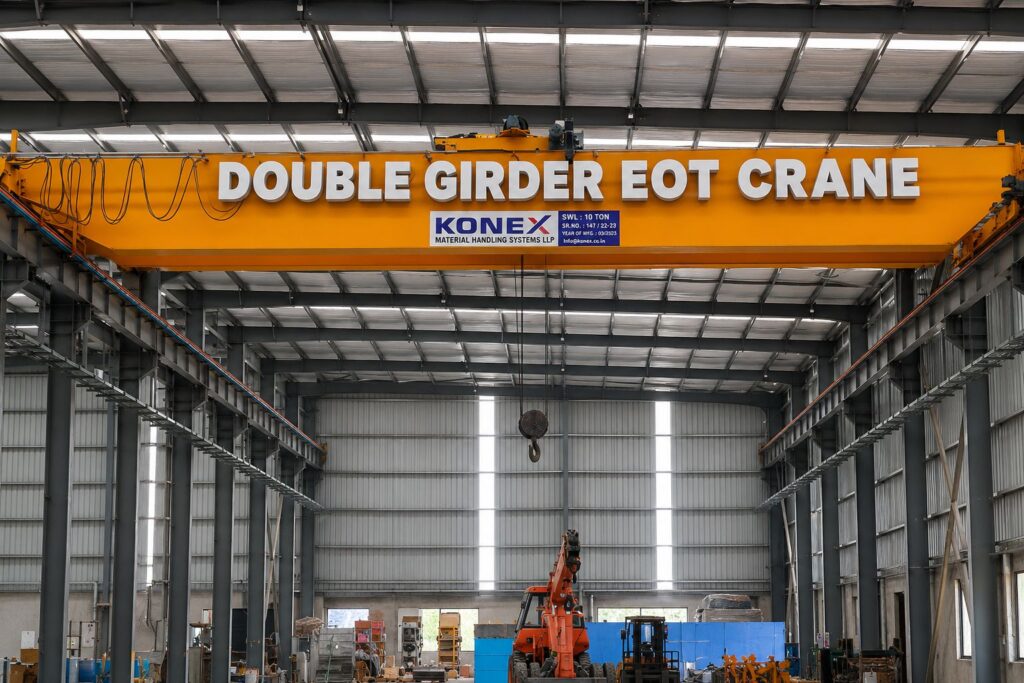
Every factory floor is unique. Installing a Double Girder EOT Crane requires seamless physical alignment with your facility’s building structure.
Key structural considerations include:
- Hook Path and Floor Coverage: Does the crane reach all necessary loading, unloading, and assembly areas?
- Headroom and Overhead Clearances: Is there adequate distance between the top of the crane bridge and the facility roof trusses?
- Runway Girders & Building Columns: Can your existing civil structure support the wheel loads, or will structural reinforcements be required?
Working early with an experienced engineering team ensures your crane maximizes available hook height without demanding expensive structural overhauls.
3. What Safety Features Are Built into the System to Protect Workers and Payload?
In modern industrial facilities, safety directly affects productivity. High-performance overhead cranes must protect both your human capital and your high-value inventory.
Essential safety mechanisms to look for include:
- Overload limiters to prevent operating beyond safe weight thresholds.
- Dual-speed control or variable frequency drives (VFDs) for smooth, jerk-free starts and stops.
- Anti-sway technology to minimize load swinging during transfer.
- Limit switches for travel and hoist movements to avoid collision risks.
Always confirm that your supplier designs equipment that strictly adheres to regional and international safety regulations.
4. Can the System Be Tailored to Our Specific Operational Workflow?
Off-the-shelf lifting solutions rarely deliver maximum efficiency for specialized operations. Whether you handle molten metal, heavy granite blocks, precision machinery, or fabricated steel structures, customization is essential.
Ask potential suppliers:
- Can the hoisting speed and bridge travel speed be customized to match our assembly pace?
- Are specialized below-the-hook attachments (such as magnets, grab buckets, or C-hooks) easily integrated?
- Can radio remote controls or cabin operations be customized for optimal operator visibility and comfort?
Custom-tailored material handling systems eliminate operational bottlenecks and streamline daily plant throughput.
5. What Is the Total Cost of Ownership (TCO), Beyond the Initial Purchase Price?
A lower upfront price tag can often mask higher long-term operating costs. Smart plant managers evaluate the Total Cost of Ownership over a 10- to 20-year operational lifecycle.
Consider these factors:
- Energy Efficiency: Modern high-torque, energy-efficient motors significantly reduce monthly electricity consumption.
- Component Wear & Durability: High-grade components require fewer replacements over time.
- Ease of Maintenance: Modular designs reduce maintenance labor hours during routine inspections.
Investing in high-quality engineering up front delivers a far lower total cost per ton lifted over the life of the crane.
6. How Simple Is Maintenance, and How Accessible Are Standard Spare Parts?
Unplanned equipment downtime can stall an entire production line. When evaluating a system, ask about the long-term serviceability of the equipment.
Key questions to ask:
- Are spare parts standard and readily available, or are they proprietary components with long lead times?
- Is the design modular, allowing technicians to easily access drives, brakes, and electrical panels?
- Does the crane feature smart diagnostic indicators to identify operational issues quickly?
Partnering with a supplier that maintains a reliable inventory of critical spares ensures your facility stays operational without extended delays.
7. How Does the System Handle Precision Movement and Load Positioning?
Heavy lifting is only half the battle; exact positioning is often where productivity is won or lost. In industries such as die manufacturing, power generation, and precision fabrication, placing a load within millimeters is essential.
Ensure your crane offers:
- Inverter-driven smooth acceleration and deceleration.
- Micro-speed control options for delicate assembly tasks.
- Ergonomic control interfaces that give operators clear sightlines and precise control.
Precise handling minimizes product damage and speeds up handling cycles across your shop floor.
8. Does the Supplier Offer Complete Turnkey Execution from Engineering to Commissioning?
Managing multiple contractors for design, manufacturing, logistics, civil runway alignment, and final installation creates communication gaps and project delays.
A turnkey partner manages the complete project lifecycle:
- Site Evaluation & Design: Customized engineering aligned with your facility layout.
- Manufacturing & Quality Control: Precision manufacturing using tested materials.
- Logistics & Assembly: Safe delivery and professional installation on site.
- Testing & Commissioning: Load testing, safety certification, and operator training.
A single point of accountability guarantees smoother execution, faster commissioning, and reliable project delivery schedules.
9. Does the Manufacturer Have Proven Technical Expertise and Global Standards Compliance?
The credibility of your equipment supplier directly reflects the reliability of your crane. Evaluate the manufacturer’s operational track record, technical capabilities, and quality management certifications.
Verify whether the supplier:
- Follows recognized design and manufacturing quality standards.
- Maintains strict quality assurance processes for raw materials, structural welding, and electrical systems.
- Has a proven track record of serving diverse industrial sectors across local and international markets.
A reputable manufacturer builds long-term reliability directly into every structural weld and electrical circuit.
10. Why Choose Konex Material Handling System LLP as Your Material Handling Partner?
Selecting the right lifting solution ultimately comes down to choosing a manufacturer you can trust for performance, longevity, and post-purchase support.
Konex Material Handling System LLP has established itself as a premier Double Girder EOT Crane Manufacturer in India, delivering robust, high-precision material handling solutions for diverse industrial applications.
The Konex Advantage:
- Custom-Engineered Precision: Every lifting system is designed around your specific load demands, span requirements, and facility layout.
- Built for Reliability: We use high-grade structural steel, advanced drive mechanisms, and top-tier electrical components to ensure maximum uptime.
- Complete Turnkey Support: From initial design consultations to site installation, load testing, and commissioning, we manage every step.
- India-Based Manufacturing with Global Export Capability: Serving heavy industries across India while exporting high-performance overhead cranes to international markets worldwide.
- Dedicated After-Sales & Spare Parts Network: Responsive technical support and prompt spare parts availability to keep your plant moving smoothly.
Ready to Upgrade Your Facility’s Lifting Efficiency?
Choosing the right overhead crane is an investment in your plant’s long-term safety, productivity, and profitability. Don’t leave your material handling operations to chance.
Consult with the engineering experts at Konex Material Handling System LLP today. Our engineering team will assess your site conditions, understand your operational goals, and recommend a custom-engineered lifting solution tailored to your exact needs.
Contact Konex Material Handling Today for a Free Site Assessment & Customized Quote
FAQs
Before buying a Double Girder EOT Crane, consider the required lifting capacity, duty cycle, span, lifting height, building clearances, hook coverage, travel requirements, safety features, customization needs, maintenance requirements, spare-parts availability, total cost of ownership, and the manufacturer’s technical support.
Determine the capacity by identifying the heaviest load that the crane will routinely lift, not just the average load. Also consider future production requirements, load frequency, lifting accessories, and whether the crane will handle different load types. The selected capacity should be based on actual operating requirements and appropriate engineering assessment.
Duty cycle indicates how frequently and intensively the crane will operate. A crane working across multiple shifts or performing frequent lifting operations may require a different duty classification than one used occasionally. Proper duty selection helps reduce excessive component wear, maintenance requirements, and premature equipment failure.
Important information includes the available crane span, runway arrangement, building width and height, hook lifting height, roof and overhead clearances, column positions, runway beam details, floor-to-hook requirements, and available approach distances. A site assessment can help identify structural or clearance limitations before manufacturing begins.
Common safety features to evaluate include overload protection, hoist and travel limit switches, emergency stop systems, suitable brakes, controlled acceleration and deceleration, VFD-based movement where required, audible or visual warning systems, and appropriate electrical protection. The final safety arrangement should match the crane’s application and applicable standards.
Yes. A Double Girder EOT Crane can be engineered around the plant’s load characteristics, span, lifting height, operating frequency, travel requirements, available clearances, control method, and workflow. Depending on the application, additional lifting attachments or specialized control arrangements may also be considered.
Compare more than the initial purchase price. Evaluate energy consumption, component quality, expected maintenance requirements, spare-parts availability, service support, downtime risks, inspection requirements, and expected operating life. A crane with a higher initial investment may have different long-term operating costs than a lower-priced alternative.
Spare-parts availability and maintenance support are important because crane downtime can interrupt material movement and production activities. Before purchasing, ask which components are standard, how replacement parts are sourced, what technical support is available, and how easily motors, brakes, electrical components, drives, and other serviceable parts can be accessed.
Precision movement allows operators to position heavy loads more accurately and control acceleration and deceleration more smoothly. This can be particularly useful when handling machinery, fabricated components, dies, steel assemblies, or other loads where controlled positioning is important. VFDs and suitable control arrangements can support smoother crane movement.
Ask about the manufacturer’s engineering process, experience with similar applications, customization capabilities, applicable design standards, quality-control procedures, testing process, documentation, spare-parts support, warranty terms, commissioning support, and after-sales service. You should also clarify exactly what is included in the project scope and delivery responsibilities.
Turnkey support can simplify crane projects by providing a coordinated approach to engineering, manufacturing, delivery, installation, testing, and commissioning. It can also reduce communication gaps between multiple contractors. However, the exact scope of turnkey services should be clearly defined in the commercial and technical proposal.
Konex Material Handling System LLP provides custom-engineered material handling solutions based on application requirements such as load capacity, span, lifting height, operating conditions, and plant layout. The company focuses on engineering, manufacturing, project execution, commissioning support, and after-sales assistance for industrial crane requirements in India and export markets.