
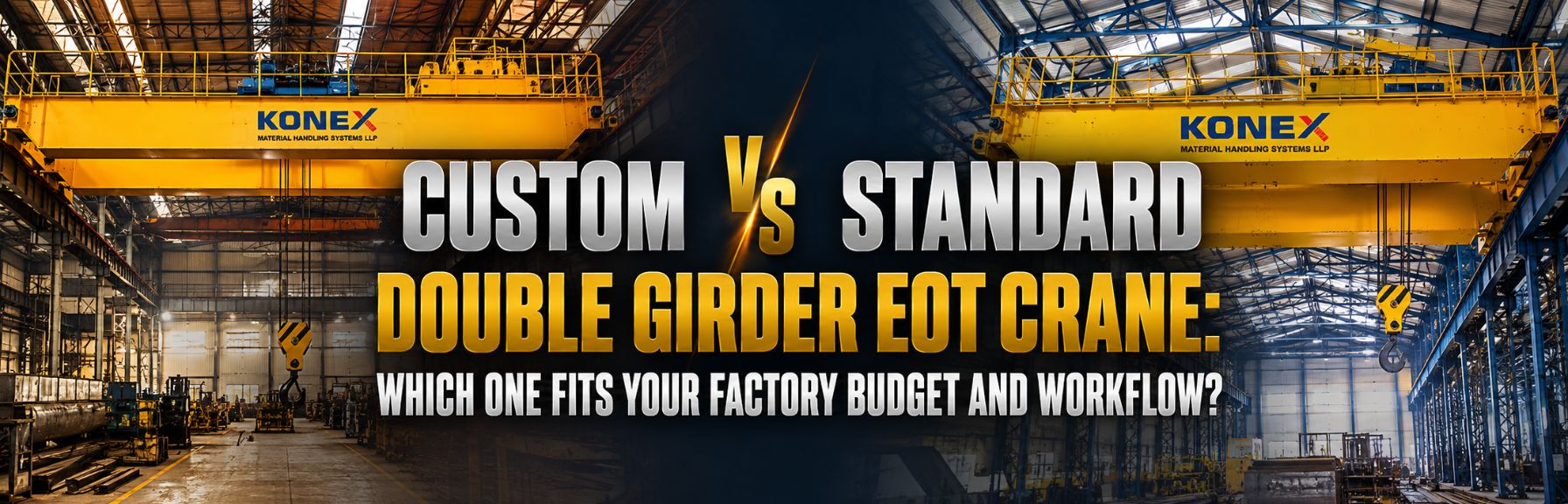
Custom vs Standard Double Girder EOT Crane: Which One Fits Your Factory Budget and Workflow?
Setting up a new manufacturing plant or expanding an existing production floor involves critical capital investment decisions. Among all overhead material handling equipment, the Double Girder EOT Crane serves as the primary backbone for moving heavy loads safely and efficiently across industrial bays.
However, once you establish that a heavy-duty double girder configuration is required for your facility, plant leaders face an important fork in the road: Should you buy a standard pre-engineered model, or invest in a custom-engineered lifting system?
Choosing incorrectly can lead to unforeseen operational bottlenecks, wasted building volume, higher long-term maintenance overhead, or unnecessary upfront capital expenditure.
In this comprehensive guide, we compare standard and custom double girder EOT cranes across real-world factory workflows, spatial constraints, and long-term financial metrics—helping you select the exact machinery setup that accelerates productivity while protecting your factory budget.
What Is a Double Girder EOT Crane? (And Why Does Configuration Matter?)
Before comparing purchasing strategies, it helps to understand the core mechanical structure in simple terms.
An Electric Overhead Traveling (EOT) crane with a double girder design uses two parallel bridge beams spanning the width of your factory bay. A hoist trolley travels on top of rails mounted to these girders, delivering greater hook height, superior lifting capacity, and enhanced structural stability compared to single girder alternatives.
While all double girder cranes fulfill the primary task of overhead material movement, their engineering architecture falls into two distinct categories:
+-----------------------------------------------------------------------------------+
|                        OVERHEAD MATERIAL HANDLING SYSTEM                          |
+--------------------------------------------------+--------------------------------+
                                                   |
                        +--------------------------+--------------------------+
                        |                                                     |
                        v                                                     v
         STANDARD DOUBLE GIRDER EOT CRANE                      CUSTOM DOUBLE GIRDER EOT CRANE
     +---------------------------------------+             +---------------------------------------+
     | - Modular pre-engineered design       |             | - Tailored to exact plant dimensions  |
     | - Fast manufacturing & delivery       |             | - Optimized hook approach & clearance  |
     | - Lower initial capital outlay        |             | - Customized speeds & control tech    |
     | - Ideal for conventional factory bays |             | - Built for specialized/harsh environments|
     +---------------------------------------+             +---------------------------------------+
1. Standard Double Girder EOT Cranes
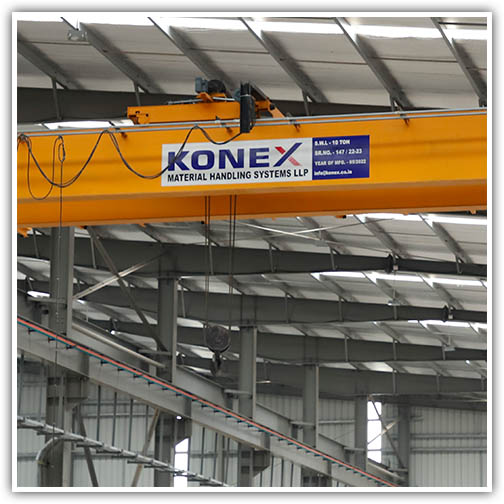
Standard pre-engineered cranes are built using pre-designed modular assemblies with standardized bridge spans, uniform lifting speeds, and fixed structural profiles. They are engineered to satisfy conventional industrial demands—such as general fabrication yards, standard storage warehouses, and routine machinery assembly plants.
Because manufacturers produce these units around pre-tested structural blueprints and off-the-shelf components, standard cranes offer predictable pricing and fast delivery schedules.
2. Custom Double Girder EOT Cranes
A custom-engineered crane is designed from the ground up to address unique spatial limitations, severe operating environments, or specialized material handling procedures.
If your facility features low ceiling clearance, narrow column spacing, extreme working temperatures, or requires synchronized double-hoist lifting, a custom system adapts the structural steelwork, drive mechanics, and electronic controls specifically to your plant layout.
When Does a Standard Double Girder EOT Crane Make Financial Sense?
For many growing manufacturing businesses, a pre-engineered standard crane offers the most practical path to operational readiness. It provides a reliable balance of heavy-duty lifting capability, short lead times, and manageable upfront investment.
           STANDARD CRANE EVALUATION FLOW
                                          |
          +-------------------------------+-------------------------------+
          |                               |                               |
          v                               v                               v
Standard Building Spans?        Routine Material Handling?       Strict Project Deadlines?
          |                               |                               |
          +-------------------------------+-------------------------------+
                                          |
                                          v
                   +---------------------------------------------+
                   |  Standard Double Girder Crane Is Ideal      |
                   +---------------------------------------------+
Here are the key operational scenarios where a standard model performs exceptionally well:
1. Conventional Building Architecture
If your factory or warehouse follows standard industrial shed dimensions—with generous headroom above the runway rail, standard column spacing, and uninhibited side clearances—a pre-engineered Double Girder EOT Crane fits onto your existing runway beams without structural alterations.
2. Routine, Uniform Material Movement
If your daily workflow consists of moving uniform, predictable loads—such as raw steel plates, standardized pallets, equipment components, or finished goods—at steady operational speeds, standard drive systems and hoisting speeds deliver all the performance your plant requires.
3. Rapid Commissioning Schedules
When expanding production capacity under tight customer delivery deadlines, waiting months for custom engineering can cost you valuable contract revenue. Standardized pre-engineered crane components are fabricated faster, helping you commission your plant on time.
Primary Business Advantages:
- Lower Upfront Capital Expenditure (CapEx): Pre-tested engineering blueprints reduce custom design hours and lower fabrication costs.
- Shorter Lead Times: Ready-to-build modular components significantly speed up production, shipment, and installation.
- Simplified Long-Term Servicing: Off-the-shelf drive motors, wire ropes, and electrical panels mean replacement spare parts are easy to source locally over time.
Operational Triggers: When Custom Engineering Becomes Essential
While standard units work well in conventional spaces, forcing a standard pre-engineered crane into a complex or space-restricted building can lead to compromised lifting height, safety hazards, premature component wear, and lost floor space.
CUSTOM ENGINEERING NEED TRIGGERS
                                        |
       +--------------------------------+--------------------------------+
       |                                |                                |
       v                                v                                v
Spatial & Headroom Constraints    Harsh Work Environments         Complex Load Dynamics
(Low ceilings / tight columns)    (Heat, dust, corrosive fumes)   (Dual hoists, delicate items)
       |                                |                                |
       +--------------------------------+--------------------------------+
                                        |
                                        v
                 +----------------------------------------------+
                 |  Custom-Engineered Crane Solution Required    |
                 +----------------------------------------------+
Here are four clear operational triggers that indicate your facility requires a customized heavy lifting system:
1. Spatial Constraints and Headroom Optimization
In older industrial buildings, low roof trusses or low runway rails restrict vertical hook travel. A standard crane frame mounted above the runway rails might strike roof beams or fail to lift materials high enough to clear machinery on the shop floor.
Custom engineering allows manufacturers to build compact end carriages, lowered bridge profiles, or tailored trolley frames that maximize effective hook height without requiring expensive building modifications.
2. Harsh or Specialized Operating Environments
Standard electrical panels, standard motor enclosures, and basic steel coatings are not designed for aggressive operating conditions. Facilities dealing with hot metal foundries, chemical processing plants, coastal humidity, or outdoor storage yards require specialized protection.
Custom solutions incorporate heat-shielding, explosion-proof electrical enclosures, specialized anti-corrosive paint coatings, and heavy-duty dust protection to prevent unexpected electrical breakdowns and structural corrosion.
3. Complex Load Dynamics and Precise Handling
Lifting long, flexible, unbalanced, or extremely delicate loads using a single hoist hook can cause dangerous load sway or structural strain.
Custom designs allow for tandem hoists operating on a single bridge, synchronized dual-trolley arrangements, variable frequency drives for ultra-smooth acceleration, and smart electronic anti-sway controls that protect sensitive machinery during placement.
4. Maximum Floor Coverage (Hook Approach)
“Hook approach” refers to how close the crane hook can travel toward the end walls and side columns of your building. A standard crane profile may leave wide “dead zones” along the edges of your factory bay where materials cannot be picked up or dropped off. Custom bridge structures minimize these side clearances, making every square foot of your floor space usable for production and storage.
Financial Strategy: Upfront Cost vs. Total Cost of Ownership (TCO)
When planning equipment budgets, finance teams often focus solely on the initial purchase quote. However, an overhead material handling system operates continuously for 15 to 20+ years. Evaluating your investment through the lens of Total Cost of Ownership (TCO) provides a clearer financial picture.
FINANCIAL MATRIX
                                       |
          +----------------------------+----------------------------+
          |                                                         |
          v                                                         v
   STANDARD CRANE                                             CUSTOM CRANE
+------------------------------+                           +------------------------------+
| Lower Initial Capital Cost   |                           | Higher Initial Capital Cost  |
| Standard Operational Cost    |                           | Maximized Floor Productivity |
| Ideal for Standard Lifespan  |                           | Lower Maintenance Downtime   |
Initial Capital Cost (CapEx)
- Standard Cranes: Offer a lower initial purchase price because engineering, drafting, and manufacturing processes are standardized across volume production.
- Custom Cranes: Require a higher upfront outlay to cover specialized structural design, custom electrical control integration, and custom mechanical fabrication.
Operational Efficiency & Long-Term Expense (OpEx)
- The Hidden Cost of an Ill-Fitted Crane: If a lower-cost standard crane leaves large unserviceable zones on your shop floor, forces double-handling of materials, or breaks down under heavy duty cycles, the resulting loss in daily production quickly wipes out your initial savings.
- The Value of Precision Fit: A custom crane engineered specifically for your building geometry eliminates dead zones, speeds up handling cycle times, and operates reliably under tough working conditions—yielding a far higher return on investment (ROI) over its operating lifespan.
Decision Rule: If a standard pre-engineered crane fulfills over 90% of your spatial, lifting height, and workflow needs without compromising safety or floor usage, it is your most cost-effective choice. If spatial restrictions or non-standard loads force major workarounds, a custom-designed crane pays for itself by protecting plant output.
Direct Decision Comparison: Standard vs Custom
To help your engineering and procurement teams evaluate options quickly, the table below contrasts both approaches across core practical criteria:
Comparison Criteria | Standard Double Girder Crane | Custom Double Girder Crane |
Initial Capital Investment | Cost-effective / Lower upfront price | Higher initial investment |
Delivery & Installation Time | Faster turnaround and commissioning | Moderately extended engineering timeline |
Building Compatibility | Ideal for standard headroom & clear bays | Custom-built for tight headroom, low roofs, or unusual spans |
Operating Environments | Normal industrial indoor facilities | High heat, outdoor, corrosive, or dusty settings |
Handling Precision & Automation | Dependable standard movement speeds | Micro-speeds, twin-hoist synchronization, automation-ready |
Hook Coverage Area | Standard hook approach distances | Maximized side and end-bay coverage to reduce dead space |
Maintenance & Spare Parts | Readily available off-the-shelf components | Application-specific components engineered for longevity |
Why Partner with Konex Material Handling System LLP?
Whether your factory requires a rapid-deployment standard crane or a complex customized overhead lifting solution, selecting the right manufacturing partner ensures long-term reliability and compliance with safety standards.
At Konex Material Handling System LLP, we build heavy-duty overhead material handling systems designed to power demanding industrial operations. Based in India with full global export capability, Konex delivers world-class engineering quality, rugged structural durability, and practical material handling design.
THE KONEX CONSULTATIVE APPROACH
                                 |
  +-------------------+  +-------------------+  +-------------------+
  | 1. On-Site Space  |->| 2. Practical      |->| 3. High-Precision |
  |    & Work Survey  |  |    Engineering    |  |    Fabrication    |
  +-------------------+  +-------------------+  +-------------------+
                                                          |
                                                          v
                                                +-------------------+
                                                | 4. Global Delivery|
                                                |    & Support      |
                                                +-------------------+
How We Deliver Long-Term Value:
- Consultative Engineering First: We analyze your actual plant layout, roof clearances, handling frequency, and budget before recommending a system. We never over-engineer a simple project, nor do we compromise safety on complex ones.
- Built to International Standards: Every Double Girder EOT Crane manufactured by Konex undergoes strict quality checks, structural testing, and safety evaluations to ensure trouble-free service across demanding shift schedules.
- Value-Driven Manufacturing: From cost-optimized standard models to fully bespoke multi-hoist systems, Konex provides reliable lifting solutions that fit your budget while optimizing shop-floor productivity.
- End-to-End Operational Support: From initial engineering consultation and bay layout design to installation support and long-term spare parts supply, Konex stays with you at every stage.
Final Decision Summary: Making the Right Choice for Your Factory
To decide between a standard and a custom double girder system, review these three closing questions with your plant management team:
- Does your building offer standard headroom and uninhibited structural bay dimensions?
If yes, a standard crane offers the fastest, most economical solution.
- Does your plant operate in severe environments, move non-standard loads, or have low ceiling clearances?
If yes, a custom-engineered crane is a vital investment that protects floor efficiency and workplace safety.
- What is your target commissioning date?
If immediate plant rollout is essential, a standard pre-engineered crane offers the shortest path to production.
Take the Next Step Toward Optimizing Your Factory Workflow
Avoid costly trial-and-error when planning your material handling infrastructure. Talk to structural and lifting experts who can evaluate your facility layout and recommend the exact crane configuration for your needs.
Ready to find the ideal lifting solution for your facility? Contact the engineering team at Konex Material Handling System LLP today for a personalized technical consultation and site evaluation.
Contact Us : +91 9824011164 | +91 90999 02956
FAQs
A standard double girder EOT crane is built using pre-engineered modular components with fixed dimensions for conventional factory layouts, whereas a custom double girder EOT crane is engineered specifically to adapt to restricted headroom, severe operating environments, or unique load-handling requirements. Standard models offer lower upfront costs and faster delivery, while custom units maximize shop floor space, hook height, and specialized operational safety.
The cost of a double girder EOT crane varies depending on lifting capacity, bridge span, vertical lift height, control technology, and customization level. Standard pre-engineered models are generally more budget-friendly due to streamlined fabrication, whereas custom-engineered cranes carry a higher initial purchase price offset by higher long-term operational productivity and eliminated downtime.
A double girder EOT crane is ideal when lifting heavy capacities (typically 10 tons and above), requiring wider bridge spans, or needing maximum vertical hook height. Because the hoist trolley travels on top of the bridge girders rather than underneath them, double girder systems deliver superior structural stability and greater hook clearance for heavy-duty industrial applications.
Yes, a custom double girder EOT crane can be engineered specifically for low-headroom facilities. Custom designs utilize low-profile end carriages, specialized bridge girder configurations, and compact trolley frames to maximize usable hook height without requiring costly structural modifications to your existing factory building.
A double girder EOT crane enhances safety by providing high structural rigidity, superior load stability, and precise motion control. Equipping the system with modern electronic features like Variable Frequency Drives (VFDs) and anti-sway controls ensures smooth acceleration, reduces structural strain, and minimizes operator risk during complex overhead material movement.
High-temperature foundries, chemical processing facilities, outdoor storage yards, coastal industrial sites, and explosive atmospheres require custom-engineered double girder EOT cranes. These environments demand specialized features such as heat radiation shields, explosion-proof electrical panels, IP-rated dust enclosures, and anti-corrosive protective paint coatings.
While a standard double girder EOT crane has a lower initial capital cost (CapEx), a custom crane often delivers a lower Total Cost of Ownership (TCO) in complex facilities by eliminating unusable “dead zones” and reducing maintenance downtime. Evaluating TCO over a 15-to-20-year operational lifecycle allows factory leaders to balance short-term budgets with long-term shop floor efficiency.
Standard pre-engineered double girder EOT cranes generally have shorter lead times of a few weeks due to pre-tested blueprints and ready modular inventory. Custom-engineered units require additional time for custom engineering drafting, tailored component fabrication, and rigorous safety testing prior to dispatch.
Yes, standard double girder EOT cranes can be retrofitted with upgraded control systems, radio wireless remotes, variable speed drives, or enhanced safety sensors. However, core structural parameters—such as span length and maximum lifting capacity—are best specified accurately during the initial manufacturing stage to ensure structural compliance.
Konex Material Handling System LLP provides consultative engineering, strict adherence to international quality standards, and cost-effective lifting solutions for standard and custom requirements. Based in India with global export capabilities, Konex helps industrial facilities optimize material handling workflows while protecting capital investment budgets.