

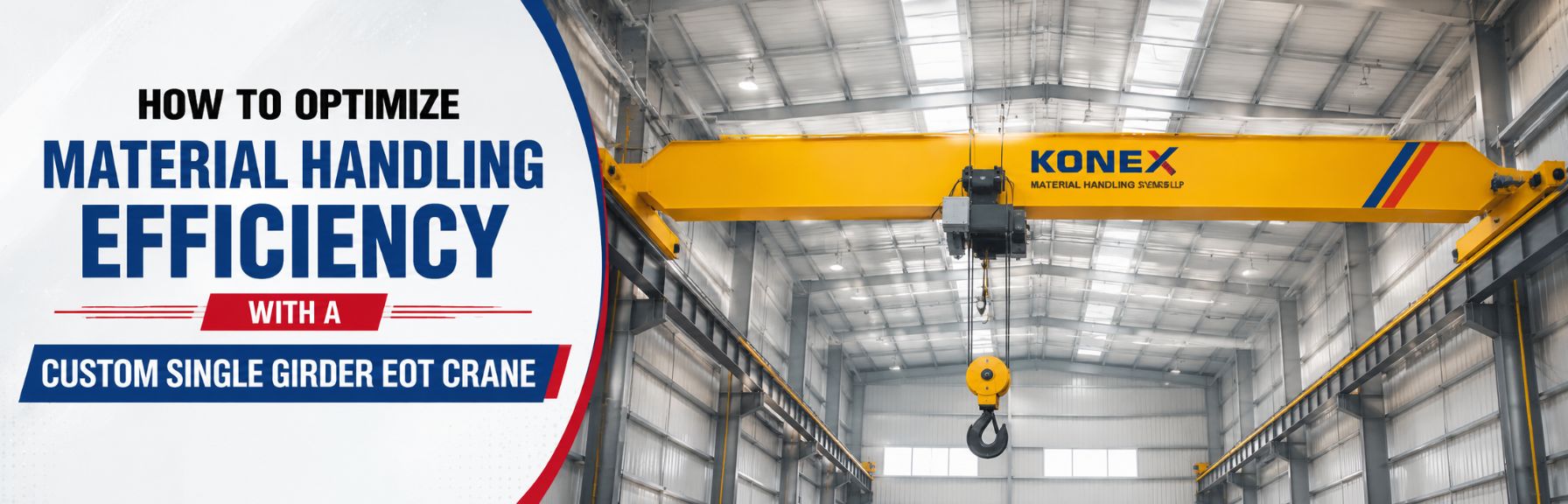
How to Optimize Material Handling Efficiency with a Custom Single Girder EOT Crane
In the modern industrial ecosystem, manufacturing facilities and logistics hubs operate under constant pressure to increase output, lower operational costs, and maintain strict safety standards. While plant directors frequently focus on optimizing machinery or upgrading digital management software, one of the most significant friction points remains right on the factory floor: material movement.
When raw materials, sub-assemblies, or heavy finished goods cannot move seamlessly through production stages, the entire plant slows down. Congested aisles, reliance on manual handling, and delayed floor transport create severe operational bottlenecks that erode profit margins.
To overcome these challenges, forward-thinking operations are shifting their focus upward. Installing a custom Single Girder EOT Crane (Electric Overhead Traveling Crane) allows facilities to utilize unused vertical space, transform material transit paths, and streamline shop floor workflows.
In this guide, we explore how tailor-made overhead lifting systems solve persistent material handling problems, enhance workplace safety, and deliver maximum operational productivity for industrial facilities.
The Hidden Bottlenecks of Ground-Level Material Handling
Before implementing an overhead solution, it is vital to recognize how traditional, ground-based material transport impacts daily plant efficiency. Many facilities rely on forklifts, hand trucks, or mobile cranes to transport materials across production bays. While versatile, ground transport introduces hidden costs and operational hurdles:
Congested Transport Aisles
Forklifts require wide, unobstructed dedicated lanes to move safely. As production volume scales, floor traffic increases, creating internal traffic jams. Every minute a forklift driver spends waiting for a clear path is lost time for production lines.
High Footprint Waste
Dedicated transport lanes consume valuable shop floor real estate. In many facilities, up to 20% to 30% of usable floor space is set aside purely for ground equipment movement and temporary staging areas.
Increased Risk of Damage and Collisions
Navigating tight factory bays with heavy loads on a forklift elevates the risk of accidental collisions with structural pillars, expensive processing machinery, or stored inventory. Minor collisions lead to costly component damage and unscheduled downtime.
Idle Operator Time
When machine technicians or assembly teams must wait for a shared forklift or manual hoist to deliver heavy workpieces, labor utilization drops. Efficient material flow ensures workpieces arrive at assembly stations exactly when required.
Demystifying the Single Girder EOT Crane: Why Customization Matters
An Electric Overhead Traveling Crane operates on elevated tracks mounted on a building’s structural columns or a specialized support framework.
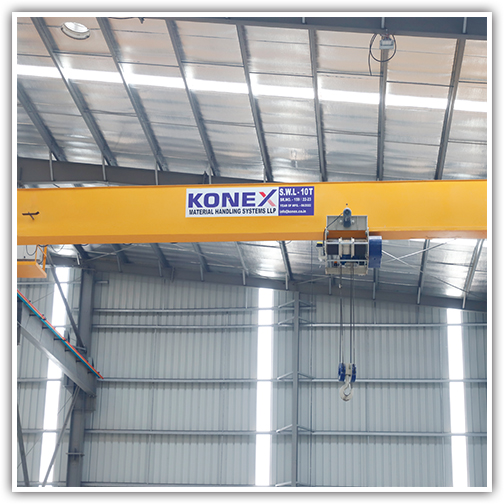
A Single Girder EOT Crane features a single horizontal bridge girder supported by two end trucks on either side. The hoisting unit travels along the lower flange of this main girder, providing smooth lifting and horizontal travel across the entire length and width of a factory bay.
  +-------------------------------------------------------+
       |                  Runway Beam / Track                  |
       +=======================================================+
            ||                                           ||
            ||                Bridge Girder              ||
       +----+============================================+----+
       |End |              [ Electric Hoist ]            |End |
       |Truck|                     ||                    |Truck|
       +----+                      ||                    +----+
                                 (Hook)
Why Standard Off-the-Shelf Cranes Fall Short
A standard crane purchased out of a standard catalog may satisfy basic weight requirements, but it rarely solves complex plant layout challenges. Every factory layout, ceiling height, and production process has unique constraints.
Partnering with a dedicated Single Girder EOT Crane Manufacturer to build a customized system ensures your lifting solution adapts to your workflow, rather than forcing your operations to adapt to the crane.
Key custom engineering enhancements include:
- Optimized Low-Headroom Designs: Maximizes hook travel height in facilities with restricted ceiling clearance, allowing heavy loads to clear tall machinery seamlessly.
- Variable Frequency Drive (VFD) Integration: Enables smooth acceleration and deceleration, preventing load sway and allowing operators to position heavy or delicate materials with millimeter precision.
- Tailored Hook Coverage: Engineered bridge spans ensure maximum coverage right up to the bay walls, eliminating dead zones on the factory floor.
- Application-Specific Duty Cycles: Custom motor and gear configurations matched to your exact shift patterns—whether for periodic maintenance lifting or continuous 24/7 assembly lines.
Core Operational Advantages of Custom Overhead Lifting Systems
Upgrading to a custom Single Girder EOT Crane provides structural, financial, and operational benefits that directly improve factory throughput:
Reclaiming Usable Floor Space
By elevating material transport to the overhead space (X, Y, and Z axes), you free up floor area previously reserved for wide transport aisles and forklift staging. This reclaimed space can be repurposed for extra machinery, assembly stations, or revenue-generating activities.
Enhancing Workplace Safety and Ergonomic Health
Manual handling and awkward rigging maneuvers are major contributors to workplace fatigue and strain injuries. Overhead cranes take the physical burden off workers, reducing injury rates while fostering a cleaner, safer work environment.
Protecting Fragile and High-Value Cargo
Sudden starts, stops, or floor bumps during ground transport can cause fragile components, machined parts, or precision dies to shift and sustain damage. Custom overhead systems offer smooth, vibration-free lifting and travel, safeguarding valuable inventory during transit.
Streamlined Process Integration
A custom overhead crane can be synchronized directly with your production rhythm. Moving materials overhead allows direct point-to-point transfer between machines, eliminating unnecessary intermediate storage steps.
Four-Step Blueprint to Integrate a Custom Overhead Crane
To achieve maximum operational efficiency, plant managers should follow a strategic approach when integrating a new lifting system:
+-------------------------------------------------------------------+
|  STEP 1: Map Internal Material Movement & Process Bottlenecks     |
+-------------------------------------------------------------------+
                                 │
                                 ▼
+-------------------------------------------------------------------+
|  STEP 2: Analyze Load Profiles & Shift Operational Frequency      |
+-------------------------------------------------------------------+
                                 │
                                 ▼
+-------------------------------------------------------------------+
|  STEP 3: Evaluate Building Dimensions & Hook Travel Limits        |
+-------------------------------------------------------------------+
                                 │
                                 ▼
+-------------------------------------------------------------------+
|  STEP 4: Select an Experienced Custom Engineering Partner          |
+-------------------------------------------------------------------+
Step 1: Map Material Movement
Document the exact path raw materials follow from arrival at the loading bay to final processing, assembly, and dispatch. Identify areas where materials wait for handling equipment or block other activities.
Step 2: Establish Realistic Load Parameters
Examine your weight profiles. Are 85% of your typical loads under 5 tons , with occasional peak lifts of 10tons? Specifying a crane tuned to your operational bell curve ensures optimum efficiency without over-investing in unnecessary structural capacity.
Step 3: Evaluate Structural Clearances
Measure available headroom, column spacing, and runway centerlines. Determine how close the lifting hook needs to reach the side walls to properly serve your machinery and storage racks.
Step 4: Collaborate with a Specialized Manufacturer
Work closely with an established manufacturer who provides full design consultation, site assessments, and lifecycle support rather than simply selling standard hardware.
Why Engineering from India Delivers World-Class Value
India has established itself as a premier global hub for advanced machinery fabrication, precision engineering, and industrial innovation. Facilities worldwide increasingly source overhead material handling equipment from leading Indian manufacturers due to a unique blend of engineering excellence, strict quality standards, and cost efficiency.
When selecting a supplier for a Single Girder EOT Crane India, look for partners offering:
  ┌─────────────────────────────────────────┐
                  │    MANUFACTURER EVALUATION CRITERIA     │
                  └────────────────────┬────────────────────┘
                                       │
         ┌─────────────────────────────┼─────────────────────────────┐
         ▼                             ▼                             ▼
┌─────────────────┐           ┌─────────────────┐           ┌─────────────────┐
│ In-House Design │           │ Rigorous Safety │           │ Global Export   │
│ & Fabrication   │           │ & Load Testing  │           │ & Service Care  │
└─────────────────┘ └─────────────────┘ └─────────────────┘- In-House Engineering Precision: Full control over design, structural welding, and assembly ensures strict quality management across every main girder and end truck.
- Adherence to International Standards: Compliance with global mechanical and electrical engineering standards ensures high structural durability, safety factors, and motor performance.
- Comprehensive Load Testing: Every custom bridge and hoist assembly undergoes thorough testing prior to dispatch to ensure long-term structural integrity.
- Global Export Capability: Manufacturers with global export experience ensure international shipping standards, clear engineering documentation, and reliable long-term technical support.
Choosing a reputable Indian manufacturer offers an ideal combination of global quality compliance, structural durability, and highly competitive total cost of ownership.
Partnering with Konex Material Handling System LLP
At Konex Material Handling System LLP, we recognize that no two industrial operations share identical requirements. Your material handling equipment must fit your operational layout, workflow, and growth strategy.
As a leading Single Girder EOT Crane Manufacturer based in India with extensive global export capabilities, Konex designs and builds tailor-made overhead lifting solutions engineered for high performance, reliability, and shop floor efficiency.
+--------------------------------------------------------------------+
|                      THE KONEX COMMITMENT                          |
+--------------------------------------------------------------------+
| [1] Individualized Site Planning & Needs Assessment               |
| [2] Tailored Structural & Mechanical Engineering                  |
| [3] Premium-Grade Steel Fabrication & Quality Audits              |
| [4] Full Lifecycle Support, Spare Parts & Technical Assistance     |
Why Operations Choose Konex:
- Custom-Engineered Solutions: We do not offer off-the-shelf compromises. Every Single Girder EOT Crane is custom designed around your specific facility dimensions, capacity requirements, and workflow goals.
- Uncompromising Manufacturing Quality: Utilizing prime-grade structural steel, precision submerged arc welding, and reliable electrical components, Konex delivers structural rigidity, minimal girder deflection, and extended operational lifespans.
- Safety-First Engineering: Safety is embedded in every design. Built-in thermal overload protection, emergency stop systems, limit switches, and smooth VFD controls protect your personnel and assets.
- Global Standards with Excellent ROI: Operating from India’s industrial manufacturing hub, Konex supplies world-class overhead crane technology to domestic enterprises and international client accounts worldwide.
- Complete Lifecycle Support: From technical consultation and facility layout analysis to installation guidance and long-term maintenance support, Konex serves as your end-to-end partner.
Operational Financial Impact: Ground Handling vs. Custom Overhead Cranes
Investing in custom overhead lifting equipment provides clear, long-term returns on operational investment:
Operational Metric | Traditional Ground Handling (Forklifts/Manual) | Custom Single Girder EOT Crane | Operational Impact |
Floor Space Efficiency | Wide transport aisles required | Zero floor footprint (elevated system) | Reclaims $15\%\text{–}25\%$ usable space for production |
Cycle Times | Intermittent floor traffic congestion | Direct, clear overhead path | Reduces material transit time by up to 40% |
Workplace Safety | Higher collision and strain risks | Remote-controlled precision lifting | Reduces risk of injuries and property damage |
Maintenance Expenses | Ongoing fuel, tire, and collision repairs | Low mechanical wear, high durability | Lowers long-term operational costs |
By accelerating workpiece movement, eliminating handling-related product damage, and freeing up floor space, a custom overhead crane system delivers a rapid return on investment while establishing a foundation for scalable plant growth.
Elevate Your Shop Floor Efficiency Today
Internal bottlenecks, clogged aisles, and slow cycle times are not unavoidable production realities—they are signs of an outdated material handling strategy.
By harnessing unused overhead space with a custom Single Girder EOT Crane, you transform your production floor into an efficient, safe, and streamlined operational environment.
Whether you are designing a new manufacturing facility, expanding an existing bay, or modernizing older equipment, Konex Material Handling System LLP provides the engineering expertise and manufacturing excellence needed to elevate your material handling operations.
Ready to Optimize Your Factory Material Flow?
Don’t let inefficient material movement hold back your production growth. Partner with India’s trusted overhead material handling experts.
- Request an Engineering Assessment: Speak directly with a Konex material handling application specialist to evaluate your facility dimensions and load requirements.
- Download Our Solutions Guide: Learn more about our custom hoists, overhead cranes, and end carriages.
👉 Contact Konex Material Handling System LLP Today to request a customized proposal or schedule a technical consultation.
+91 9824011164 | +91 90999 02956
FAQs
A Single Girder EOT Crane (Electric Overhead Traveling Crane) is an elevated lifting system that uses a single horizontal bridge beam mounted on overhead runways to transport heavy materials across a facility bay. It optimizes shop floor efficiency by clearing floor aisles, freeing up to $30\%$ of usable floor space, eliminating forklift congestion, and streamlining point-to-point material transit.
Custom overhead cranes are specifically engineered to match a facility’s unique ceiling clearances, bay widths, load profiles, and operational duty cycles. Unlike standard off-the-shelf models, a custom design built by a specialized Single Girder EOT Crane Manufacturer eliminates structural dead zones, provides optimal hook coverage, and seamlessly integrates into existing production workflows.
Overhead cranes operate entirely in vertical space ($X$, $Y$, and $Z$ axes), requiring zero dedicated floor space for transit lanes. In contrast, forklifts require wide traffic aisles, suffer from floor congestion, present higher risks of pedestrian or equipment collisions, and incur continuous fuel, tire, and repair costs.
By moving heavy material transit from the floor to the ceiling, industrial facilities typically reclaim between 15% and 30% of usable shop floor area. This reclaimed space can be directly allocated to additional processing machinery, assembly lines, or profit-generating storage.
A single girder crane utilizes a single bridge beam with the hoist suspended underneath, making it a cost-effective, lightweight solution ideal for light-to-medium duty cycles and moderate spans. A double girder crane uses two bridge beams with the hoist traveling on top, making it better suited for ultra-heavy capacities, extreme spans, or severe continuous duty cycles.
Sourcing a Single Girder EOT Crane India from leading manufacturers like Konex Material Handling System LLP provides industrial operators with international engineering standards, exceptional structural durability, and high safety factors at a significantly lower capital cost. Established Indian manufacturers offer global export capabilities, reliable documentation, and end-to-end technical support.
Overhead cranes remove heavy forklift traffic from pedestrian floor paths, drastically reducing collision risks with workers, machinery, and structural columns. Furthermore, precision controls (such as Variable Frequency Drives) and radio remote controls allow operators to lift, move, and position heavy loads from a safe distance without physical strain.
Integrating Variable Frequency Drives (VFDs) into the travel and hoist motions ensures smooth, gradual acceleration and deceleration. This micro-speed control prevents sudden jerks, eliminates load sway, and allows operators to position delicate or high-value materials with millimeter accuracy.
Key factors affecting total cost include structural design quality, duty cycle classification, electrical motor efficiency, ease of maintenance, and availability of spare parts. Investing in a high-quality custom crane from a trusted manufacturer reduces long-term operational expenses, lowers downtime, and extends equipment lifespan.
Look for a partner that offers comprehensive facility evaluations, custom engineering capabilities, strict quality control standards, and reliable long-term lifecycle support. Leading manufacturers like Konex Material Handling System LLP work directly with plant directors to design, build, and support tailor-made material handling systems aligned with long-term business goals.