

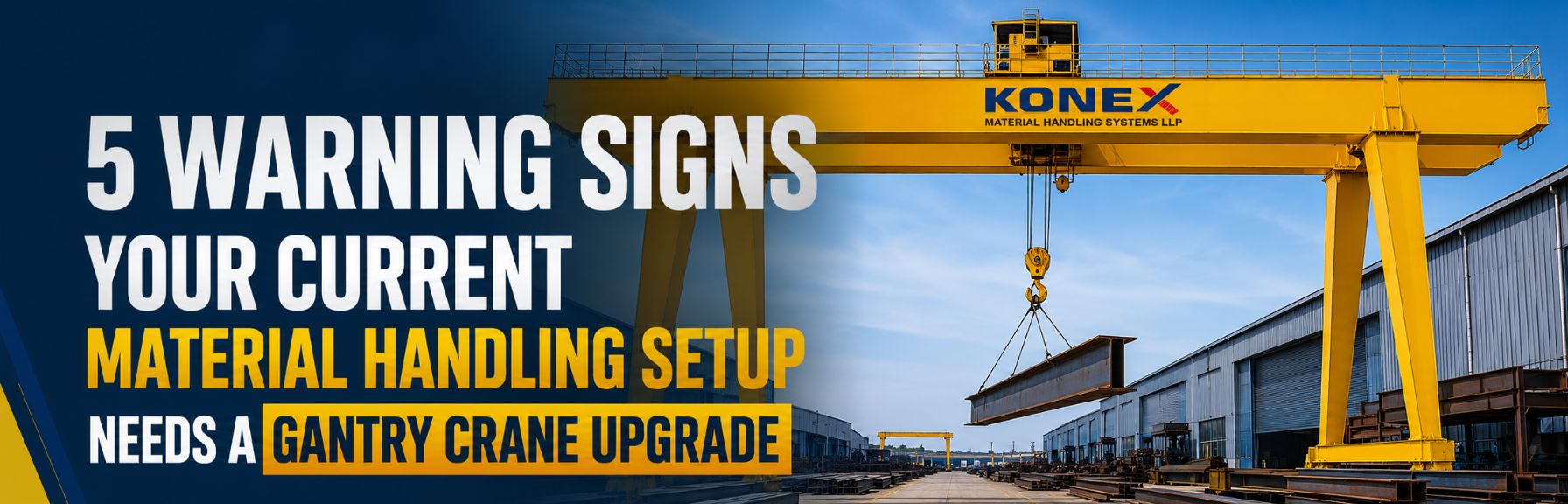
5 Warning Signs Your Current Material Handling Setup Needs a Gantry Crane Upgrade
In modern manufacturing, warehousing, and fabrication facilities, time spent moving raw materials and finished goods directly impacts your bottom line. As production targets rise and shop floors become more dynamic, relying on outdated or ill-suited material handling setups creates operational friction that hurts both profitability and workplace safety.
Many plant managers and facility directors attempt to solve material movement challenges by adding more forklifts or waiting patiently for an overburdened bridge crane to become free. However, these workaround solutions often lead to workflow bottlenecks, increased maintenance expenses, and unnecessary floor congestion.
Upgrading to a modern gantry crane system provides a flexible, cost-effective, and highly efficient solution for targeted material handling needs. As a leading material handling equipment manufacturer based in India with global export capabilities, Konex Material Handling System LLP works alongside industrial operators worldwide to streamline workshop operations.
In this article, we will explore the five critical warning signs that indicate your current material handling system has reached its limits—and why transitioning to a dedicated gantry crane solution can unlock instant productivity gains.
Why Material Handling Efficiency Matters More Than Ever
Whether you operate a manufacturing plant, steel processing unit, engineering workshop, construction project, logistics yard, or infrastructure facility, material movement directly impacts profitability.
When materials are not moved efficiently:
- Production slows down
- Labour productivity decreases
- Equipment utilization drops
- Project timelines get affected
- Operational costs increase
- Workplace risks become harder to manage
Many companies focus heavily on production equipment while overlooking the systems used to move raw materials, finished goods, heavy components, or machinery. In reality, inefficient material handling can become one of the biggest hidden barriers to growth.
That is why businesses increasingly evaluate whether their current setup still matches their operational requirements.
1. Frequent Workstation Bottlenecks and Overhead Crane Queues
One of the most obvious signs that your shop floor is struggling is “crane waiting time.” In many industrial plants, a single heavy-duty overhead EOT crane is expected to handle every lifting task across an entire bay—from loading heavy machinery to moving light sub-assemblies between workstations.
When operators across multiple cells must constantly wait for the main overhead crane to finish another task, production comes to a temporary standstill. Operators stand idle, assembly sequences get delayed, and cycle times lengthen.
How a Gantry Crane Resolves This Bottleneck:
Implementing a targeted gantry crane—whether a fixed workstation model or a flexible rubber-tyred/rail-mounted system—decentralizes your lifting setup. By placing a local gantry crane over specific work cells, assembly bays, or outdoor loading zones, you free up your primary overhead crane for heavy-duty, full-bay transfers.
Operators can handle localized lifting tasks independently, eliminating wait times and keeping production lines moving steadily.
2. Shop Floor Congestion and Safety Hazards from Overused Forklifts
Forklifts are versatile tools, but relying on them as your primary material handling solution across crowded production floors introduces significant operational risks. When forklifts operate in narrow aisles or tight assembly areas to move heavy components, several problems emerge:
- High Risk of Collisions: Pedestrian traffic and heavy machinery operating in the same space increase the likelihood of workplace accidents.
- Floor Damage: Continuous heavy wheel traffic wears down specialized factory flooring and foundation slabs over time.
- Inconvenient Material Placement: Forklifts require substantial turning radiuses and clear pathways, making precise positioning of heavy parts in tight work bays difficult.
The Floor-Clearing Advantage:
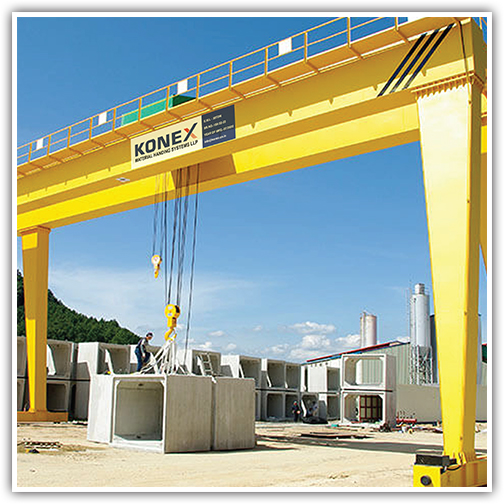
A semi-gantry or full gantry crane system utilizes dedicated floor rails or smooth-rolling polyurethane casters to operate within a defined footprint. By lifting items cleanly from above rather than navigating through congested aisles, you reclaim valuable floor space and dramatically lower the risk of aisle-way accidents.
This ergonomic material movement method protects your workforce while facilitating smooth, micro-positioning of heavy loads during assembly operations.
3. Your Facility Has Structural Constraints That Prevent Heavy Overhead Installations
Installing a traditional, top-running overhead crane system requires a building structure capable of supporting substantial runway beams and building columns. For many expanding businesses—especially those operating in rented premises, pre-engineered buildings (PEBs), or older structures—building retrofits to support heavy overhead cranes can be cost-prohibitive or structurally impossible.
If your facility suffers from low headroom, limited column load capacity, or if you lease your property and cannot make permanent modifications, your material handling options might seem restricted.
The Structural Independence of Gantry Crane Systems:
Unlike standard bridge cranes that depend on building columns for support, a gantry crane supports its own weight on floor-mounted legs. This structural independence offers distinct operational advantages:
- Zero Building Stress: Loads are transferred directly to the floor slab rather than building support pillars.
- Ideal for Rented Premises: If you move or reconfigure your plant in the future, your gantry crane can be disassembled, relocated, and re-erected with minimal downtime.
- Outdoor Versatility: Gantry cranes operate seamlessly in outdoor yards, loading docks, and open storage spaces where overhead building support does not exist.
4. Maintenance Costs and Wear on Inflexible Equipment Are Escalating
Are your utility bills and maintenance expenses rising due to using oversized equipment for small-to-medium lifting jobs? Firing up a massive multi-ton bridge crane or constantly running diesel/electric forklifts to move a 2-ton component is energetically inefficient and leads to accelerated wear and tear.
When material handling tools are misaligned with operational demands, maintenance teams spend far too much time fixing broken hydraulics, replacing tires, or servicing worn cable hoists.
Efficiency and Long-Term Value:
Upgrading to a right-sized gantry crane tailored specifically to your load capacity requirements dramatically reduces energy consumption and mechanical stress. Modern gantry designs engineered by Konex Material Handling System LLP incorporate high-efficiency hoist drives, low-friction end trucks, and smooth control systems that minimize component wear.
By matching the right crane to the right task, you protect your long-term capital investment and lower your ongoing maintenance budget.
5. Production Expansion Is Outpacing Your Current Material Movement Capabilities
As your business grows, your facility layout must adapt. New product lines, higher volume demands, and updated machinery layouts mean that static material handling setups quickly become outdated.
If your team is struggling to keep pace with higher output demands because moving items between workstations takes too long, your material handling system is actively limiting your growth potential.
Scalable Material Handling for Growing Operations:
Future-proofing your facility requires equipment that adapts to change. Modern gantry crane options—including portable, adjustable-height, and trackless models—provide the operational flexibility required by scaling manufacturers.
Whether you need to extend your crane runway down an outdoor yard or reconfigure your internal assembly stations next quarter, a modular gantry design seamlessly scales alongside your business demands.
Why Partner with Konex Material Handling System LLP?
Upgrading your material handling equipment is an investment in your operational future. At Konex Material Handling System LLP, we manufacture and export durable, high-performance material handling solutions engineered to overcome unique industrial challenges.
Designed in India, Serving Global Industries
Based in India, Konex combines engineering expertise with strict quality standards to serve customers domestically and across international markets. Our commitment to robust engineering ensures every gantry crane we deliver offers long service life, reliable operation, and exceptional safety features.
Tailored Solutions for Every Application
We recognize that no two industrial operations are identical. Our engineering team works closely with your plant managers to evaluate site dimensions, duty cycles, and lifting capacities. Whether you require a light-duty mobile gantry crane for quick maintenance tasks or a heavy-duty double girder gantry crane for raw material storage, Konex delivers solutions customized to your specific needs.
Safety, Reliability, and Compliance Focus
Every gantry crane designed by Konex prioritizes operator safety and smooth load handling. Featuring intuitive control interfaces, overload protection systems, and smooth-travel end trucks, our systems empower your team to handle heavy loads with confidence and precision.
Simple Steps to Evaluate Your Crane Upgrade Needs
Before selecting a replacement or supplementary lifting system for your facility, walk through your shop floor and consider these core operational factors:
- Identify the True Bottleneck Area: Is material movement delayed across the entire building, or specifically at key assembly cells and outdoor yards?
- Measure Floor and Height Constraints: Document clear door heights, floor slab specifications, and available aisle width.
- Assess Required Duty Cycles: Determine how frequently items are lifted, the maximum weight requirement, and how precisely loads must be positioned.
- Consult an Experienced Specialist: Partner with an established manufacturer who can evaluate your site layout and recommend the optimal crane configuration.
Streamline Your Material Handling Setup Today
If your facility is experiencing crane waiting times, crowded shop floor aisles, or structural limitations, sticking with the status quo will continue to cost you productivity and money. Upgrading to a custom-built gantry crane from Konex Material Handling System LLP is a practical, cost-effective way to clear your bottlenecks and improve overall operational flow.
Ready to optimize your material handling setup?
Contact the engineering team at Konex Material Handling System LLP today to schedule an expert facility assessment or request a custom quotation tailored to your operational requirements.
- Location: India (Exporting High-Performance Material Handling Solutions Worldwide)
- Direct Consultation: Reach out to our technical sales team for tailored guidance on your next crane project.
Contact us : info@konex.co.in , +91 98240 11164 | +91 90999 02956
👉 Click Here to Connect with a Konex Material Handling Expert
FAQs
If your facility experiences frequent lifting delays, crane waiting times, forklift congestion, rising maintenance costs, or production bottlenecks, it may be time to upgrade to a modern gantry crane. A properly designed gantry crane improves material flow, productivity, and workplace safety.
A gantry crane provides faster material handling, reduced dependence on forklifts, lower maintenance costs, improved safety, better load positioning accuracy, and greater operational flexibility for indoor and outdoor applications.
For repetitive heavy lifting applications, a gantry crane is often more efficient and safer than a forklift. Gantry cranes lift loads vertically, reduce aisle congestion, improve load control, and minimize the risk of workplace accidents.
Yes. One of the biggest advantages of a gantry crane is that it is self-supporting and does not rely on the building structure. This makes it ideal for existing factories, rented facilities, warehouses, and pre-engineered buildings (PEBs).
Gantry cranes are widely used in manufacturing plants, fabrication workshops, steel processing facilities, warehouses, construction sites, shipyards, logistics centers, power plants, and infrastructure projects where efficient material handling is critical.
The lifting capacity of a gantry crane depends on the application and design. Industrial gantry cranes can be manufactured in capacities ranging from 500 kg to over 100 tons, depending on operational requirements.
An EOT crane operates on runway beams attached to a building structure, while a gantry crane runs on legs supported by floor rails or wheels. Gantry cranes are often preferred where building support structures are unavailable or impractical.
A gantry crane reduces material movement delays, eliminates unnecessary crane queues, improves workstation accessibility, and enables faster loading, unloading, and assembly operations, leading to higher productivity.
Yes. Gantry cranes are specifically designed for both indoor and outdoor operations. They are commonly used in stockyards, loading areas, construction sites, ports, and open storage facilities where overhead crane systems cannot be installed.
When selecting a gantry crane manufacturer, consider engineering expertise, customization capability, safety standards, after-sales support, installation experience, load capacity requirements, and compliance with IS, FEM, and international crane standards. Experienced manufacturers like Konex Material Handling System LLP provide customized solutions based on your facility’s operational needs.