

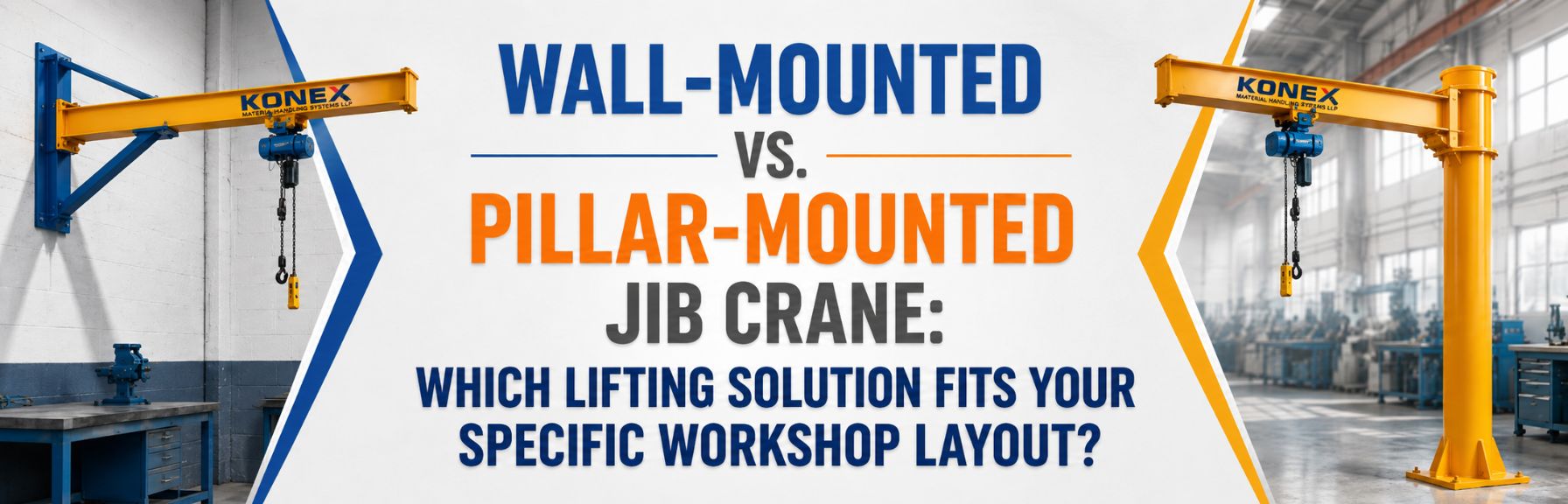
Wall-Mounted vs. Pillar-Mounted JIB Crane: Which Lifting Solution Fits Your Specific Workshop Layout?
The Quick Answer: If you are dealing with a tight workshop where floor space is a premium and you need to move light-to-medium loads along an existing structural boundary, a Wall Mounted JIB Crane is your ideal solution. However, if your operations demand heavy-duty lifting, full 360-degree rotation, and you have open floor space to install a dedicated foundation, a Pillar Mounted JIB Crane will provide the versatility and power you need.
Choosing the right material handling equipment is more than just a purchasing decision; it is a critical operational strategy. Selecting the wrong lifting system can lead to workflow bottlenecks, wasted floor space, and even structural risks to your building.
At Konex Material Handling System LLP, a leading JIB Crane Manufacturer in India serving a global clientele, we have helped hundreds of plant managers, engineers, and facility owners optimize their workshop layouts. In this comprehensive guide, we will break down the exact differences between wall-mounted and pillar-mounted setups, helping you make a confident, ROI-driven decision that perfectly aligns with your specific workspace.
Understanding the True Value of a JIB Crane in Modern Manufacturing
Before diving into the specific types, it is vital to understand why a JIB Crane is an indispensable asset for modern industrial setups. Unlike massive overhead bridge cranes that span an entire facility, jib cranes offer localized, highly efficient lifting solutions.
They are designed to handle repetitive lifting tasks, load and unload materials from machinery, and assist workers in assembly lines. By installing the right crane at a specific workstation, you instantly reduce worker fatigue, eliminate the risk of manual handling injuries, and drastically speed up your production cycle.
The core components—the boom (arm), the hoist, and the mounting structure—work in harmony to provide localized lifting power. But the true secret to maximizing your productivity lies in how that crane is mounted. The layout of your workshop, the strength of your building, and the specific movement of your materials will dictate whether you need a wall-mounted or pillar-mounted system.
Deep Dive: The Wall Mounted JIB Crane
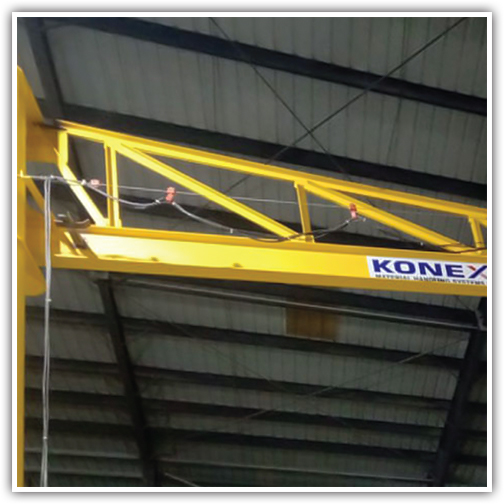
A Wall Mounted JIB Crane is a marvel of spatial efficiency. As the name suggests, this lifting system utilizes your facility’s existing structural columns or reinforced walls for support. Because it does not require a floor foundation, it is widely favored by operations managers looking to maximize every square inch of ground space.
Ideal Workshop Layouts for Wall-Mounted Systems
This type of crane thrives in specific environments. It is the perfect fit if your workshop layout includes:
- Narrow Aisles: Facilities where forklifts and personnel frequently move through tight floor spaces that cannot be obstructed by a freestanding pillar.
- Perimeter Workstations: Assembly lines or machining centers located directly against the structural walls or columns of your building.
- Multi-Level Operations: Workshops that already have a massive overhead crane running above, but require smaller, localized lifting assistance underneath the main crane’s path.
The Strategic Advantages
- Zero Floor Space Required: The most significant benefit is the preservation of your valuable floor real estate. Without a base plate and pillar taking up room, your workers and ground transport vehicles can move freely beneath the crane.
- Highly Cost-Effective: Because it leverages your building’s existing architecture for support, you save on the cost of manufacturing a steel pillar and the intensive civil engineering work required to pour a concrete foundation.
- Seamless Integration: It acts as an excellent supplementary lifting system, working in tandem with larger material handling equipment without getting in the way.
The Limitations to Consider
While highly efficient, a Wall Mounted JIB Crane does have constraints. First, the rotation angle is typically limited to 180 or 200 degrees because the wall itself physically blocks full circular movement. Second, the lifting capacity is entirely dependent on the structural integrity of your existing building columns. If your facility’s walls cannot safely support the dynamic load and torque of a loaded crane, this option becomes unviable without expensive structural reinforcements.
Deep Dive: The Pillar Mounted JIB Crane
A Pillar Mounted JIB Crane (often called a freestanding jib crane) is the heavy-duty workhorse of localized material handling. This system consists of a robust vertical steel mast that is bolted securely into a reinforced concrete floor foundation. It stands completely independent of your building’s walls or support columns.
Ideal Workshop Layouts for Pillar-Mounted Systems
The freestanding nature of this crane makes it incredibly versatile, provided you have the space. It is highly recommended for:
- Open Floor Plans: Large manufacturing bays, warehouses, and assembly yards where workstations are located in the center of the room, far away from any walls.
- Outdoor Applications: Loading docks, shipping yards, and outdoor assembly areas where there are no existing structures to mount a crane to.
- Heavy Machining Centers: Areas requiring the lifting of massive metal casts, heavy dies, or large assembled components that exceed the safe limits of wall-mounted systems.
The Strategic Advantages
- Unmatched Versatility with 360-Degree Rotation: Because there is no wall blocking the boom arm, a freestanding pillar crane can pivot in a complete circle. This allows a single crane to service multiple workstations or machines clustered around the central pillar.
- Superior Load Capacity: By anchoring the mast into a deep, dedicated concrete foundation, these cranes can handle significantly heavier loads compared to their wall-mounted counterparts.
- Independence from Building Structure: You do not need to worry about stressing your facility’s architecture. The crane relies entirely on its own engineering and the floor foundation, making it safe for modern, lightweight steel-framed buildings.
The Limitations to Consider
The primary trade-off is space and installation complexity. A Pillar Mounted JIB Crane requires a permanent footprint on your shop floor. Furthermore, the installation process involves analyzing the depth and strength of your existing concrete floor. Often, a new, deeper foundation must be excavated and poured to safely anchor the heavy-duty base plate, which requires a larger initial investment and slightly longer installation time.
Head-to-Head Comparison: Which Lifting Solution Should You Choose?
When consulting with our clients at Konex Material Handling System LLP, we guide them through a structured workspace audit. If you are debating between a Pillar Mounted JIB Crane and a Wall Mounted JIB Crane, evaluate your facility based on these four critical pillars:
1. Evaluate Your Floor Space vs. Building Strength
Look at where the lifting needs to happen. Is the workstation pressed against a heavy structural I-beam? If yes, a wall-mounted system is a highly logical choice to save space. However, if your building is an older structure, or made of pre-engineered lightweight materials that cannot handle lateral stress, you must choose a pillar-mounted system, regardless of floor space, to ensure absolute safety.
2. Analyze Your Load Capacity Needs
What exactly are you lifting, and what is its maximum weight? While wall-mounted systems are excellent for fast, repetitive lifting of lighter components (like automotive parts or packaging materials), they hit a weight ceiling relatively quickly. If you are moving heavy steel coils, massive engine blocks, or industrial molds, the freestanding stability of a pillar-mounted crane is non-negotiable.
3. Determine the Required Range of Motion
Trace the path the material needs to travel. If a worker only needs to lift a part from a pallet and swing it 90 degrees onto a workbench, a wall-mounted crane provides ample rotation. But if a worker needs to pick up a heavy component from an aisle, swing it around to a machine tool, and then pass it off to a secondary assembly station behind them, the 360-degree rotation of a pillar-mounted crane is essential.
4. Consider Future Scalability and Layout Changes
Manufacturing floors are dynamic. If you frequently reconfigure your assembly lines, consider the permanence of your crane. Moving a pillar-mounted crane requires pouring a brand new concrete foundation at the new location. A wall-mounted crane, while still a permanent fixture, can sometimes be relocated to another suitable structural column with relatively less civil engineering hassle, provided the new column is structurally sound.
The Hidden Costs of Choosing the Wrong Lifting Solution
As a premier JIB Crane Manufacturer, we have seen the expensive fallout of companies choosing the wrong equipment simply because it was cheaper upfront.
Installing a wall-mounted crane on an unverified building column can lead to structural warping, cracked masonry, and severe safety hazards that could shut down your entire facility. Conversely, forcing a pillar-mounted crane into a cramped aisle can obstruct forklift traffic, creating massive daily workflow bottlenecks that silently drain your profitability over time.
Choosing the right crane is an investment in operational flow. The right choice minimizes material handling time, reduces manual labor costs, keeps your workforce safe, and provides a clear, measurable Return on Investment (ROI) within the first year of operation.
Why Konex Material Handling System LLP is Your Trusted Partner
Finding the perfect material handling equipment requires more than just picking a product from a catalog. It requires a partnership with engineering experts who understand the realities of industrial workflow.
Konex Material Handling System LLP stands as a beacon of reliability and engineering excellence in the material handling sector. Based in India, with a robust global export capability, we design, manufacture, and install world-class lifting solutions tailored precisely to your operational needs.
What Sets the Konex Advantage Apart?
- Custom-Engineered Solutions: We do not believe in one-size-fits-all. Whether you need a low-headroom Wall Mounted JIB Crane for a cramped facility or a heavy-duty Pillar Mounted JIB Crane capable of enduring harsh environmental conditions, our engineering team designs the crane around your specific workspace.
- Uncompromising Safety Standards: Material handling is high-stakes work. Every crane manufactured in our facility undergoes rigorous load testing and quality assurance to ensure it meets and exceeds global safety and durability standards.
- Global Export Quality: While proudly manufactured in India, our material handling systems are trusted by industries worldwide. We use premium-grade steel, world-class hoists, and precision bearings to ensure smooth, effortless rotation and decades of reliable service.
- End-to-End Consultation: We do not just sell equipment; we solve layout problems. Our team helps you evaluate your structural integrity, analyze your load requirements, and map out your workflow to guarantee you select the absolute best crane for your money.
Ready to Optimize Your Workshop Layout? Let’s Talk.
Your production speed, worker safety, and operational efficiency hinge on the quality of your material handling equipment. Do not let workspace limitations or heavy loads slow down your business growth.
Whether you have perfectly identified the need for a space-saving wall-mounted system, or require the robust 360-degree power of a freestanding pillar crane, Konex Material Handling System LLP is ready to build it for you.
Stop guessing and start optimizing. Contact our engineering team today for a comprehensive workspace evaluation. Let us discuss your specific lifting challenges, and we will provide you with a customized, transparent, and highly competitive quote.
Reach out to Konex Material Handling System LLP now and take the first step toward a safer, faster, and more profitable industrial operation.
Contact us : info@konex.co.in , +91 98240 11164 | +91 90999 02956
FAQs
A Wall-Mounted JIB Crane is generally better for small workshops because it does not occupy valuable floor space. It attaches directly to existing structural columns or walls, making it ideal for compact manufacturing facilities and workshops.
The main difference is the mounting method. A Wall-Mounted JIB Crane is attached to a building structure, while a Pillar-Mounted JIB Crane is installed on a dedicated floor-mounted pillar with its own concrete foundation.
No. Most Wall-Mounted JIB Cranes offer a rotation range of approximately 180° to 200° because the wall limits the crane’s movement. For full 360° rotation, a Pillar-Mounted JIB Crane is recommended.
A Pillar-Mounted JIB Crane typically offers a higher lifting capacity because it is supported by a dedicated reinforced foundation rather than relying on the building’s structural strength.
Yes. Pillar-Mounted JIB Cranes are commonly used in loading docks, warehouses, shipyards, fabrication yards, and outdoor industrial environments because they do not require wall support.
Consider four factors:
- Available floor space
- Building structural strength
- Required lifting capacity
- Required rotation range
If floor space is limited, choose a Wall-Mounted JIB Crane. If heavy lifting and 360° coverage are required, choose a Pillar-Mounted JIB Crane.
Wall-Mounted JIB Cranes are widely used in:
- Automotive workshops
- Assembly lines
- Machine shops
- Packaging facilities
- Manufacturing plants
- Maintenance departments
These industries benefit from efficient lifting without sacrificing floor space.
Key advantages include:
- 360-degree rotation
- Higher load capacities
- Independent operation from building structures
- Flexible workstation coverage
- Suitable for indoor and outdoor use
These features make it ideal for heavy-duty material handling operations.
Yes. A Pillar-Mounted JIB Crane requires a reinforced concrete foundation to safely support lifting loads, operational stresses, and rotational forces during daily operation.
Konex Material Handling System LLP provides:
- Custom-engineered JIB Crane solutions
- High-quality manufacturing standards
- Global export capability
- Expert installation support
- Reliable after-sales service
- Compliance with industrial safety standards
This ensures a durable, safe, and efficient lifting solution tailored to your specific workshop requirements.