

How to Determine the Right EOT Crane Capacity & Span for Your New Factory Shed?
Setting up a new factory shed is a massive milestone for any industrial enterprise. Whether you are expanding your manufacturing footprint in India or setting up an export-oriented industrial unit, the structural decisions you make today will govern your operational efficiency for the next few decades. To immediately address the core challenge of choosing the correct EOT Crane specifications, you must calculate two fundamental dimensions: total load capacity and structural span. Determining your required lifting capacity involves adding the weight of your heaviest anticipated payload to the weight of your below-the-hook lifting tackles (such as slings, magnets, or custom grabs), and then applying a 15% to 20% safety margin to accommodate future business expansion. Meanwhile, the ideal crane span—the center-to-center distance between the runway rails—is calculated by subtracting the necessary structural side clearances (typically 400mm to 500mm on each side) from the internal bay width of your pre-engineered building (PEB) shed. Mathematically, this relationship is defined as:
Crane Span = Internal Bay Width of the Shed − Total Side Clearances
While these basic principles provide an immediate starting point, integrating an overhead material handling system requires a deeper look into your daily operational dynamics. Among all layout decisions, integrating the right material handling system is paramount. An EOT Crane (Electric Overhead Traveling Crane) acts as the workhorse of your factory floor. However, selecting a crane that is too small will cripple your production capabilities and compromise structural safety. Conversely, over-specifying your crane will unnecessarily inflate your civil construction costs, gantry girder requirements, and initial capital expenditure.
As a leading EOT Crane Manufacturer, we have guided hundreds of factory owners, structural consultants, and project managers through this critical decision-making process. This comprehensive guide breaks down exactly how to determine the ideal crane capacity and span for your new factory shed without getting lost in overly complex engineering jargon.
Demystifying EOT Crane Capacity: It is More Than Just Your Heaviest Load
When industrial buyers think of capacity, they often think of the heaviest product they currently manufacture. If your heaviest machine or raw material roll weighs 8 tons, it is natural to assume you need an 8-ton crane. However, professional industrial design requires looking beyond static weight. To determine the correct capacity for your overhead crane, you must evaluate three primary variables.
1. The Cumulative Load Calculation
Your crane does not just lift your product; it must also support the tools used to secure that product. Your total required lifting capacity must include the actual maximum weight of the payload, the weight of below-the-hook attachments (such as lifting beams, C-hooks, sheet lifters, custom grabs, or heavy-duty wire slings), and a strategic buffer for future-proofing. If your business scales or you introduce heavier machinery in the next five years, upgrading an existing building’s structural load capacity is exponentially more expensive than purchasing a slightly higher-capacity crane today.
2. Understanding Duty Cycles and Operational Intensity
Two cranes with the exact same 10-ton capacity can be built entirely differently based on how often they are used. In India, crane designs conform to standard guidelines (like IS 3177 and IS 807) which classify cranes into distinct duty classes:
- Light Duty (Class 1 / Class M3-M4): Used for maintenance, occasional servicing, or standby assembly operations. The crane may run only a few times a week.
- Medium Duty (Class 2 / Class M5): Ideal for general engineering workshops, storage yards, and standard manufacturing assembly lines where the crane operates regularly but not continuously at maximum capacity.
- Heavy Duty (Class 3 & 4 / Class M7-M8): Required for steel mills, foundries, busy warehouses, and high-speed production plants where the crane is constantly lifting heavy loads near its rated limit.
By communicating your actual hourly usage to an experienced EOT Crane Manufacturer, you ensure you get a crane that delivers maximum uptime without premature wear on components like wire ropes, gearboxes, and motors.
Calculating the Crane Span: Aligning with Your Factory Layout
The span is the horizontal distance between the centerlines of the two runway rails on which your crane travels. It determines the horizontal coverage area of your material handling system. To determine the ideal span for your factory shed, you need to collaborate closely with both your pre-engineered building (PEB) structural designer and your chosen crane manufacturer.
First, you must establish your shed’s overall bay width. Your structural engineer designs your factory shed with a specific overall bay width (such as 20 meters, 24 meters, or 30 meters). This represents the distance from the outer edge of one structural column to the outer edge of the opposite column.
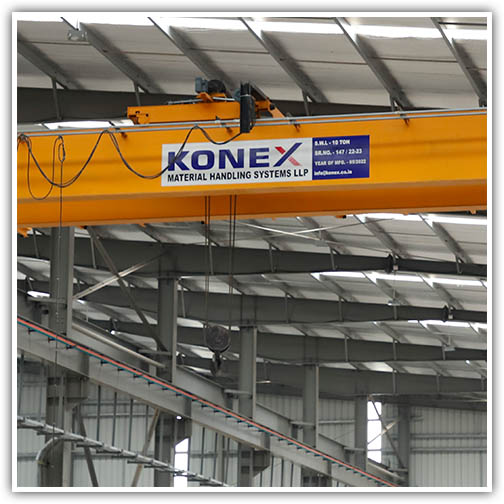
Second, you must account for support columns and runway clearances. An EOT Crane does not hang directly from the roof; it rides on crane runway rails supported by gantry girders, which sit on column brackets (corbels) or independent portal frames. To prevent the moving crane end-carriages from hitting the building columns, structural standards require a safe lateral clearance on both sides.
Third, you apply the standard span formula used by any reliable EOT Crane India specialist. The span is calculated by subtracting these structural clearances from the interior width of the building:
Crane Span = Distance Between Inner Faces of Columns − (Left Side Clearance + Right Side Clearance)
For instance, in a typical 20-meter wide factory shed, the crane span often falls in the range of 18.5 meters to 19.2 meters. This layout allows comfortable room for structural columns, gantry girders, and busbar systems (DSL) that supply electrical power to the crane.
Single Girder vs. Double Girder EOT Crane: Which Configuration Fits Your Factory?
Once you have a general estimate of your capacity and span, the next logical step is to choose the physical configuration of the crane. This choice heavily impacts both your initial machinery investment and the civil cost of your factory shed.
When to Choose a Single Girder EOT Crane
A single-girder crane consists of one bridge beam supported by end carriages, with the wire rope hoist trolley running along the bottom flange of the girder.
- Best Suited For: Capacities up to 15 Tons and spans up to 25 meters.
- The Key Benefits: It features a highly lightweight construction that exerts less structural load on your factory’s PEB columns and gantry girders. This allows your structural engineer to design lighter, more cost-effective columns and foundations. It is also highly economical, offering a lower initial purchase price and reduced installation costs. Furthermore, it provides excellent clearance, making it ideal for low-headroom factory sheds where vertical clearance is limited.
If your production workflow involves light-to-medium manufacturing, warehousing, or machinery assembly, consulting a certified Single Girder EOT Crane Manufacturer will help you design a highly cost-efficient layout.
When to Choose a Double Girder EOT Crane
A double-girder crane utilizes two parallel bridge beams. The hoist crab/trolley travels on top of rails mounted to the top of these girders.
- Best Suited For: Capacities ranging from 10 Tons up to 100+ Tons, and spans extending up to 40 meters.
- The Key Benefits: This configuration offers maximum hook height. Because the hoist trolley sits on top of the girders rather than hanging underneath them, you gain significant vertical lifting space (hook path). This is critical if you are lifting tall equipment or stacking materials high. It easily handles severe duty cycles (Class 3/4) and continuous operations. Additionally, these systems are highly maintenance-friendly, often featuring walkways, handrails, and platforms that make servicing, motor inspections, and electrical adjustments safer and quicker.
For heavy engineering, steel fabrication, heavy fabrication yards, and high-frequency handling of heavy loads, partnering with an experienced Double Girder EOT Crane Manufacturer is the safest and most reliable route.
Key Building Factors to Plan with Your PEB Shed Designer
Your overhead crane and your pre-engineered building (PEB) shed must function as a single, integrated unit. Before the PEB manufacturer fabricates your steel columns, ensure you have addressed these structural factors.
1. Gantry Girders and Runway Rails
The gantry girder is the longitudinal beam that runs along the length of your factory shed. The runway rail is mounted directly on top of this girder. Your shed designer must know the maximum wheel load of the crane (provided by your chosen EOT Crane Manufacturer) and the spacing between the wheels on the crane end-carriages. This data determines the thickness and bending resistance needed for the gantry girders.
2. Vertical Hook Approach and “Dead Zones”
No crane can lift a load right up to the very ceiling, nor can the hoist travel to the absolute edge of the walls. The areas the hook cannot reach are called “dead zones.” The physical size of the trolley and end carriages limits how close the hook can get to the side walls (side hook approach). Additionally, you must ensure your shed height (the height of the building up to the eave) leaves enough vertical clearance above the crane for safe operation, while still allowing the hook to reach your factory floor’s lowest pit if needed.
By determining these clearances early, you can plan your indoor assembly areas, machine installations, and storage racks outside these dead zones, maximizing your usable floor space.
Common Pitfalls to Avoid When Selecting Crane Capacity and Span
To save you from expensive modifications and operational bottlenecks, our engineering team at Konex Material Handling System LLP has compiled the most common mistakes made by factory owners:
- Finalizing the Shed Design Before the Crane Design: This is the most frequent and costly mistake. If your PEB provider designs columns based on a generic load estimate, and your actual crane turns out to have heavier wheel loads, you will have to pay for expensive column reinforcements. Always choose your crane partner first or concurrently with your PEB designer.
- Overlooking Long-Term Utility Costs: A poorly engineered crane with high dead weight will draw more electricity every time it accelerates and travels. Modern, structurally optimized cranes use high-grade steel and efficient gear motors to keep power bills low.
- Ignoring the Control Interface: Will your crane operator stand on the floor with a pendant cable, move freely with a wireless radio remote control, or sit in a climate-controlled cabin? A radio remote control is highly recommended for modern factory layouts as it allows the operator to stand at a safe distance from the heavy load.
Elevating Material Handling Efficiency: The Konex Advantage
and motors—you are buying safety, precision, and operational continuity.
As a premier EOT Crane Manufacturer based in Ahmedabad, Gujarat, Konex Material Handling System LLP has established itself as an industry leader, earning national acclaim including the prestigious India 5000 Best MSME Award (2023) for Quality Excellence.
Why B2B Buyers Trust Konex:
- Custom-Engineered Precision: We don’t believe in “one-size-fits-all” cranes. Every single girder and double girder crane we manufacture is engineered using advanced design software to match your exact span, duty cycle, and factory layout constraints.
- Compliance with Global & National Standards: All our material handling systems strictly adhere to IS 3177, IS 807, and international FEM design standards, ensuring peace of mind regarding structural safety.
- India-Wide Network & Global Export Capabilities: Operating from our state-of-the-art manufacturing facilities in Gujarat, we cater to infrastructure, heavy manufacturing, and engineering clients across the Indian subcontinent and export high-performance material handling equipment globally.
- End-to-End Execution: From initial structural feasibility studies and detailed engineering drawings to manufacturing, transport, on-site installation, load testing, and proactive after-sales maintenance—we handle everything.
Ready to Design Your Factory's Lifeline?
Choosing the right EOT Crane is a pivotal step that defines your factory’s production throughput for decades to come. Avoid guessing your structural requirements or relying on generic estimates. Let the engineering experts at Konex Material Handling System LLP help you calculate the perfect crane capacity, duty class, and span for your new factory shed.
Get a Free Expert Consultation Today
- Need a Customized Crane Layout Drawing?
- Looking for an Accurate, High-Value Quotation?
- Want to Verify if Your Proposed PEB Shed Can Support Your Lifting Needs?
Contact Us : +91 9824011164 | +91 90999 02956
FAQs
To calculate the required EOT crane capacity, add the weight of your heaviest load, lifting accessories (slings, hooks, lifting beams, grabs, magnets), and a 15–20% safety margin for future requirements. This ensures safe lifting operations and prevents costly crane upgrades later.
Formula:
Required Capacity = Payload Weight + Lifting Attachment Weight + Safety Margin
The ideal EOT crane span is determined by subtracting the required side clearances from the internal width of the factory shed. Proper span selection ensures smooth crane movement and optimal coverage of the working area.
Formula:
Crane Span = Internal Shed Width − Side Clearances
Typically, a 20-meter-wide shed may require a crane span between 18.5 and 19.2 meters.
Key factors include:
- Maximum load capacity
- Factory shed span
- Duty cycle classification
- Lifting height requirements
- Frequency of operation
- Future expansion plans
- Structural design of the building
- Safety standards compliance
Choosing the right combination improves productivity, safety, and operational efficiency.
A Single Girder EOT Crane is ideal for capacities up to 15 tons and spans up to 25 meters, offering lower installation and maintenance costs.
A Double Girder EOT Crane is recommended for heavy-duty applications, capacities above 10 tons, longer spans, higher lifting heights, and continuous industrial operations.
The best choice depends on your load handling requirements and factory layout.
Crane duty classification determines how frequently and intensively the crane will operate.
- Light Duty (M3-M4): Occasional lifting.
- Medium Duty (M5): General manufacturing operations.
- Heavy Duty (M7-M8): Continuous production environments, steel plants, foundries, and warehouses.
Selecting the correct duty class increases crane lifespan and reduces maintenance costs.
Yes. Crane specifications should be finalized before or alongside the factory shed design. The crane’s wheel loads, gantry girders, runway beams, and structural supports directly affect the building design. Designing the shed first can result in expensive structural modifications later.
Crane dead zones are areas that the crane hook cannot reach due to physical limitations of the trolley, end carriages, and building structure. Understanding dead zones helps optimize equipment placement, storage layouts, and production flow within the factory.
Most industrial EOT crane installations require approximately 400–500 mm side clearance on each side between the crane and building columns. Additional clearance may be needed based on crane type, span, maintenance access, and electrical systems such as DSL busbars.
To receive an accurate crane design and quotation, provide:
- Factory shed dimensions
- Maximum load to be lifted
- Required lifting height
- Duty cycle requirements
- Production process details
- Future expansion plans
- Building structural drawings (if available)
This enables the manufacturer to recommend the most suitable crane solution.
A properly designed EOT crane improves material handling speed, workplace safety, equipment utilization, and workflow efficiency. It reduces manual handling, minimizes downtime, lowers operating costs, and supports long-term production growth, making it a critical investment for modern manufacturing facilities.