

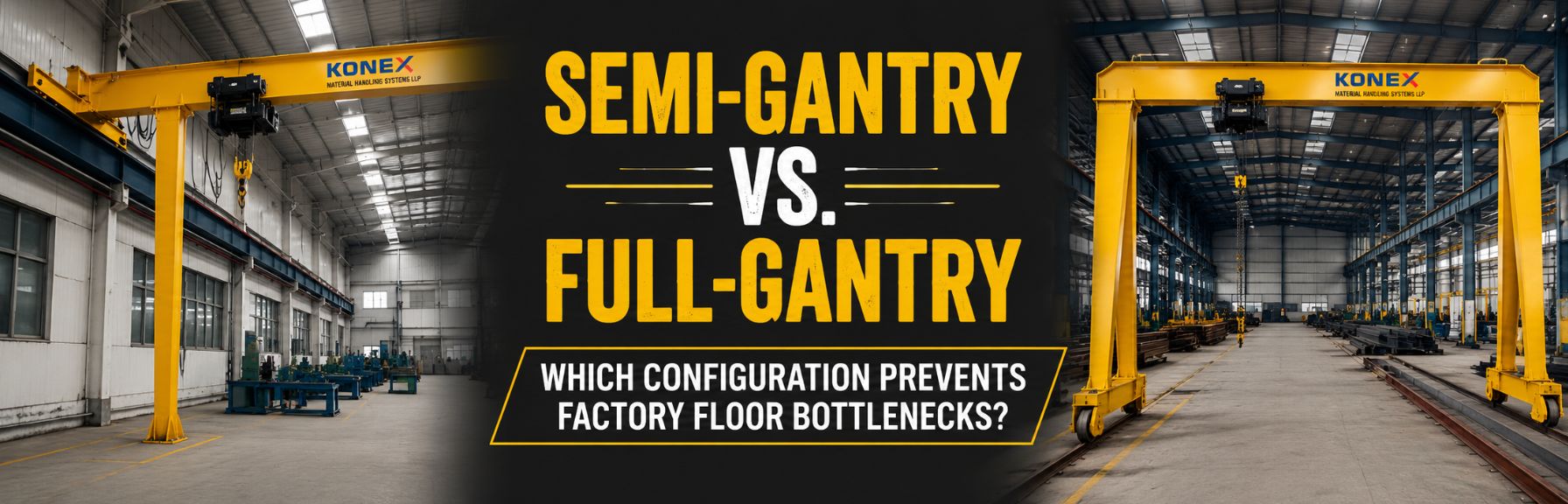
Semi-Gantry Crane vs. Full-Gantry Crane: Which Configuration Prevents Factory Floor Bottlenecks?
In modern heavy manufacturing, assembly, and warehousing plants across India and globally, time is the ultimate currency. Yet, one of the most common, profit-draining challenges plant managers face is the floor bottleneck—where assembly lines halt, workers stand idle, and throughput crawls because everyone is waiting for a single overhead crane to move a load.
If your facility is struggling to maintain a continuous, fluid workflow, your choice of material handling configuration is likely the root cause.
When searching for the ideal solution, the debate almost always lands on two heavyweights: the Semi-Gantry Crane and the Full Gantry Crane. But which configuration is engineered to eliminate your specific workflow bottlenecks, optimize your floor space, and maximize your return on investment?
As a leading gantry crane manufacturers in india with global export capabilities, Konex Material Handling System LLP has engineered and installed hundreds of custom lifting solutions. In this comprehensive guide, we will break down the practical differences between these two configurations, analyze how they impact factory-floor traffic, and help you select the exact system to keep your operations moving seamlessly.
The Anatomy of Factory Floor Bottlenecks (And Why Your Crane Choice Matters)
Before comparing systems, we must understand why bottlenecks happen. In most industrial layouts, material handling is treated as a secondary utility rather than a core driver of throughput.
When a factory relies solely on a single, high-capacity Overhead Electric Traveling (EOT) crane, a natural bottleneck forms. The EOT crane is often tasked with two competing jobs:
- Macro-Lifting: Moving massive, heavy components from one end of the shop floor to the other.
- Micro-Lifting (Workstation Level): Supporting localized, repetitive assembly, welding, or machining tasks within specific bays.
When the massive overhead crane is tied up holding a piece for a localized welding job, the rest of the plant’s material movement stops. This is where choosing the right configuration from a qualified industrial gantry crane supplier becomes a business-critical decision. By strategically deploying a Gantry Crane or a Semi-Gantry Crane, you can bypass these floor blockages, liberate your overhead airspace, and create a highly responsive, multi-tiered material handling ecosystem.
Understanding the Contenders: Semi-Gantry vs. Full-Gantry
To make an informed decision for your plant, it is vital to understand how each crane operates, utilizes your building’s structural framework, and interacts with your facility’s floor plan.
+-------------------------------------------------------------------------+
|                      CRANE STRUCTURAL COMPARISON                        |
+-------------------------------------------------------------------------+
|                                                                         |
|  [FULL-GANTRY CRANE]                         [SEMI-GANTRY CRANE]        |
|                                                                         |
|       Gantry Girder                               Gantry Girder         |
|   =====================                       =====================     |
|    ||               ||                         ||               ||      |
|    ||               ||                         ||               ||      |
|    || (Leg)   (Leg) ||                         || (Leg)         ||      |
|    ||               ||                         ||               |       |
|   /  \             /  \                       /  \              | (Wall |
|  [====]           [====]                     [====]             |  Rail)|
|  Floor            Floor                      Floor              |       |
|  Track            Track                      Track              |       |
|                                                                         |
+-------------------------------------------------------------------------+1. What is a Full-Gantry Crane?
A traditional Gantry Crane consists of a bridge beam (either single or double girder) supported by two tall, self-supporting A-frame legs. These legs travel along steel rails embedded directly into, or mounted on, the floor level.
Because they are fully self-supported, they do not rely on your factory’s wall columns, building pillars, or overhead runway beams for structural support.
2. What is a Semi-Gantry Crane?
A Semi-Gantry Crane is a highly versatile hybrid design that bridges the gap between an EOT crane and a full gantry. It features only one A-frame leg that travels on a floor-level rail, while the opposite side of the bridge is supported directly by your building’s existing structural columns via an elevated runway rail.
This asymmetric configuration allows the crane to run parallel to walls, underneath larger overhead EOT cranes, or along the perimeter of your facility, saving precious floor space.
Which Configuration Resolves Your Specific Bottleneck?
Every factory floor has a unique operational signature. Let us analyze how these two configurations perform across key operational challenges so you can pinpoint the bottleneck-killer your plant needs.
Scenario A: The “Overhead Logjam” (When multiple departments share one crane)
- The Problem: Your main overhead EOT crane is constantly busy. Assembly Station A cannot proceed because the crane is stuck lifting a heavy frame for Assembly Station B.
- The Solution: A single girder semi gantry crane is the undisputed champion for this scenario. Because one end of the semi-gantry runs on an elevated runway below your main overhead crane, it can operate independently without ever interfering with the EOT crane’s path above.
- The Bottleneck Verdict: The semi-gantry serves as a dedicated “local transport” system for specific work zones, freeing up the main EOT crane for high-level, plant-wide transfers. This multi-tiered lifting approach immediately resolves wait-time bottlenecks.
Scenario B: The “Floor Space Premium” (When floor space is crowded and narrow)
- The Problem: Your plant layout is densely packed with machinery, inventory, and designated pedestrian walkways. You cannot afford to lose space to floor tracks on both sides of a bay.
- The Solution: A Semi-Gantry Crane only requires a single floor track on one side. The other side is mounted high up on the wall columns. This keeps one entire side of your work bay completely free of floor rails, structural legs, and tripping hazards.
- The Bottleneck Verdict: By utilizing wall-mounted runways on one side, you preserve open, unobstructed floor space for forklift traffic, material staging, and operator movement, resulting in a cleaner, faster floor dynamic.
Scenario C: The “Heavy-Duty/Variable Workspace” (Outside yards, raw material bays, or changing layouts)
- The Problem: You need to move exceptionally heavy loads (e.g., steel slabs, large pre-cast concrete structures, heavy machinery fabrication) in an outdoor storage yard or a massive, open-span indoor bay where building columns are either non-existent or not designed to bear heavy vertical loads.
- The Solution: A heavy-duty Gantry Crane is engineered specifically for this environment. As a premier heavy duty gantry crane manufacturer, Konex builds these systems with high-rigidity structural steel designed to carry immense loads independently of any building structure.
- The Bottleneck Verdict: In open-yard or ultra-heavy fabrication settings, trying to build columns to support a crane creates physical blockages. A full-gantry spanning the entire yard moves heavy materials smoothly over the top of stacked inventory, keeping the ground lanes clear for trucks and loaders.
Strategic Advantages of Partnering with a Premier Indian Manufacturer
When sourcing your lifting equipment, selecting the right partner is just as critical as choosing the crane configuration itself.
As a prominent Semi Gantry Crane Manufacturer and globally recognized semi gantry crane supplier, Konex Material Handling System LLP brings unique advantages to your procurement process:
1. Advanced Structural Engineering
We don’t believe in “one size fits all” solutions. Whether you require a highly precise single girder semi gantry crane for high-speed component assembly, or a massive double-girder system for raw metal handling, our Indian engineering hub utilizes state-of-the-art FEA (Finite Element Analysis) to optimize deadweight, minimize wheel loads, and maximize structural longevity.
2. High Cost-Efficiency & Global Compliance
By manufacturing out of India, we leverage a highly skilled engineering workforce and cost-effective manufacturing processes. We pass these savings directly to our clients without compromising on international safety and quality standards (including ISO, FEM, and DIN compliance). This makes Konex a highly competitive partner for European, Middle Eastern, African, and Asian markets.
3. Integrated Safety and Smart Controls
Every system we deliver is equipped with modern safety features including:
- Overload limit switches to prevent structural fatigue.
- Anti-collision sensors for plants operating multiple cranes on a single runway.
- Variable Frequency Drives (VFDs) for ultra-smooth micro-positioning, which eliminates load sway—a major contributor to material handling delays and workplace accidents.
Gantry Crane vs. Semi-Gantry Crane
To help your engineering and procurement teams make a swift, data-driven decision, here is a direct comparison of how these two configurations stack up against critical operational metrics:
Operational Metric | Full-Gantry Crane | Semi-Gantry Crane |
Primary Structural Support | Fully self-supported by its own A-frame legs on both sides. | Asymmetric; supported by one leg on the floor and one elevated runway. |
Impact on Floor Space | Requires floor tracks/clear paths on both sides of the working span. | Frees up one side of the floor by utilizing existing wall columns. |
Co-existence with EOT Cranes | Harder to run directly beneath an EOT without careful height planning. | Perfect for running on a lower tier, completely independent of overhead EOTs. |
Best Suited For | Outdoor yards, open-span fabrication, and plants without load-bearing walls. | Side bays, assembly lines, machining workshops, and perimeter bays. |
Installation Flexibility | Can be relocated relatively easily if the plant layout changes. | Requires a structurally sound wall/column line to support the upper runway. |
Ideal Load Capacities | Excellent for both light loads and extreme heavy-duty material handling. | Highly optimised for light-to-medium localized lifting (up to 20+ tons). |
How to Choose: The Practical Decision Matrix for Plant Managers
If you are still evaluating which configuration will deliver the highest efficiency for your facility, ask your operations team these four diagnostic questions:
- Do we have existing, load-bearing building columns? If yes, a Semi-Gantry Crane can leverage this infrastructure to save you significant floor space and foundation costs. If your building structure cannot support lateral or vertical crane loads (or if you are working outdoors), a full Gantry Crane is the logical, self-contained choice.
- Are our bottlenecks caused by local workstation delays or plant-wide transfers? If your main overhead crane is constantly held hostage by localized welding or fitting tasks, installing a single girder semi gantry crane underneath it will instantly break the logjam.
- What are our long-term factory layout plans? If you anticipate relocating your production lines or moving facilities in the next 5 to 10 years, a full-gantry crane is generally easier to dismantle, move, and reinstall because it doesn’t rely on building-specific elevated runways.
- Who is the most reliable partner to execute this custom build? You need a partner with a proven track record. Working with a dedicated gantry crane manufacturers like Konex ensures that your crane is designed with your specific cycle times, safety margins, and spatial constraints in mind.
Elevate Your Factory’s Throughput with Konex
A material handling bottleneck is more than just an inconvenience—it is a direct leak in your daily profitability. By investing in the correct crane configuration, you aren’t just buying steel and motors; you are purchasing a faster cycle time, a safer work environment, and a highly optimised manufacturing flow.
At Konex Material Handling System LLP, we specialise in designing, manufacturing, installing, and servicing world-class lifting systems. From compact, high-efficiency semi-gantries to custom heavy-duty gantry systems, our team of material handling experts is ready to help you analyse your floor layout, identify your bottlenecks, and implement the perfect solution.
Ready to eliminate your factory floor bottlenecks?
Contact our engineering sales team today for a comprehensive layout analysis and a customised quote tailored to your facility’s unique needs. Let’s build a safer, faster, and more profitable operation together.
Contact us : info@konex.co.in , +91 98240 11164 | +91 90999 02956
FAQs
A Full-Gantry Crane is completely self-supported with two legs running on floor-mounted rails, while a Semi-Gantry Crane uses one floor-supported leg and one side attached to an elevated runway or building column. Semi-gantry cranes save floor space, whereas full-gantry cranes provide complete structural independence.
A Semi-Gantry Crane is often the better choice for reducing factory floor bottlenecks because it can operate independently beneath an existing EOT crane. This allows localized lifting tasks to continue without occupying the main overhead crane, improving workflow efficiency and reducing production delays.
Choose a Full-Gantry Crane when your facility lacks load-bearing building columns, operates in outdoor yards, handles extremely heavy loads, or requires future relocation flexibility. Full-gantry cranes are ideal for steel plants, fabrication yards, shipyards, and large manufacturing facilities.
Yes. Semi-Gantry Cranes are specifically designed for indoor manufacturing facilities where floor space optimisation is important. They work well in assembly lines, machining workshops, maintenance bays, and production areas that already have structural support available.
Yes. One of the biggest advantages of a Semi-Gantry Crane is its ability to work beneath or alongside an overhead EOT crane. This creates a multi-level material handling system that minimises crane waiting times and improves operational productivity.
A Semi-Gantry Crane requires less floor space because only one side needs a floor-mounted rail. The opposite side is supported by an elevated runway, leaving more room for forklifts, material storage, pedestrian movement, and production equipment.
Full-Gantry Cranes are widely used in steel processing plants, shipyards, construction yards, precast concrete manufacturing, heavy engineering facilities, railway workshops, and outdoor material storage yards where high-capacity lifting is required.
Semi-Gantry Cranes are commonly used for light-to-medium-duty lifting applications and can handle capacities ranging from a few hundred kilograms to over 20 tons, depending on design specifications, span, and operational requirements.
Yes. Full-Gantry Cranes are highly suitable for outdoor operations because they do not rely on building structures for support. Their self-supporting design makes them ideal for loading yards, stockyards, container handling areas, and large fabrication sites.
A Semi-Gantry Crane improves production efficiency by handling workstation-level lifting tasks independently. This prevents the main overhead crane from being occupied with repetitive assembly or maintenance activities, reducing downtime and increasing throughput.
Key factors include:
- Available building structure and load-bearing capacity
- Required lifting capacity
- Indoor or outdoor application
- Available floor space
- Future facility expansion plans
- Workflow bottlenecks and material handling requirements
- Budget and installation constraints
An experienced gantry crane manufacturer evaluates your facility layout, lifting requirements, production workflow, load capacities, safety standards, and future expansion plans. Based on this analysis, they recommend a customised Semi-Gantry or Full-Gantry Crane solution that maximizes productivity and minimizes operational bottlenecks.