

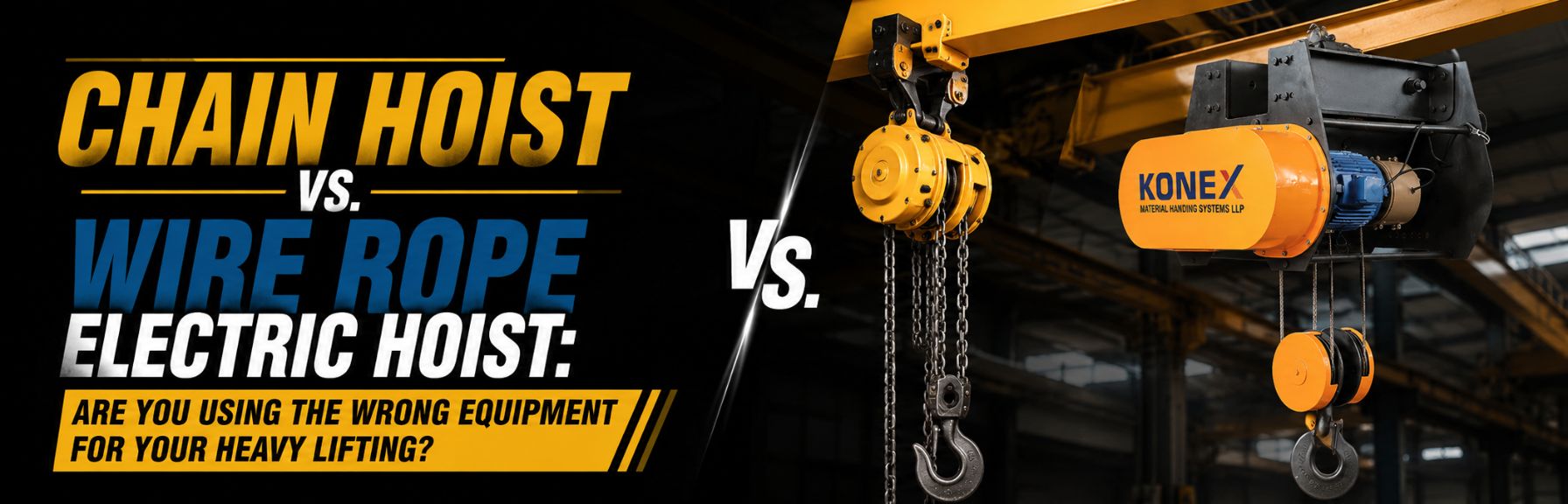
Chain Hoist vs. Wire Rope Electric Hoist: Are You Using the Wrong Equipment for Your Heavy Lifting?
In the fast-paced world of industrial manufacturing, warehousing, and infrastructure development, efficiency is the currency of survival. Yet, one of the most common operational bottlenecks occurs right above our heads—in the overhead crane systems silently moving tons of material across your facility floor.
Choosing the wrong material handling equipment does not just slow down your production line; it actively eats into your profit margins, accelerates wear and tear, and introduces preventable safety risks.
When it comes to heavy-duty lifting, industrial buyers and plant managers constantly grapple with one fundamental dilemma: Should you invest in a Chain Hoist or a Wire Rope Electric Hoist?
Using the wrong hoist for your specific application is an expensive mistake. In this comprehensive guide, we will break down the differences between these two lifting powerhouses, clear up common misconceptions, and help you determine which system will maximise your operational efficiency and return on investment (ROI).
What is a Wire Rope Electric Hoist?
To make an informed decision, we must first understand how these systems operate.
A Wire Rope Electric Hoist is an industrial lifting device designed for high-capacity, high-frequency, and highly precise material handling. It utilises a steel wire rope wound around a grooved hoist drum to raise and lower heavy loads.
Because steel wire ropes consist of multiple individual wires wrapped around a central core, they offer immense tensile strength, exceptional durability under high-stress cycles, and incredibly smooth operation.
These hoists are typically integrated into heavy-duty electric hoist crane systems, such as gantry cranes, monorails, and double-girder overhead cranes, where operations demand continuous run times and extreme load management.
What is an Electric Chain Hoist?
An electric chain hoist, on the other hand, utilises a durable metal chain passing through a pocket wheel (or load sheave) to lift loads. The chain links fold into a chain container suspended next to the hoist body when not in use.
Chain hoists are compact, highly portable, and incredibly robust. They are excellent for vertical lifts where space is limited and where the load is moderate (typically under 5 to 10 tons). Because they pull the load directly up via chain links, they offer highly reliable vertical lift, though they are generally slower and noisier than their wire rope counterparts.

Chain Hoist vs. Wire Rope Electric Hoist: The Direct Comparison
To help you audit your current setup or plan your next facility upgrade, let us evaluate both lifting systems across five critical operational parameters.
1. Lifting Capacity and Load Profiles
The most immediate differentiator between these two lifting systems is their total lifting capacity.
- Electric Chain Hoists: Typically designed for light to moderate lifting. While high-capacity chain hoists do exist, they are most effective and cost-efficient for loads ranging from 250 kg up to 5 tons. Beyond this range, the chains become excessively heavy, slow, and difficult to manage.
- Wire Rope Electric Hoist Systems: Built specifically for the heavy lifting demands of heavy industry. These hoists effortlessly handle capacities ranging from 1 ton to well over 50 tons. If your facility regularly moves massive machinery, steel coils, structural beams, or heavy raw materials, a high-quality wire rope hoist is the safest and most efficient choice.
2. Duty Cycle and Operational Intensity
How long and how frequently must your lifting equipment run without stopping? This is referred to as the hoist’s duty cycle.
- Electric Chain Hoists: Best suited for intermittent, light-to-medium duty applications. They are perfect for assembly workstations, maintenance bays, and tool rooms where lifting happens periodically throughout the shift.
- Wire Rope Electric Hoists: Engineered for continuous, high-speed, and high-duty cycles. If your production line operates 24/7 or requires constant material transport (Class C, D, or E crane duty), a wire rope system is non-negotiable. Its motor and drum configuration are built to dissipate heat rapidly, ensuring the system runs smoothly without overheating or causing unexpected downtime.
3. Lifting Height and Precision Tracking
As loads are lifted higher into the air, the physical behaviour of your lifting medium (chain vs. rope) matters significantly.
- Chain Hoists: Over extreme heights, chain links can vibrate or experience minor sway. The chains can also twist slightly if not maintained perfectly, which can impact precision placement.
- Wire Rope Hoists: Offer unmatched precision. Because the steel wire rope is wrapped neatly along a grooved drum, the load remains exceptionally stable. This design minimises load swing and ensures dead-on accuracy when positioning heavy parts into sensitive machinery or onto transport trucks. Furthermore, for heights exceeding 10 meters, wire rope is much lighter and more manageable than a massive length of steel chain.
4. Headroom and Spatial Constraints
Physical space in your factory layout often dictates your equipment choices.
- Chain Hoists: Have a highly compact footprint. They require much less horizontal space, making them ideal for small workshops, low-clearance areas, and localized workstations.
- Wire Rope Hoists: Because of the motor, gearbox, and drum assembly, these units are physically larger. However, when integrated into a low-headroom electric hoist crane design, they can be configured to maximize the available hook height even in facilities with low ceilings.
5. Lifespan and Return on Investment (ROI)
While upfront cost is always a factor, the long-term cost of ownership (maintenance, parts replacement, and downtime) is what truly impacts your business.
- Chain Hoists: Have a lower initial acquisition cost. However, because metal-on-metal friction occurs between the chain links and the load sheaves, they require frequent lubrication and wear out faster under heavy, continuous use.
- Wire Rope Hoists: While they represent a higher initial investment, their lifespan is significantly longer. The wire rope is designed to distribute weight across hundreds of individual steel strands, greatly reducing localized wear. For large-scale manufacturing operations, the minimized maintenance costs and lack of operational downtime deliver a much higher ROI over the lifespan of the equipment.
Practical Application Mapping: Which One Fits Your Industry?
To make your decision-making process completely foolproof, let us look at where each hoist excels in real-world industrial settings.
Choose an Electric Chain Hoist If:
- You run a small-to-medium workshop, automotive garage, or assembly station.
- Your lifting requirements rarely exceed 5 tons.
- You need a highly portable hoist that can be easily relocated to different workstations.
- Lifting is sporadic rather than continuous throughout the day.
- Your budget is highly constrained, and the physical space above your work area is limited.
Choose a Wire Rope Electric Hoist If:
- You operate a large-scale manufacturing plant, steel mill, foundry, cement plant, or shipping terminal.
- You regularly lift loads exceeding 5 tons.
- Your production runs on multiple shifts requiring constant, high-speed lifting.
- You require integration with a double-girder overhead crane or an electric hoist crane for expansive facility coverage.
- You are lifting materials to significant heights where absolute precision, zero load-swing, and high speed are required for safety and efficiency.
The Hidden Cost of Using the Wrong Lifting Equipment
Many procurement managers mistakenly choose a chain hoist for heavy applications simply because of its lower initial price tag. This choice often backfires in several costly ways:
- Premature Wear and Part Failures: Forcing a chain hoist to operate near its maximum capacity on a high-duty cycle causes rapid stretching of the chain links, pocket wheel damage, and motor overheating.
- Increased Facility Downtime: When a primary hoist fails, your entire production line can grind to a halt. The cost of just one hour of downtime in a modern manufacturing facility can easily exceed the cost difference between a chain hoist and a high-performance wire rope hoist.
- Compromised Workplace Safety: Overworked lifting equipment is a major safety hazard. Wire rope hoists feature advanced safety mechanisms, including upper and lower limit switches, overload limiters, and electromagnetic brakes that provide multiple layers of protection for your workforce.
Konex Material Handling System LLP: Your Trusted Wire Rope Electric Hoist Manufacturer in India
Selecting the right equipment is only half the battle; partnering with a reliable, world-class manufacturer is the other.
At Konex Material Handling System LLP, we have earned our reputation as a premier Wire Rope Electric Hoist Manufacturer in India. We design, engineer, and manufacture state-of-the-art lifting systems that meet both Indian standard specifications (IS) and international standards.
Why Choose Konex for Your Lifting Solutions?
- Engineering Excellence: Our hoists are engineered with precision-machined rope drums, high-tensile steel wire ropes, and heavy-duty motors designed to withstand the harshest industrial environments.
- Tailored Solutions: Whether you need a standard monorail hoist or a highly customized double-girder electric wire rope hoist in india, our engineering team designs equipment that integrates seamlessly into your existing overhead crane systems.
- Safety-First Design: Every Konex hoist is equipped with advanced safety features, including fail-safe electromagnetic brakes, overload sensors, and precision limit switches to ensure smooth and hazard-free operations.
- Global Export Capability: Based in India’s industrial heartland, Konex is not just a leading domestic manufacturer. We have a robust global export network, supplying top-tier material handling equipment to businesses across Asia, the Middle East, Africa, and Europe.
- Comprehensive Lifecycle Support: From initial consultation and custom engineering to installation, maintenance, and genuine spare parts supply, we stand by our clients at every stage of their operational journey.
How to Conduct an Internal Material Handling Audit
Before you place your next equipment order, we highly recommend answering these five simple questions with your plant engineering team:
- What is our absolute maximum load? (If it exceeds 5 tons, you should almost certainly use a wire rope system).
- How many hours a day will this hoist run? (For continuous multi-shift operations, wire rope is highly recommended for duty-cycle management).
- What is our required lift height? (For high lifts, wire rope keeps the load stable and minimizes sway).
- What are our environmental conditions? (Exhaustive heat, dust, or chemical exposure require specific motor protections and wire rope materials).
- What is our long-term budget? (Factor in maintenance costs and downtime risks over a 5-to-10-year window, not just the initial purchase price).
Transform Your Operations with Konex
Don’t let inefficient material handling slow down your business growth. Choosing the correct hoist is an investment in your company’s safety, productivity, and bottom-line profitability.
Whether you are looking to upgrade an existing electric hoist crane or install a brand-new overhead lifting system, our team of material handling experts at Konex Material Handling System LLP is here to guide you.
Ready to find the perfect lifting solution for your facility?
Contact Konex Material Handling System LLP Today to speak with a senior engineer, or request a customized quote for a high-performance electric wire rope hoist in india tailored to your exact industrial requirements. Let us lift your business to new heights!
Contact Us : +91 98240 11164 | +91 90999 02956 , info@konex.co.in
Konex Material Handling System LLP – Engineering Safety, Lifting Excellence.
FAQs
A chain hoist uses a metal chain and load sheave to lift materials, while a wire rope electric hoist uses a steel wire rope wound around a drum. Wire rope hoists are generally preferred for heavier loads, higher lifting heights, and continuous industrial operations.
A wire rope electric hoist is typically the better choice for loads exceeding 5 tons. It offers higher lifting capacities, smoother operation, better load stability, and improved durability in demanding industrial environments.
An electric chain hoist is ideal for workshops, maintenance facilities, automotive garages, and assembly stations where lifting requirements are usually below 5 tons and operations are intermittent rather than continuous.
Yes. Wire rope electric hoists are specifically designed for high-duty cycles and continuous operation in manufacturing plants, steel mills, warehouses, foundries, and other heavy-duty industrial applications.
A wire rope electric hoist provides superior lifting precision and load stability because the rope is guided along a grooved drum, reducing load sway and improving positioning accuracy during lifting operations.
Chain hoists generally have a lower initial purchase cost. However, for high-capacity and high-frequency applications, a wire rope electric hoist often delivers a better long-term return on investment due to lower downtime and longer service life.
Wire rope electric hoists are widely used in steel plants, cement plants, shipyards, power plants, manufacturing facilities, warehouses, construction projects, and material handling operations requiring heavy lifting.
Calculate the maximum load you need to lift, consider future capacity requirements, evaluate lifting frequency, lift height, and operational conditions. For loads above 5 tons or continuous operation, a wire rope electric hoist is usually recommended.
Modern wire rope electric hoists typically include overload protection, upper and lower limit switches, electromagnetic brakes, emergency stop functions, and advanced control systems to enhance workplace safety.
Selecting the right hoist reduces equipment wear, minimizes downtime, improves worker safety, increases lifting efficiency, and helps businesses achieve higher productivity and lower operating costs over the equipment’s lifespan.