

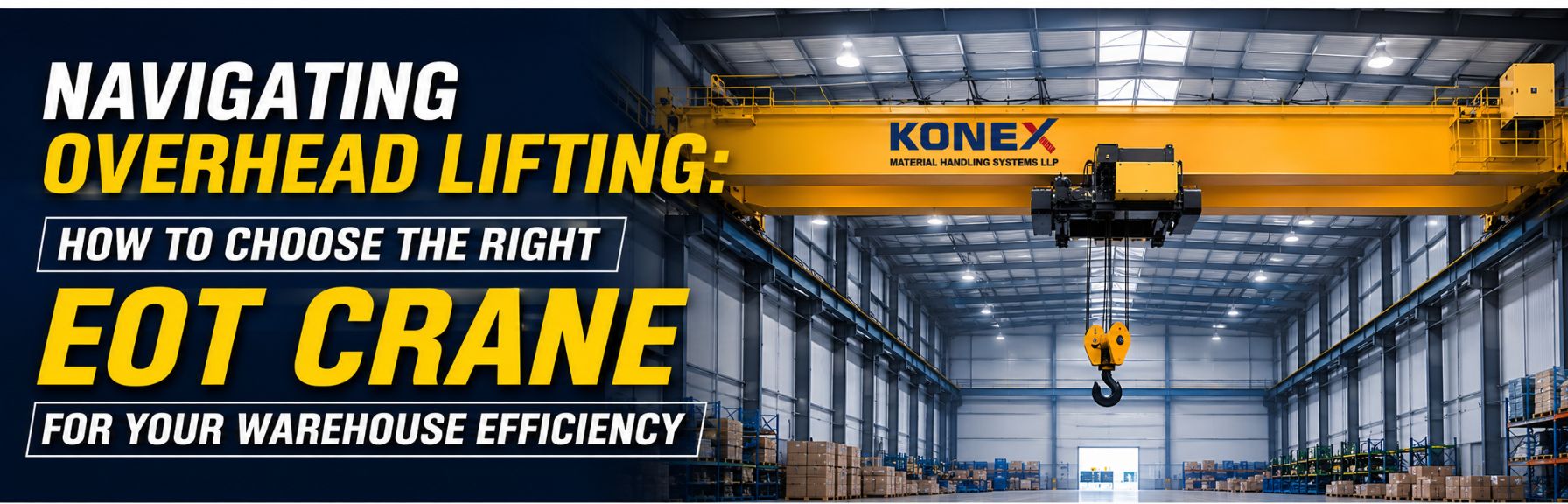
Navigating Overhead Lifting: How to Choose the Right EOT Crane for Your Warehouse Efficiency
If you are managing a busy warehouse, manufacturing facility, or distribution hub in India, you already know that vertical space is just as valuable as floor space. Moving heavy loads safely and quickly is the backbone of your daily operations. When it comes to optimizing this material movement, overhead cranes—specifically Electric Overhead Traveling (EOT) cranes—are the ultimate workhorses.
However, making the wrong choice between a single girder and a double girder configuration can lead to unnecessary expenditures, structural overheads, or underperforming operations.
In this guide, we will break down the practical differences between these two lifting powerhouses. We will help you determine which system fits your building’s structure, your lifting requirements, and your budget—without getting bogged down in overly complex engineering jargon.
Understanding the Core Setup: Single vs. Double Girder
Before we look at the specific scenarios where one outshines the other, let us establish what these terms actually mean in everyday warehouse operations.
An EOT crane consists of a bridge that runs across your facility on elevated runways. The main difference lies in how many bridge beams (girders) span this gap:
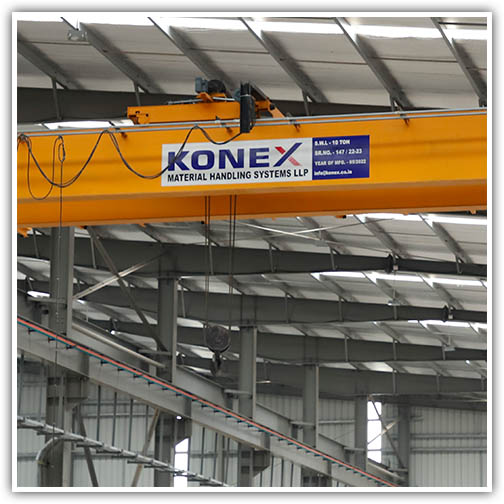
- The Single Girder Setup: This system uses one strong cross-beam. The trolley and hoist (the mechanism that actually lifts your load) hang directly from the bottom flange of this single beam. If you are looking to maximize hook approach and save on installation costs, a Single Girder EOT Crane is often the ideal starting point.
- The Double Girder Setup: This system utilizes two parallel cross-beams. Instead of hanging underneath, the trolley and hoist ride on top of rails mounted to the upper surface of both beams.
While Konex Material Handling System LLP is widely recognized as a premier Single Girder EOT Crane Manufacturer, we engineer, manufacture, and export both high-quality single girder and robust double girder systems globally. Our engineering focus is always on matching the exact structural capacity of your facility with the safest, most cost-effective lifting machinery.
The Practical Matchup: Where Each Crane Excels
Choosing the right system is not about finding the “best” crane; it is about finding the right fit for your specific facility design and operational goals. Let’s compare how they perform in real-world scenarios.
1. Weight Capacities and Duty Cycles
A single girder configuration features one bridge beam supported by two end carriages. The hoist and trolley run along the bottom flange of this single girder.
- Best Suited For: Light to medium duty applications, spans up to 25 meters, and lifting capacities up to 15-20 tons.
- Maintenance Advantages: Fewer moving parts, simpler electrical systems, lighter wheel loads (which reduces wear on the building’s runway structure), and lower initial investment.
- The Maintenance Risk: If a Single Girder EOT Crane Manufacturer uses low-grade steel profiles instead of robust, box-plate fabricated girders for longer spans, the girder can twist under diagonal loads. This structural twisting leads to rapid trolley wheel wear and frequent hoist jams.
2. Utilizing Your Warehouse’s Vertical Space
Real estate is expensive. Maximizing the height of your building (your “headroom”) is vital for stacking inventory higher and utilizing your vertical cube.
- Under-running or Top-running Single Girder Systems: Because the hoist hangs underneath a single girder, it does occupy some vertical space below the beam. However, for standard warehouse storage, this clearance is usually more than sufficient.
- The Double Girder Advantage for High Stacking: Because the hoist sits on top of the two girders rather than hanging underneath them, you gain precious vertical room. The hook can travel up between the two beams, allowing you to lift loads much closer to the ceiling of your warehouse.
3. Structural Demands on Your Building
An often-overlooked factor is how much weight your existing warehouse walls, pillars, and foundations can support.
- Lighter Footprint: A single girder crane is significantly lighter than its double girder counterpart. Because the crane itself weighs less, it exerts much less wheel load on your building’s runway beams and columns. This makes a Single Girder EOT Crane for Warehouse environments ideal for older buildings or lighter pre-engineered steel buildings (PEB) where modifying the building’s support structure is not financially viable.
- Heavier Footprint: Double girder setups require a much stronger runway support structure to handle both the weight of the crane itself and the massive loads it is built to carry. This is a crucial consideration when designing a new warehouse from scratch.
Cost vs. Value: Aligning Your Budget
For procurement managers and business owners, the financial aspect is always top of mind. Let’s look at how the return on investment (ROI) plays out for both options.
Factor | Single Girder EOT Crane | Double Girder EOT Crane |
Initial Purchase Cost | Highly economical, requires less steel and simpler hoist mechanisms. | Higher initial investment due to extra materials and complex trolley designs. |
Installation Expense | Fast, straightforward, and requires less heavy equipment to set up. | More complex installation, requiring extra time and alignment precision. |
Structural Building Costs | Low impact; saves money on runway and pillar reinforcement. | Higher impact; requires robust support pillars and foundations. |
Maintenance & Parts | Easier to access, fewer moving parts, lower long-term maintenance costs. | Requires specialized maintenance but built to withstand extreme wear over decades. |
If your lifting needs fall within the moderate range, choosing a Single Girder EOT Crane for Warehouse use allows you to allocate saved capital toward other automated storage and retrieval systems (ASRS) or inventory management tools.
How Your Crane Choice Impacts Daily Maintenance and Long-Term Efficiency
Beyond the initial purchase and structural setup, your overhead crane becomes a permanent part of your daily workflow. Understanding the operational reality of both systems helps you avoid unexpected bottlenecks and high maintenance bills down the road.
1. Daily Workflow Speed and Ease of Handling
In a fast-paced logistics hub, speed is measured not just by how fast the crane travels, but by how quickly and precisely your operators can spot and secure loads.
- The Nimble Nature of Single Girder Systems: Because a single girder crane has a lighter overall weight, it exhibits lower structural inertia. This means it can accelerate, decelerate, and change directions smoothly with minimal structural sway. Operators find it highly responsive, making it excellent for fast, repetitive material handling tasks where precision and cycle times are vital.
- The Solid Foundation of Double Girder Systems: Double girder cranes are naturally stiffer and heavier. While they may require slightly more energy to accelerate, they offer unmatched structural rigidity. For extremely heavy, delicate, or hazardous materials, this stability ensures that the load remains perfectly balanced with absolutely zero structural twisting or bending during transit.
2. Streamlining Maintenance and Reducing Downtime
In industrial settings, downtime is the ultimate profit-killer. Every hour your crane is out of service for repairs is an hour of lost productivity.
- Simpler Maintenance Cycles: A single girder crane utilizes a hoist that hangs below the girder, making it incredibly accessible. Technicians do not need complex scaffolding or heavy rigging setups to inspect, lubricate, or service the rope drum and motors. With fewer total wear-and-tear components, long-term maintenance is straightforward, cost-effective, and fast.
- Specialized Upkeep: Double girder cranes involve more complex mechanical components, such as dual-rail trolley travel mechanisms, cross-travel drives, and integrated walkways. While these require a more robust, specialized maintenance schedule, they are physically engineered to withstand highly abrasive, dusty, or high-temperature environments over decades of continuous operation.
3. Future-Proofing for Long-Term Business Growth
When investing in material handling equipment, you must plan for where your business will be five to ten years from now.
- If Your Business Strategy Involves Rapid Expansion: A single girder crane offers excellent modularity and quick installation. If you plan to lease a new warehouse space or expand your current facility footprint quickly, single girder setups can be decommissioned, relocated, and re-installed in another bay with minimal structural disruption.
- If Your Business Strategy Involves Moving to Heavy Manufacturing: If you foresee your warehouse transitioning from simple storage to heavy fabrication, assembly, or bulk raw material processing, opting for a double girder structure from day one protects your investment. It ensures your infrastructure can support auxiliary equipment like operator cabins, heavy magnets, grab buckets, or secondary auxiliary hoists when your business needs evolve.
We source our motors, gearboxes, wire ropes, and electrical control panels (including Variable Frequency Drives – VFDs) from globally recognized suppliers.
By pairing these premium components with our robust structural frames, we ensure that every part of the crane works in harmony, greatly reducing wear, vibration, and component fatigue.
Why Leading Warehouses Partner with Konex
At Konex Material Handling System LLP, we believe that material handling is not just about moving steel—it is about keeping your workforce safe, your operations efficient, and your overheads low.
As a trusted Single Girder EOT Crane Manufacturer based in India with a strong global export presence, we take a consultative approach to your material handling challenges. We do not believe in one-size-fits-all solutions. Our team of engineering experts works closely with your warehouse design team to analyze your building drawings, assess your daily lifting cycles, and recommend a crane that delivers the highest safety standards and the quickest return on investment.
Whether you need a sleek, space-saving single girder setup to optimize a local distribution hub or a heavy-duty double girder system exported to a global manufacturing plant, Konex delivers precision-engineered, reliable lifting systems.
Ready to Optimize Your Warehouse Floor Space?
Don’t let guesswork dictate your warehouse layout. Let our material handling specialists help you select, custom-design, and install the perfect overhead crane for your facility.
[Contact the Konex Engineering Team Today] to request a customized site evaluation and find the ideal lifting solution for your business.
Contact Us : +91 9824011164 | +91 90999 02956
FAQs
The main structural difference lies in the number of bridge beams. A single girder EOT crane uses one cross-beam with the lifting hoist hanging underneath the beam. A double girder EOT crane uses two parallel cross-beams, with the hoist trolley riding on top of rails built onto the upper surface of the beams.
Generally, a single girder system is highly efficient and cost-effective for lifting capacities ranging up to 15 or 20 metric tons. If your operations require lifting loads heavier than 20 tons on a regular basis, a double girder system is highly recommended for safety and structural stability.
If maximizing vertical stacking height is your primary concern, a double girder design is often superior. Because the hoist sits on top of the parallel girders rather than hanging beneath them, the hook can rise up between the two beams, giving you extra vertical lifting room close to the ceiling.
For standard warehouse setups in India—especially those operating within Pre-Engineered Buildings (PEBs)—a single girder system is highly economical. It is significantly lighter, which means it exerts less wheel load on the building’s columns, often saving you from having to make expensive foundation and structural building reinforcements.
Yes. Because the hoist hangs directly below the single beam, it is highly accessible for routine lubrication, inspections, and part replacements. Additionally, single girder systems have fewer moving parts, resulting in lower long-term maintenance costs and less operational downtime.
A standard single girder crane can comfortably cover spans of up to 30 meters (approximately 100 feet). While longer spans are possible, they require careful engineering to prevent structural deflection. At Konex, we custom-design spans to precisely match your facility’s layout.
Yes, absolutely. While we are a leading Single Girder EOT Crane Manufacturer, we design, engineer, and manufacture both high-capacity single girder and heavy-duty double girder EOT cranes tailored to meet Indian (IS) and international quality and safety compliance standards.
Yes. Konex is an established global exporter. We ship precision-engineered material handling equipment, runway structures, and custom EOT crane packages to international industrial hubs, managing the entire logistical process to ensure safe, on-time delivery.
Our EOT systems are equipped with advanced safety mechanisms, including over-hoist and over-travel limit switches, overload limit sensors, anti-collision devices, emergency stop buttons, and robust warning alarms to protect your operators and inventory.
Before choosing a crane, you should have your building drawings reviewed by a qualified engineer. As a full-service partner, the engineering team at Konex analyzes your facility’s column strength, runway beams, and foundation capacity to recommend the safest, most cost-effective crane configuration.