

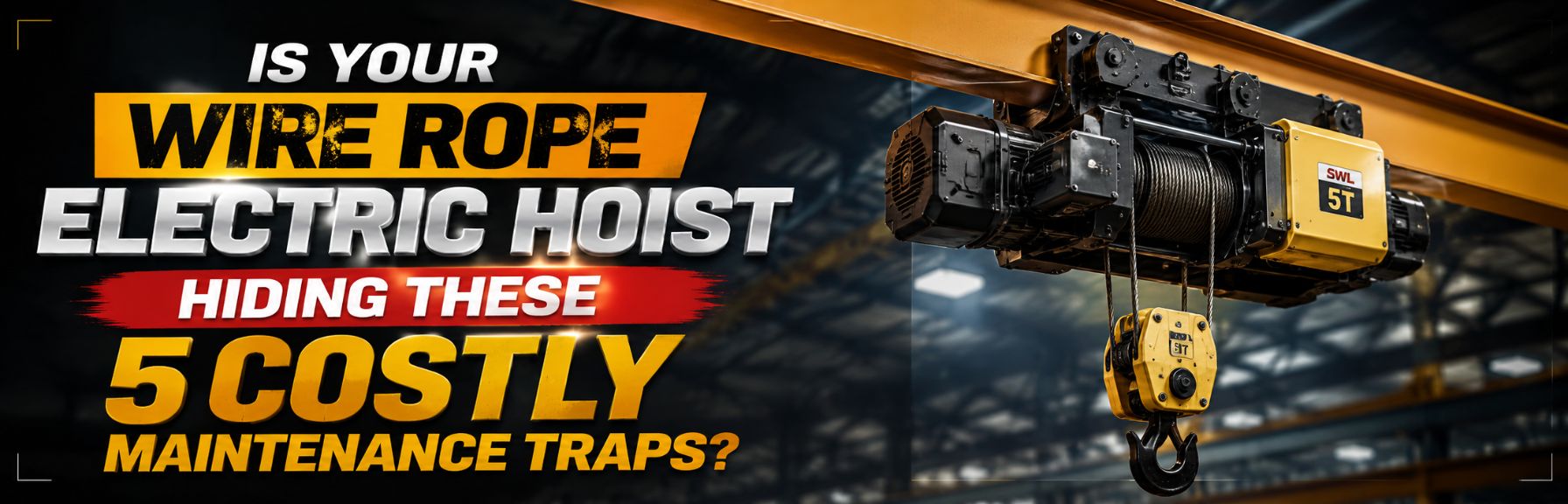
Is Your Wire Rope Electric Hoist Hiding These 5 Costly Maintenance Traps?
In any busy industrial environment, your machinery is the heartbeat of your operations. Among these, the Wire Rope Electric Hoist serves as the ultimate workhorse, silently lifting tons of material day in and day out. Whether it is integrated into a massive electric hoist crane system or acting as a standalone workstation lift, this equipment keeps your production lines moving and your supply chains intact.
However, because these systems are engineered to be incredibly durable, a dangerous complacency often sets in. Many plant managers, safety officers, and maintenance engineers operate under a false sense of security, assuming that if the hoist is lifting, it is perfectly healthy.
The truth? Beneath the rugged exterior of your hoist, silent, costly, and potentially catastrophic maintenance traps could be developing right now.
As a leading global Wire Rope Electric Hoist Manufacturer, Konex Material Handling System LLP has engineered and inspected thousands of lifting systems. Over the years, our engineering teams have noticed a recurring pattern: most catastrophic failures are not caused by sudden, unpredictable accidents. Instead, they are the result of minor, overlooked wear and tear—silent maintenance traps that slowly drain your operational budget.
In this comprehensive guide, we will unmask the five most common and costly maintenance traps associated with your electric wire rope hoist in India or international facilities, and show you exactly how to avoid them to protect your bottom line, keep your operators safe, and extend the lifespan of your heavy investments.
The Hidden Cost of Overhead Hoist Downtime
Before diving into the specific traps, let’s look at the financial reality. In modern industrial operations, a single hour of unplanned downtime on a primary production line can cost anywhere from thousands to tens of thousands of dollars.
When an electric hoist crane fails:
- Production Halts: Upstream and downstream processes quickly bottleneck.
- Labor Expenses Skyrocket: Operators are left idle while specialized maintenance teams work overtime.
- Emergency Shipping Costs Mount: Sourcing replacement parts at the last minute incurs heavy premiums.
- Reputational Damage Occurs: Delayed shipments can lead to missed contract deadlines and dissatisfied B2B clients.
Transitioning from a reactive “run-to-failure” mindset to a proactive predictive maintenance model is the single most effective way to protect your business. Let’s explore the five traps that prevent most companies from achieving this goal.
Trap 1: The "Looks Good from the Ground" Visual Inspection Fallacy
The Trap
This is perhaps the most common trap in industrial facilities. A supervisor stands on the factory floor, looks up 20 feet at the wire rope drum and the suspended cable of the Wire Rope Electric Hoist, sees no obvious snapping strands, and signs off on the daily safety inspection.
This “ground-level” check is highly deceptive. It is virtually impossible to detect internal structural decay, microscopic stress fractures, or core wire damage from several meters away.
Why It Costs You Fortune
A wire rope is not a single piece of metal; it is a complex, precision-engineered machine composed of dozens of individual wires wrapped around a core. Over time, friction, tension, and bending fatigue create internal wear.
If the core of the rope degrades or rusts internally due to atmospheric moisture, the outer strands will eventually collapse inward. By the time you can see visible damage from the ground, the rope is already on the verge of sudden, catastrophic failure under load.
How to Escape It
- Implement Close-Up Inspections: Ensure that your maintenance team uses mobile scaffolding, scissor lifts, or overhead maintenance platforms to inspect the wire rope up close at scheduled intervals.
- Understand the “Whip” Effect: Check the sections of the rope that pass over the sheaves and enter the wire rope drum most frequently. These areas experience the highest bending fatigue.
- Establish Wear Criteria: Teach your team how to count broken wires over a specific length (e.g., within 6 diameters of the rope) based on international ISO or Indian Standard (IS) safety norms to determine exactly when a rope must be retired.

Trap 2: Ignoring the Subtle Warning Signs of Brake Slippage
The Trap
When an operator releases the “Up” or “Down” button on the hoist pendant, they expect the load to stop instantly and hold its position. If the load drifts downward by just a few millimeters or centimeters before coming to a complete stop, many operators simply compensate by releasing the button slightly earlier. They treat this drift as a minor operational quirk rather than a critical warning sign.
Why It Costs You Fortune
Brake slippage is a clear indicator that either your hoist brake lining is worn, the air gap is misaligned, or the brake magnet is failing. If left unaddressed, this minor drift will rapidly escalate into an uncontrollable “load drop.”
An dropped load destroys the materials being moved, damages the surrounding material handling equipment, ruins the shop floor, and poses a fatal risk to anyone working within the lift zone.
How to Escape It
- Conduct Daily No-Load and Loaded Brake Tests: At the start of every shift, operators should lift a nominal load a few inches off the ground and verify that the brake holds firmly without any downward drift.
- Perform Regular Brake Air-Gap Adjustments: Over time, friction wears down the brake pads, widening the gap between the brake magnet and the armature. Regular inspection and adjustment of this gap back to the manufacturer’s exact specifications will prevent slippage.
- Keep Brakes Free of Contaminants: Ensure that oil, grease, or dust from the surrounding factory environment has not seeped into the brake assembly.
Trap 3: Underestimating the Impact of Rope Guide Wear
The Trap
The rope guide is a circular, ring-like component that wraps around the wire rope drum. Its primary job is to ensure that the wire rope winds and unwinds smoothly into the drum’s machined grooves without overlapping or crossing over itself. Because it is considered a “consumable” part, many maintenance teams ignore it until it completely breaks apart.
Why It Costs You Fortune
Operating a Wire Rope Electric Hoist with a worn, chipped, or missing rope guide is a recipe for expensive mechanical damage. Without a properly functioning guide, the rope can jump out of its designated drum grooves.
When this happens, the rope wraps unevenly, causing severe pinching, crushing, and cutting of the steel strands against the sharp edges of the drum. Within just a few cycles, an expensive wire rope can be completely ruined, and the drum itself can suffer deep, irreversible grooving that requires a complete replacement of the hoisting unit.
[Damaged Rope Guide]
       │
       ├──> Rope jumps out of drum grooves
       ├──> Overlapping & pinching of steel strands
       └──> Severe wear on the Wire Rope Drum ──> Total Drum Replacement Required
How to Escape It
- Make Rope Guides a Standard Inspection Item: During monthly crane inspection routines, physically inspect the guide for signs of cracking, thinning, or missing segments.
- Enforce Strict Angle Lifting Limits: One of the main causes of premature rope guide failure is pulling loads at an angle (side pulling). Ensure operators only perform vertical lifts. Side-pulling exerts intense lateral pressure on the rope guide, snapping it instantly.
- Partner with an Established OEM: Always source high-quality, durable replacement rope guides directly from a reputable Wire Rope Electric Hoist Manufacturer like Konex to ensure absolute component compatibility.
Trap 4: The Danger of "Over-Greasing" or Using the Wrong Lubricant
The Trap
There is a common belief in industrial maintenance that “more lubrication is always better.” When it comes to the hoisting gear box, wire ropes, and sheave bearings, maintenance technicians often pump grease into grease nipples or coat the wire rope until it is dripping, without checking the lubricant’s specific properties or the required volume.
Why It Costs You Fortune
Over-greasing and using incorrect lubricants are leading causes of component failure.
- Over-greasing gearboxes builds up excessive internal pressure, blowing out oil seals and allowing lubricant to leak directly onto the motor windings or brake assemblies, causing electrical short-circuits or brake failure.
- Using the wrong wire rope dressing can trap moisture inside the inner strands instead of lubricating them. Furthermore, excessive sticky grease on a wire rope acts as a magnet for abrasive airborne dust, sand, or metal shavings, creating an abrasive paste that rapidly grinds away the rope and sheaves.
How to Escape It
- Follow the Manufacturer’s Lubrication Chart: Use only the exact grades of gear oil and wire rope dressing recommended by your hoist manufacturer.
- Use Specialized Wire Rope Lubricants: Opt for light, penetrating lubricants that can seep into the core of the wire rope to protect against internal friction, rather than heavy, sticky greases that only sit on the outer surface.
- Keep Gearbox Breathers Clean: Ensure that the gearbox ventilation plug or breather is clean and unblocked, allowing heat and pressure to escape safely.
Trap 5: Operating Without Calibrated Limit Switches
The Trap
The limit switch is the ultimate safety net of a Wire Rope Electric Hoist. It is designed to automatically cut off power to the hoisting motor when the hook reaches its upper or lower travel limits.
The trap occurs when operators rely on the limit switch as an everyday “stop button” to halt the hook at the top of its cycle, or when maintenance teams fail to test if the switch is functioning properly.
Why It Costs You Fortune
If a limit switch fails to activate, or if it has been bypassed by a technician searching for a quick fix, a catastrophic event known as “two-blocking” can occur. The hook block will crash directly into the hoist frame and drum at full power.
This structural collision instantly snaps the wire rope, drops the suspended load, breaks the hoisting gear teeth, and can easily bend the main overhead crane girder, resulting in tens of thousands of dollars in structural repairs and severe safety hazards.
[Limit Switch Fails to Trigger]
               │
               ▼
[Hook Block Crashes into Hoist Frame ("Two-Blocking")]
               │
               ▼
[Wire Rope Snaps + Gear Teeth Break + Structural Damage to Girder]
How to Escape It
- Treat Limit Switches as Emergency Stops Only: Instruct operators to manually release the control button before the hook reaches the absolute top or bottom limit. The switch should never be used as a primary operational control.
- Test Limit Switches Daily: At the start of every shift, perform a quick, low-speed test of both the upper and lower limit switches with no load attached to verify immediate power cut-off.
- Incorporate Limit Switches in Safety Audits: Ensure your crane inspection checklist includes checking the electrical contacts, wiring integrity, and physical alignment of the limit switch levers.
How to Build a Proactive Maintenance Culture (A 3-Step Framework)
Understanding these five traps is only half the battle. To truly eliminate unexpected breakdowns and protect your equipment investments, your facility must transition to a structured, proactive maintenance culture. Here is a simple, highly effective 3-step framework to get started:
1. Standardize Your Inspection Schedule
Divide your maintenance tasks into clear, time-based intervals. This ensures that major components are evaluated long before they can reach a point of failure.
- Daily Checks (Operator-led): Visual inspection of the wire rope, safety latch on the hook, pendant control buttons, and a quick test of the brakes and limit switches.
- Monthly Inspections (Technician-led): Deep-dive visual inspection of the wire rope drum, rope guide, structural frame, and sheave wear. Check for correct lubrication levels.
- Annual Comprehensive Audits (Expert-led): Non-destructive testing (NDT) of the load hook, structural weld inspections, oil replacement in the gearbox, electrical contactor checks, and dynamic load testing to verify the hoist’s hoist lifting capacity.
2. Educate Your Operators on Load Limits
Even the most perfectly maintained hoist will fail if it is consistently subjected to operator abuse. Make sure every hoist operator in your facility is thoroughly trained on:
- The Hoist Lifting Capacity: Every overhead system has a clearly marked Safe Working Load (SWL). Never exceed this load limit, even for a brief lift.
- Preventing Side Pulling: Ensure the crane is positioned directly above the load before lifting to prevent damaging the rope guide and putting uneven stress on the structural runway.
- Avoiding Shock Loading: Instruct operators to slowly tension the sling before initiating a full-speed lift. Sudden, jerky starts put immense structural stress on the entire system.
3. Maintain an Accurate Spares Inventory
When a critical part wears out, waiting days or weeks for a replacement component to arrive from an overseas supplier is an unnecessary drain on your business. Keep a critical spares kit on-site, including:
- Spare wire rope assemblies (pre-cut and seized to the correct length)
- Replacement rope guides
- Brake disc linings and coil assemblies
- Pendant control switches and cables
- Contactors and fuses
Why Industry Leaders Partner with Konex Material Handling System LLP
When it comes to heavy-duty lifting, you cannot afford to compromise on quality, reliability, or engineering expertise. As a premier Wire Rope Electric Hoist Manufacturer based in India, Konex Material Handling System LLP has established itself as an industry leader in designing and manufacturing high-performance industrial lifting solutions.
We specialize in delivering state-of-the-art electric wire rope hoist in India and to international markets, ensuring that our products stand up to the most demanding industrial environments.
┌─────────────────────────────────────────────────────────────────┐
│              The Konex Engineering Advantage                     │
├─────────────────────────────────────────────────────────────────┤
│  ✓ Precision-machined steel rope drums for minimal wear         │
│  ✓ Heavy-duty, high-torque motors with built-in thermal safety  │
│  ✓ Fail-safe electromagnetic brakes with minimal drift          │
│  ✓ Rugged, impact-resistant rope guides                         │
│  ✓ Compliance with Indian (IS) and International safety norms   │
└─────────────────────────────────────────────────────────────────┘
Global Standards, Seamless Export Capabilities
From our modern manufacturing facilities in India, we engineer heavy-duty material handling systems that adhere to rigorous global quality standards. Whether you run a steel mill in Gujarat, an automotive manufacturing plant in Chennai, or an infrastructure project in Europe, the Middle East, or Southeast Asia, our robust export pipeline ensures timely delivery, complete engineering documentation, and uninterrupted aftermarket spare parts support.
At Konex, we don’t just manufacture hoisting machinery; we partner with your business to optimize your entire material handling workflow, minimize maintenance costs, and maximize operational uptime.
Take Action: Don't Wait for a Breakdown to Occur
An unexpected hoist failure is a costly, stressful, and entirely preventable event. By avoiding these five common maintenance traps and partnering with an expert manufacturer, you can keep your factory floor running smoothly, efficiently, and safely.
Are you unsure about the health of your current lifting systems? Do you want to ensure your operations are fully optimized and compliant with modern safety regulations?
Get in touch with the engineering experts at Konex Material Handling System LLP today.
Our team is ready to assist you with custom engineering designs, comprehensive technical advice, and world-class overhead lifting equipment designed to take your industrial productivity to the next level.
Contact Konex Material Handling System LLP today to discuss your lifting requirements or request a custom quote!
Contact Us : +91 98240 11164 | +91 90999 02956 , info@konex.co.in
Konex Material Handling System LLP – Engineering Safety, Lifting Excellence.
FAQs
The most common maintenance issues include worn wire ropes, brake slippage, damaged rope guides, improper lubrication, and faulty limit switches. Ignoring these problems can lead to unexpected downtime, expensive repairs, reduced lifting performance, and serious workplace safety risks. Regular inspections help prevent these failures.
A Wire Rope Electric Hoist should undergo:
- Daily: Visual inspection of rope, hook, brakes, pendant controls, and limit switches.
- Monthly: Detailed inspection of the rope drum, rope guide, gearbox, motor, and electrical components.
- Annually: Comprehensive inspection including load testing, NDT inspection, brake adjustment, gearbox oil replacement, and electrical system testing.
Following this schedule improves safety and extends equipment life.
Wire rope failure is usually caused by excessive wear, corrosion, broken wire strands, improper lubrication, overloading, side pulling, bending fatigue, and poor maintenance. Replacing worn wire ropes before failure significantly reduces accident risks and downtime.
Brake slippage allows the suspended load to move downward after lifting has stopped. This indicates worn brake linings, incorrect brake adjustment, or brake component failure. If ignored, brake slippage can cause dropped loads, equipment damage, production losses, and severe safety hazards.
The rope guide ensures the wire rope winds correctly on the drum without overlapping. A damaged rope guide can cause uneven winding, rope crushing, drum damage, increased wear, and costly repairs. Regular inspection and timely replacement help maintain smooth hoist operation.
Always use the lubricant recommended by the hoist manufacturer. Specialized wire rope lubricants penetrate the rope strands and protect against internal corrosion and wear. Using incorrect or excessive grease may damage seals, attract dust, and reduce component lifespan.
Limit switches automatically stop the hoist before the hook reaches its maximum upper or lower travel limit. They prevent over-travel, hook collision, rope damage, and structural failures. Limit switches should be tested regularly and should never be used as routine operating stops.
Preventive maintenance helps detect wear before major failures occur. Regular inspections, lubrication, brake adjustments, and timely replacement of worn components reduce breakdowns, minimize downtime, lower repair expenses, improve productivity, and increase equipment lifespan.
Common warning signs include:
- Unusual noises
- Load drifting after lifting
- Broken wire strands
- Uneven rope winding
- Oil leakage
- Slow lifting speed
- Motor overheating
- Abnormal vibrations
- Damaged rope guide
- Frequent electrical faults
Ignoring these signs can result in expensive repairs or equipment failure.
You can extend the life of your hoist by:
- Following a preventive maintenance schedule
- Performing daily inspections
- Avoiding overloading
- Preventing side pulling
- Using genuine spare parts
- Applying the correct lubricant
- Testing brakes and limit switches regularly
- Training operators on safe lifting practices
Proper maintenance significantly improves reliability and operational efficiency.
Konex Material Handling System LLP manufactures high-quality Wire Rope Electric Hoists designed for reliability, safety, and long service life. Their hoists feature precision engineering, heavy-duty motors, fail-safe brakes, durable rope guides, and compliance with Indian and international quality standards, making them suitable for demanding industrial applications.
Wire Rope Electric Hoists are widely used in:
- Manufacturing Plants
- Steel Industries
- Automotive Factories
- Warehouses
- Engineering Workshops
- Heavy Fabrication Units
- Power Plants
- Cement Plants
- Shipyards
- Mining Operations
- Construction Projects
- Logistics Centers
- Paper Industries
- Chemical Plants
- Infrastructure Projects
These industries rely on Wire Rope Electric Hoists for safe, efficient, and heavy-duty material handling.