

Custom vs Standard Double Girder EOT Crane: Which One Fits Your Factory Budget and Workflow?
Setting up a new industrial facility or upgrading an existing production floor requires decisions that shape your daily productivity, workplace safety, and operational efficiency for decades. Among these decisions, selecting the right material handling system is one of the most critical steps you will take.
A Double Girder EOT Crane often serves as the heavy-lifting backbone for steel stockyards, heavy equipment manufacturing, paper mills, power plants, and automotive assembly lines. It handles demanding, continuous loads across wide bay distances where smaller overhead systems simply cannot deliver.
However, choosing the right equipment is not as simple as selecting the largest model or guessing your current heaviest item. Selecting an incorrect lifting capacity or span can cause severe operational bottlenecks, accelerated mechanical wear, unnecessary structural stress on your building, and safety risks for floor operators.
This practical guide will walk you through everything you need to know about determining the exact capacity and span for your facility. Written in plain, straightforward language, this guide focuses on real-world industrial insight, helping you make an informed investment that supports your plant’s long-term growth.
What Makes a Double Girder EOT Crane Essential for Industrial Facilities?
Before diving into measurements and operational planning, it helps to understand how a double girder configuration works in daily shop-floor operations.
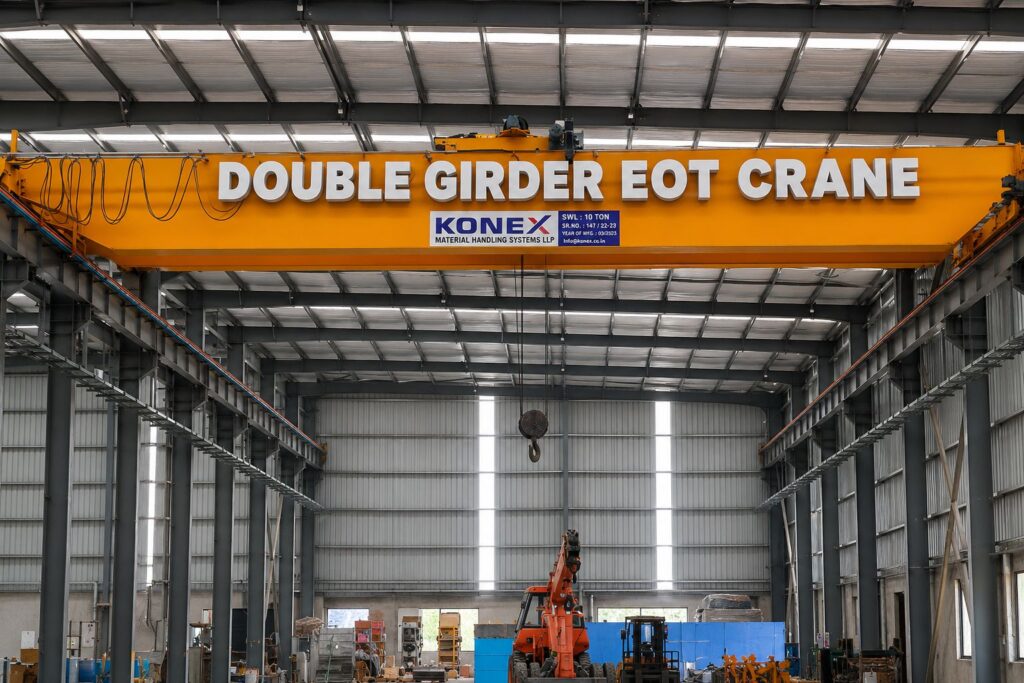
A Double Girder EOT Crane features two heavy-duty bridge girders that span the width of your plant bay. These girders are supported at each end by end trucks, which travel along elevated gantry rails running down the length of your building. Unlike single girder setups where the hoist hangs below a single beam, a double girder system allows the hoisting mechanism to travel on top of the bridge beams.
Core Practical Benefits on the Shop Floor
- Maximum Hook Height: Because the trolley sits on top of the bridge girders rather than underneath, you gain significant vertical space. This extra lifting height is essential when working in plants with restricted vertical headroom or when stacking high material racks.
- Superior Stability for Heavy Loads: Having two parallel structural beams distributes the lifted weight evenly. This eliminates sway and structural twisting when moving heavy or bulky materials across your shop floor.
- Wide Bay Coverage: Dual-beam structures maintain their stiffness across long horizontal spans. This allows large manufacturing facilities to cover wide bays without experiencing excessive beam deflection or bounce.
- Easier Inspection and Maintenance: Double girder systems usually feature dedicated walkway platforms along the bridge. Maintenance personnel can inspect electrical panels, motors, and wire ropes safely without requiring temporary scaffolding or aerial lifts.
Understanding Crane Capacity: Beyond the Maximum Weight
Lifting capacity is commonly defined as the maximum tonnage a crane can safely lift. However, evaluating true capacity for an active manufacturing environment requires looking well beyond a single weight number.
1. Operational Base Load vs. Peak Workload
A frequent mistake during facility planning is sizing equipment solely around an extreme load that occurs only once or twice a year. For instance, if your daily operations involve lifting 5-ton steel plates 95% of the time, but you occasionally move a 20-ton tool or mold, buying a standard system without studying daily cycle patterns can lead to inefficient energy use and higher building construction costs.
When evaluating your capacity requirements, map out:
- Your average daily working load.
- Your absolute peak load requirement.
The frequency of peak loads throughout the production week.
2. Accounting for Below-the-Hook Attachments
The rated capacity of a crane includes everything hanging from the hook. If your process relies on specialized lifting accessories—such as electromagnets, motorized grab buckets, heavy C-hooks, or custom spreader beams—their weight must be subtracted from the crane’s net capacity.
For example, if you require a net lifting load of 15 tons and your spreader beam weighs 2 tons, your actual required lifting capacity is at least 17 tons. Failing to account for attachment weight is a common cause of equipment overload.
3. Usage Frequency and Duty Cycles
Two cranes with identical 10-ton ratings can have completely different internal mechanical builds depending on how often they operate. A 10-ton crane used twice a day in a maintenance bay experiences very light stress. In contrast, a 10-ton crane operating continuously in a high-speed metal scrap facility experiences heavy mechanical wear.
International standards, such as those published by the Material Handling Institute (MHI) and standards organizations like ISO, categorize cranes into distinct duty classes based on operating hours and load severity. Aligning your selection with the right duty class ensures long-term gear and motor reliability.
4. Planning for Future Factory Expansion
Industrial plants evolve over time. Production lines expand, raw material batch sizes increase, and heavier machinery is installed. Factoring in a reasonable margin for future operational growth prevents the need for early equipment replacement or costly building upgrades five years down the line.
Determining the Correct Crane Span for Your Building
While lifting capacity defines how much weight your system can handle, the span determines the physical area your crane covers across your factory floor.
What Exactly Is Crane Span?
In practical terms, the span is the horizontal distance measured center-to-center between the two elevated runway rails. It is not the total width of your factory building, nor is it the overall length of the crane bridge beam.
Practical Steps to Calculate the Required Span
Step 1: Measure Your Building Bay Width
Begin with the internal architectural drawings or physical measurements of your plant bay. Measure the center-to-center distance between the building support columns on opposite sides of the room. Your gantry runway beams will be mounted on or supported near these structural columns.
Step 2: Allow for Required Safety Clearances
A crane cannot run directly flush against building walls or side columns. Safety regulations, including those established by workplace health and safety authorities like OSHA, require strict minimum lateral and overhead clearances between the moving crane structure and fixed building elements. These clearance allowances reduce the available rail-to-rail span slightly compared to the total building width.
Step 3: Account for Hook Approach and Unusable Dead Zones
The crane bridge travels along the length of the building, and the hoist trolley moves across the width of the bridge. However, the hook itself cannot travel all the way to the absolute end of the bridge girders.
The distance between the center line of the hook at its furthest position and the runway rail is known as the hook approach. When planning machine layouts on your shop floor, you must account for these boundary zones to avoid creating dead spots where heavy materials cannot be picked up or set down.
A Step-by-Step Practical Framework for Plant Managers
To keep your decision process straightforward, follow this four-step practical framework before finalizing your facility layout:
Step 1: Map Your Material Flow
Trace the exact path materials take through your facility. Identify where raw materials enter the bay, where they undergo processing, and where finished products are loaded for transport. Understanding material flow prevents placing drop zones in crane dead spots.
Step 2: Audit Facility Support Structures
Double girder systems carry substantial dead weight in addition to the payload. Ensure your existing building columns, brackets, gantry beams, and concrete foundations can safely handle the calculated wheel loads. If you are constructing a new facility, sharing crane wheel load calculations early with your civil structural engineer will save significant construction costs.
Step 3: Assess Environmental Conditions
Operating conditions heavily influence equipment longevity. Consider whether your crane will operate indoors or outdoors, and evaluate factors like:
- Ambient temperature extremes (e.g., hot metal foundries or cold storage facilities).
- High dust or abrasive particulate levels.
- Exposure to humidity, outdoor rain, or corrosive vapors.
Identifying these factors allows your equipment maker to add protective motor covers, specialized paints, or heat shields.
Step 4: Consult an Experienced Manufacturing Partner Early
Engaging a specialist during the plant layout stage prevents structural rework later. An experienced manufacturer can conduct site surveys, verify clearance dimensions, and recommend structural configurations tailored to your specific process layout.
Common Selection Pitfalls to Avoid
Even seasoned project teams can run into unexpected problems when specifying overhead lifting equipment. Keeping these common mistakes in mind will help you avoid costly mid-project corrections:
Pitfall 1: Over-Specifying Bridge Weight
Installing an excessively heavy crane system in a building that does not require it creates high wheel loads. This forces you to build unnecessarily heavy support columns, thicker gantry beams, and deeper concrete foundations, inflating overall project expenditure.
Pitfall 2: Ignoring Vertical Headroom Constraints
Focusing solely on horizontal floor area while ignoring overhead space can lead to disappointing results. Roof trusses, hanging light fixtures, fire sprinkler lines, electrical conduits, and HVAC ducts must clear the top of the crane trolley. Always measure vertical clearance from the floor to the lowest overhead obstruction.
Pitfall 3: Overlooking Localized Service and Spare Parts
Industrial cranes operate under rigorous daily demands. Choosing custom or proprietary components from suppliers who lack local service support can result in prolonged downtime when routine maintenance or spare parts are needed.
Partnering with the Right Partner: Konex Material Handling System LLP
Selecting material handling equipment is about more than evaluating layout dimensions—it is about establishing a reliable partnership with a manufacturer who understands your plant’s operational goals.
As a trusted Double Girder EOT Crane Manufacturer in India, Konex Material Handling System LLP brings practical design knowledge, engineering rigor, and field experience to industrial facilities across the country.
Why Industrial Facilities Trust Konex
- Application-Focused Design: Konex works closely with plant managers and structural engineers to evaluate floor layouts, wheel load limits, and material handling workflows, delivering tailored lifting solutions built for long-term performance.
- Commitment to Safety and Quality: All manufacturing processes align with recognized standards, placing structural integrity, smooth control systems, and operator safety at the forefront of every build.
- Complete Lifecycle Support: From initial site assessments and structural consultations to installation guidance and long-term service support, Konex ensures your plant operations run reliably without costly interruptions.
Making an Informed Investment
Investing in a Double Girder EOT Crane is a strategic decision that directly influences your plant’s daily output, workplace safety, and long-term operational efficiency. By carefully evaluating your true capacity needs, measuring accurate span dimensions, accounting for hook approach, and partnering with an expert Double Girder EOT Crane Manufacturer like Konex Material Handling System LLP, you can build a safe, efficient material handling foundation that supports your business for decades.
Ready to optimize your facility’s material handling workflow? Explore custom engineering solutions and schedule an expert site evaluation with Konex Material Handling System LLP today.
Contact Us : +91 9824011164 | +91 90999 02956
FAQs
The right Double Girder EOT Crane capacity depends on your average working load, maximum or peak load, lifting frequency, and the weight of below-the-hook lifting attachments. You should evaluate both your current lifting requirements and reasonable future production needs before finalizing the crane capacity.
Important factors include the average daily load, maximum load, frequency of peak loads, lifting accessories such as spreader beams or C-hooks, crane duty cycle, operating environment, and future expansion plans. Considering these factors helps prevent both crane overloading and unnecessary investment in an oversized system.
Crane span is the horizontal distance measured center-to-center between the two elevated runway rails. It should be determined after considering the building bay width, required safety clearances, structural supports, and hook approach. The total factory width should not simply be used as the crane span.
Hook approach defines how close the crane hook can travel toward the runway rail or building structure. It is important because areas near the ends of the crane bridge may become inaccessible to the hook. Considering hook approach during plant layout planning helps reduce material-handling dead zones.
Yes. The rated crane capacity includes the total load suspended from the hook, including lifting attachments. Equipment such as spreader beams, electromagnets, grab buckets, and C-hooks adds to the lifted weight. For example, a 15-ton material load with a 2-ton spreader beam requires at least 17 tons of lifting capacity.
Yes. Crane duty cycle is an important selection factor because two cranes with the same rated capacity can experience very different levels of mechanical stress. A crane used occasionally for maintenance has different requirements from one operating continuously in a heavy production environment. The crane should therefore be selected according to operating hours and load severity.
The building structure should be evaluated for crane dead weight, payload, calculated wheel loads, and the loads transferred through runway beams, brackets, columns, and foundations. For an existing plant, a structural assessment is recommended. For a new facility, crane wheel load information should be shared with the structural engineer during the building design stage.
Vertical clearance depends on the crane configuration, required hook height, building height, and overhead obstructions. Roof trusses, lighting fixtures, fire sprinkler lines, electrical conduits, HVAC ducts, and other fixed elements must be considered. Measuring the floor-to-lowest-obstruction height helps determine a suitable crane configuration.
Industrial requirements can increase as production volumes grow, heavier machinery is introduced, or material sizes change. Considering reasonable future requirements during crane selection can help prevent premature replacement or expensive building modifications. However, the crane should not be unnecessarily oversized because excessive crane weight can increase structural and project costs.
An experienced Double Girder EOT Crane Manufacturer can evaluate your material flow, lifting requirements, building clearances, structural conditions, operating environment, and service requirements before recommending a crane. Konex Material Handling System LLP provides application-focused design, structural consultation, installation guidance, and lifecycle support for industrial material handling requirements in India.