

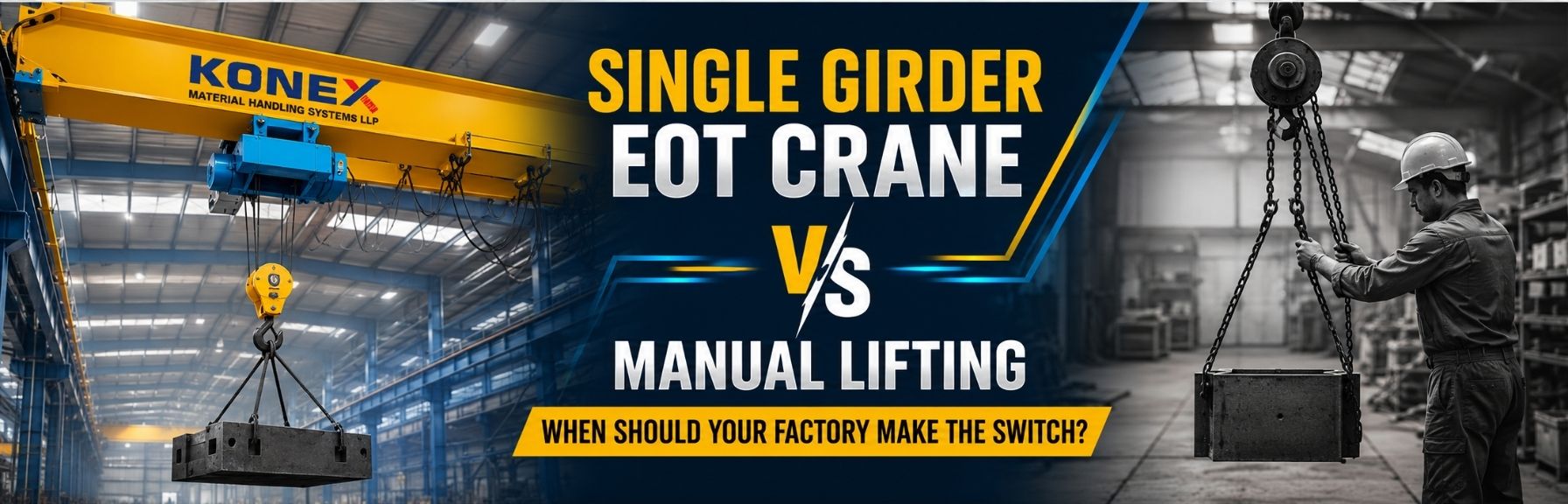
Single Girder EOT Crane vs Manual Lifting: When Should Your Factory Make the Switch?
Running a smooth manufacturing or fabrication facility requires a constant focus on speed, safety, and operational efficiency. However, as production demands grow, many factory owners and plant managers hit a frustrating plateau. Loads that were once manageable with manual hoists, chain blocks, or floor crew labor suddenly become major bottlenecks.
If your facility is experiencing delayed production cycles, crowded shop floors, or rising workplace fatigue, you have likely asked yourself: Is it time to automate our material movement?
Upgrading from traditional manual lifting to a Single Girder EOT Crane is one of the most effective strategic investments a growing manufacturing facility can make. In this comprehensive guide, we will explore the hidden operational costs of manual material handling, the key signs that your factory is ready for an upgrade, and how partnering with an experienced Overhead Crane Manufacturer can transform your plant’s productivity.
The Hidden Costs of Relying on Manual Lifting
In the early stages of a workshop or small industrial unit, manual lifting tools—such as chain pulley blocks, manual gantry setups, or hydraulic hand trucks—seem cost-effective. They require low initial capital investment and minimal structural setup. However, as production volume scales, the true costs of manual lifting begin to reveal themselves.
1. Production Bottlenecks and Slow Cycle Times
Manual material handling relies heavily on human effort and physical coordination. Moving heavy metal plates, machinery parts, or raw materials across the shop floor takes significant time and labor. Every minute your operators spend manually positioning a load is a minute lost in actual production.
2. Heightened Risk of Workplace Injuries
Heavy manual lifting and awkward load handling are leading causes of workplace strain and severe physical injury. Repeated manual labor leads to worker fatigue, frequent downtime, higher absenteeism, and potential liability issues that disrupt daily shop floor morale and efficiency.
3. Risk of Material and Equipment Damage
Manual handling lacks the controlled precision needed for delicate or high-value industrial components. Accidental drops, sudden shifts, or hard landings can result in costly material scrap, reworked parts, and customer delivery delays.
4. Wasted Floor Space
Ground-based manual lifting equipment—such as hand trolleys or mobile floor cranes—requires wide aisles and clear floor paths to operate. This reduces the effective usable floor space for your primary production machinery and worktables.
What Is a Single Girder EOT Crane?
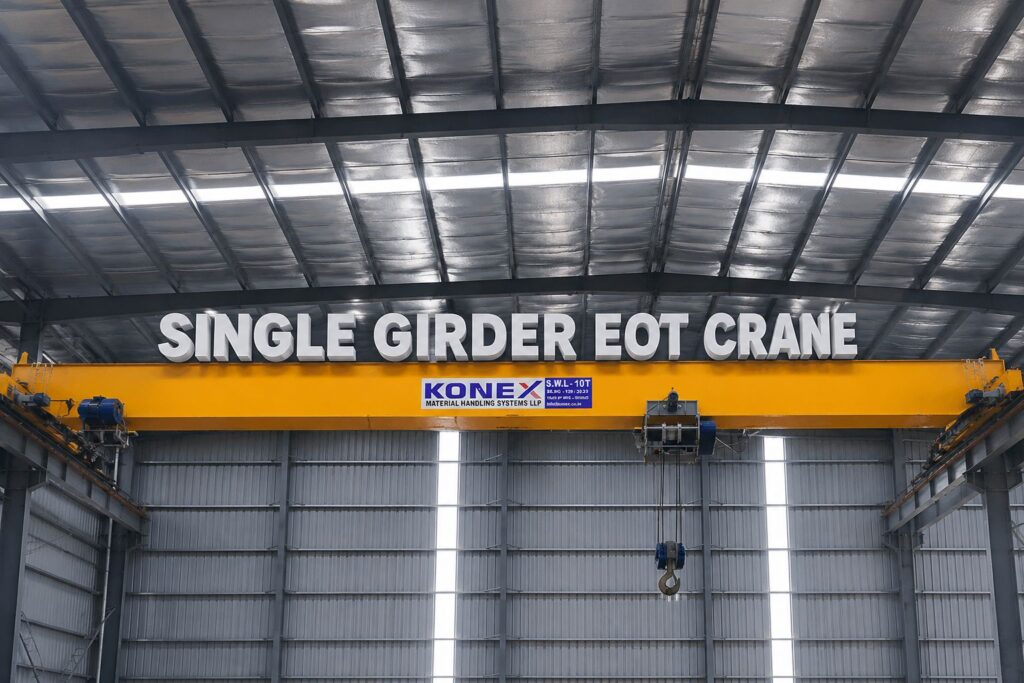
A Single Girder EOT Crane (Electric Overhead Traveling Crane) is an overhead material handling system designed to lif, lower, and move heavy loads horizontally across a facility’s ceiling space.
Unlike complex double girder systems built for extreme heavy-duty steel mills, a single girder system utilizes a single cross-bridge beam supported by end trucks on elevated runway tracks. An electric hoist travels along the bottom flange of the bridge girder to handle load movement smoothly and precisely.
Because it operates above the production floor, a single girder overhead traveling system utilizes underutilized ceiling height, keeping your valuable shop floor completely clear for machines and workers.
5 Clear Signs Your Factory Needs a Single Girder EOT Crane
Knowing when to transition from manual methods to an overhead electric system is critical for maximizing your return on investment. Here are five practical operational indicators that signal it is time to make the switch:
Sign 1: Daily Production Output Is Stalling During Load Transfers
If your machines are sitting idle waiting for raw materials to be manually carried over, or if finished components take too long to reach the packaging area, your floor logistics are holding back your revenue. An electric overhead system moves loads quickly across the entire length and width of your facility in a fraction of the time.
Sign 2: Loads Consistently Exceed Safe Manual Handling Capacities
While manual hoists work fine for occasional light lifting, handling materials weighing 1 ton to 15 tons on a regular basis manually poses severe safety hazards and extreme physical strain. An overhead electric system handles these heavy capacities effortlessly with smooth, push-button controls.
Sign 3: Shop Floor Congestion Is Limiting Machine Placement
If your factory floor is cluttered with transport carts, engine cranes, and wide walkways for manual movement, you are sacrificing valuable space. An overhead system lifts loads above the equipment, allowing you to optimize your floor layout and add more revenue-generating machinery.
Sign 4: Component Damage Rates Are Impacting Profit Margins
If fragile molds, polished steel shafts, or pre-fabricated assemblies are getting scratched or damaged during manual floor transfers, precise variable-speed electrical lifting provides the controlled start, stop, and positioning needed to protect your products.
Sign 5: You Are Expanding Operations or Adding Work Shifts
When order volumes increase and operations expand to multiple shifts, manual lifting quickly becomes unsustainable. An overhead crane provides consistent, repeatable lifting performance throughout the day without human fatigue slowdowns.
Manual Lifting vs. Single Girder EOT Crane: Operational Comparison
To help you evaluate your facility’s current setup, here is how manual lifting compares to a modern overhead electric system across key operational parameters:
|
Operational Parameter |
Manual Lifting / Floor Methods |
Single Girder EOT Crane System |
|
Material Movement Speed |
Slow; dependent on physical effort & fatigue |
Fast, consistent electric travel speed |
|
Floor Space Requirement |
Requires wide, clutter-free floor aisles |
Zero floor footprint; operates in unused upper space |
|
Operator Safety |
High risk of ergonomic strain & impact injury |
High safety with remote controls & limit switches |
|
Load Positioning Precision |
Low; subject to manual swaying and jerky motion |
High; smooth inching and exact position control |
|
Scalability & Production Rate |
Limited by human strength and labor availability |
High capacity; ready for continuous multi-shift use |
Don't Choose a Crane Only by Price
For many industrial buyers, the first search is:
“Single Girder EOT Crane Price.”
Price is important, but it should not be the only deciding factor.
A lower initial quotation may not necessarily represent the best fit for your factory.
Before selecting a supplier, consider:
- Your actual material movement requirements
- Factory layout
- Frequency of lifting
- Installation requirements
- Service support
- Maintenance assistance
- Spare parts availability
- Supplier understanding of your application
A reliable Single Girder EOT Crane Manufacturer should first understand your requirement and then suggest a suitable solution.
This application-first approach helps buyers avoid choosing equipment that does not match their actual working conditions.
Why Application-Based Crane Selection Matters
Every factory is different.
A solution suitable for a fabrication unit may not be the right choice for a warehouse, engineering plant, automotive facility, foundry, or manufacturing unit.
That is why buyers should discuss their actual workflow with an experienced Single Girder EOT Crane Manufacturer instead of selecting equipment based only on an online price or a generic product description.
The right conversation should begin with your problem:
What are you lifting? Where does it need to move? How often does it move? What difficulty are you currently facing?
Once these points are clear, it becomes easier to determine whether an overhead lifting system is genuinely required.
Planning to Upgrade Your Factory's Material Handling?
If manual lifting is becoming difficult to manage, start with your application—not the price.
Konex Material Handling System LLP can help industrial buyers discuss their material handling requirements and evaluate whether a suitable crane solution makes sense for their operation.
Whether you are planning a new installation or reviewing an existing material handling process, the first step is simple:
Tell us what you need to move, where you need to move it, and what problem you are facing.
From there, you can make a more informed decision about your next material handling investment.
Contact Konex Material Handling System LLP to discuss your factory’s lifting requirement.
+91 9824011164 | +91 90999 02956
FAQs
A factory should consider switching when manual lifting causes production delays, worker fatigue, floor congestion, frequent material damage, or difficulty handling heavier loads. If lifting has become a regular part of production, a Single Girder EOT Crane can provide faster and more consistent material movement.
Yes. A Single Girder EOT Crane is generally more efficient for repetitive lifting because it can move loads across the production area with consistent electric operation. This reduces dependence on physical labor and helps maintain predictable material handling cycles.
A Single Girder EOT Crane can move materials directly between workstations without relying on multiple workers or floor-based equipment. Faster and more controlled load movement can reduce waiting time between production stages and help improve overall workflow.
Yes. By mechanically lifting and transporting heavy materials, a Single Girder EOT Crane reduces the amount of physical effort required from workers. This can help minimize repetitive manual handling and create a safer, more efficient working environment.
Yes. Because a Single Girder EOT Crane operates on an overhead runway, material movement takes place above the production floor. This can reduce dependence on floor-based lifting equipment and help factories use available floor space more efficiently.
Yes. A Single Girder EOT Crane can be a practical upgrade when production volumes, material movement frequency, or working shifts increase. It provides repeatable lifting and travelling performance without being limited by worker fatigue or manual handling speed.
An electric overhead crane provides more controlled lifting, cross travel, and long travel than many manual handling methods. This makes it easier to position materials accurately near machines, workstations, storage areas, or assembly points.
It can. Controlled electric lifting and travelling can reduce sudden movements, dragging, and unstable floor transfers. This is particularly useful when factories handle finished components, moulds, fabricated parts, or other materials where handling damage can increase costs.
A factory should evaluate the load weight, lifting frequency, lifting height, required movement area, runway arrangement, available headroom, building structure, operating environment, and future production requirements. These factors help determine whether a Single Girder EOT Crane is appropriate for the application.
No. The lowest Single Girder EOT Crane price does not necessarily provide the best value. Buyers should also consider crane suitability, design quality, installation, safety requirements, maintenance support, spare parts, and after-sales service before making a purchasing decision.
Yes, in many cases an existing factory can be upgraded, but the building structure, available headroom, runway arrangement, electrical requirements, and load requirements should be evaluated first. A professional crane manufacturer can assess the site and recommend a suitable configuration.
A factory is likely ready when manual lifting is consistently causing delays, labour dependency, fatigue, floor congestion, handling damage, or difficulty supporting higher production volumes. The best decision should be based on the factory’s actual lifting frequency, load movement problems, layout, and future growth plans.