

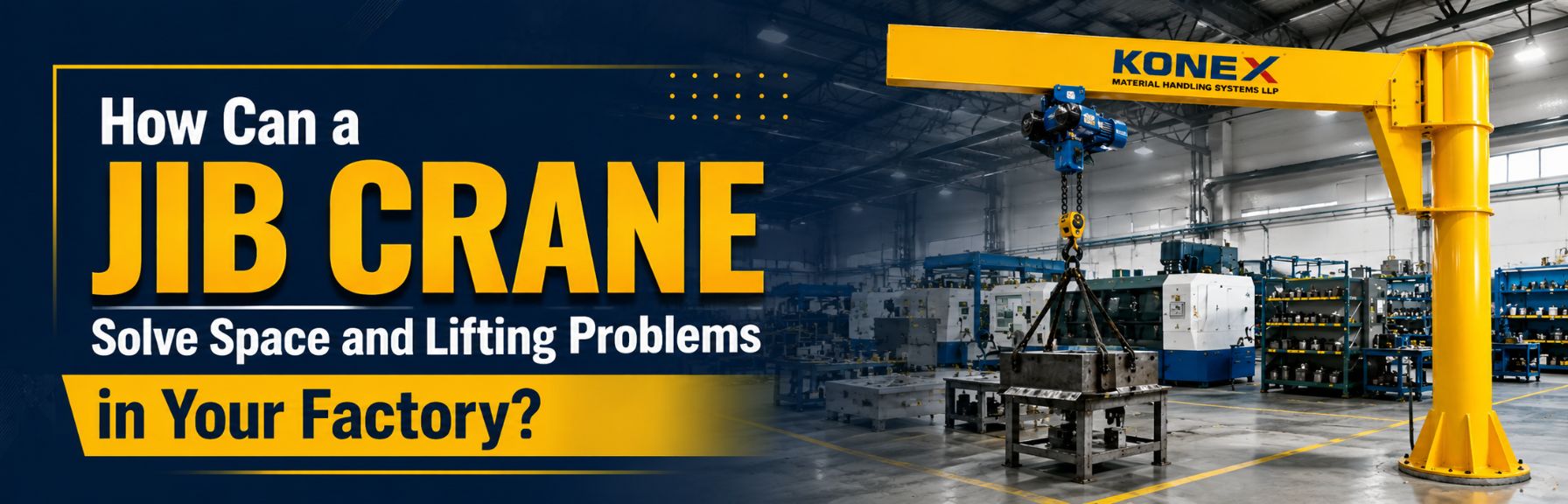
How Can a JIB Crane Solve Space and Lifting Problems in Your Factory?
In a busy factory, lifting problems are not always caused by the weight of the material. Often, the bigger problem is where the lifting has to happen.
A production team may need to lift a component beside a machine, move a fabricated part at a workstation, position a tool during maintenance, or transfer material within a small working area. If the available lifting equipment is located somewhere else in the factory, every small lifting task can involve extra movement, waiting, manual effort, or floor congestion.
This is where a JIB Crane can become a practical material handling solution.
A JIB Crane provides a dedicated lifting point around a defined work area. Instead of moving every load to a large crane or using floor-based equipment for localized tasks, the lifting process can be brought closer to where the work actually takes place.
For factories dealing with limited floor space, repeated lifting, machine loading, material movement, or workstation delays, the right JIB Crane can help create a more organized and efficient handling process.
This guide explains the problems a JIB Crane can help solve, where it makes sense to use one, and what industrial buyers should consider before approaching a JIB Crane Manufacturer.
What Factory Problems Can a JIB Crane Help Solve?
A JIB Crane is most useful when the lifting requirement is concentrated around a particular area rather than across the entire factory.
Consider a machine operator who regularly needs to move heavy components into position. If the factory’s main overhead crane is being used elsewhere, the operator may have to wait. If a forklift is used instead, it may need access through a busy production area. If the material is moved manually, the task may become difficult or unsuitable for the available workforce.
A dedicated lifting point can change this workflow.
A JIB Crane can help address problems such as:
- Limited working space around machines
- Repeated lifting at the same workstation
- Dependence on a shared overhead crane
- Unnecessary movement of materials across the factory
- Difficult machine loading and unloading
- Manual handling of heavy components
- Congestion caused by floor-based handling equipment
- Lifting requirements in maintenance and fabrication areas
The key point is that a JIB Crane does not need to replace every other material handling system in a factory. It can instead support specific lifting activities where a dedicated solution makes practical sense.
How Does a JIB Crane Help When Factory Space Is Limited?
Factory space is valuable.
Adding more equipment to an already crowded production area can make movement more difficult. Machines, raw materials, racks, workstations, operators, trolleys, and finished products all compete for the same floor area.
This is why the physical footprint of a lifting solution matters.
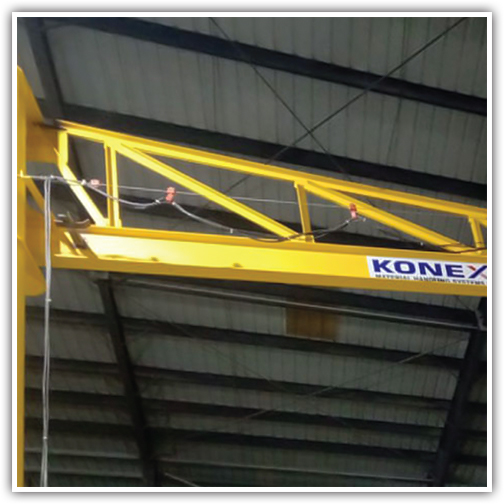
A JIB Crane is designed around a defined working area. Depending on the factory layout, a wall-mounted or pillar-mounted arrangement can provide lifting support without requiring the same type of floor coverage associated with mobile handling equipment.
The objective is simple:
Use the available factory space for production while placing lifting capability where it is actually required.
For example, a workstation beside a structural wall may benefit from a wall-mounted arrangement, while an open production area may require a pillar-mounted solution.
The right choice depends on the existing layout and the movement required around the workstation.
Why Localized Lifting Can Be Better Than Moving Materials Across the Factory
Imagine a component arriving at a machine station.
If the nearest suitable lifting equipment is several metres away, the component must first be transported to that location or the lifting equipment must be brought to the component.
Both approaches add movement.
With a suitable JIB Crane positioned near the workstation, the lifting activity can happen closer to the point of use.
This can help simplify the sequence:
Bring material to the workstation → lift → position → continue production
rather than:
Move material → find available lifting equipment → lift → move again → return to workstation
The difference may appear small for one operation, but repeated handling tasks are where workflow improvements become more noticeable.
5 Factory Problems a JIB Crane Can Help You Solve
1. Your Main Crane Is Often Busy
If production teams regularly wait for an overhead crane to become available for small lifting activities, there may be an opportunity for a dedicated workstation lifting solution.
A JIB Crane can handle suitable localized tasks while the main crane remains available for movements that genuinely require broader coverage.
The result is better separation between general factory lifting and workstation lifting.
2. Workers Are Handling Heavy Materials Manually
Manual material handling can become difficult when components need to be lifted, positioned, or repeatedly moved.
Instead of expecting workers to perform every part of the handling process manually, a suitable lifting system can provide mechanical assistance.
This is particularly relevant for:
- Machine components
- Fabricated parts
- Tools
- Fixtures
- Dies
- Equipment parts
- Assembly components
The aim is not simply to reduce physical effort. It is to create a more consistent way of moving materials around the workstation.
3. Forklift Movement Is Difficult in Crowded Areas
Forklifts are useful for many material handling applications, but they require suitable movement space.
In a congested workstation, introducing additional vehicle movement may not always be the most convenient approach.
Where the lifting requirement is localized, a JIB Crane can provide an alternative way to handle suitable loads without moving a forklift through every workstation.
This can be especially relevant in machine shops, fabrication areas, maintenance workshops, and assembly environments.
4. Materials Travel Too Far Before They Can Be Lifted
A material handling process should ideally support the production process rather than create unnecessary movement.
If materials repeatedly travel away from the workstation simply because the nearest lifting point is too far away, it is worth reviewing the layout.
A JIB Crane can bring the lifting point closer to the operation.
This can be useful where the same lifting activity occurs repeatedly at a fixed location.
5. One Workstation Needs Repeated Lifting Support
Sometimes the problem is not factory-wide.
One particular workstation may simply require lifting assistance several times every day.
In such cases, installing a large lifting system across the entire factory may not be the only option worth considering.
A dedicated JIB Crane can be evaluated as a focused solution for that specific workstation.
This approach allows the buyer to start with the actual operational problem instead of automatically selecting the largest available lifting system.
Where Can a JIB Crane Be Used in a Factory?
The usefulness of a JIB Crane depends on the application, but several industrial areas can benefit from localized lifting.
Manufacturing Workstations
Manufacturing operations often involve components that need to be positioned at machines or workbenches.
A JIB Crane can provide lifting support close to the point where the component is used.
Fabrication Areas
Fabrication work frequently involves moving and positioning metal components during production.
A suitable JIB Crane can support localized handling around fabrication workstations.
Machine Shops
Machine loading and unloading can involve repeated handling of components, fixtures, tools, or other materials.
A dedicated lifting point can make these operations easier to organize.
Maintenance Workshops
Maintenance teams may need to remove or position machine components during repair activities.
A JIB Crane located near a maintenance workstation can provide useful lifting assistance for suitable applications.
Assembly Areas
Assembly work often requires components to be positioned at specific locations.
Localized lifting can support this process without requiring a factory-wide crane for every individual operation.
Warehousing and Material Handling Areas
Certain warehouse activities may also require dedicated lifting around packing, inspection, repair, or loading points.
The important consideration is whether the lifting requirement is concentrated within a defined working area.
When Should You Consider a JIB Crane Instead of a Larger Crane?
A common purchasing mistake is selecting lifting equipment based only on the maximum load.
The better starting point is understanding the movement required.
A JIB Crane may be worth considering when:
- The lifting requirement is concentrated around one workstation.
- Materials do not need to travel across the entire factory.
- Operators repeatedly need lifting assistance in the same area.
- A shared overhead crane is being used for small localized tasks.
- Floor space is limited.
- Machine loading or unloading requires regular lifting.
- Maintenance teams need a dedicated lifting point.
- You want to reduce unnecessary material movement.
A larger overhead crane may be more appropriate when materials need to move across a wider production area.
Similarly, a Gantry Crane may be considered for applications where the required movement and workspace are different from a fixed workstation lifting arrangement.
The right material handling solution is therefore determined by the problem you are trying to solve, not simply by the equipment category.
How to Choose a JIB Crane for Your Factory's Actual Problem
Before purchasing, walk through the lifting process from beginning to end.
Ask these questions:
Where does the load start?
Identify the pickup location.
Where does it need to go?
Identify the final position.
How often does the movement happen?
Look at the frequency of the task.
Who performs the operation?
Understand how operators currently handle the material.
What equipment is being used today?
Is it manual handling, a forklift, an overhead crane, trolley, or another method?
What is causing the biggest difficulty?
This could be waiting, movement, space, access, or handling effort.
Could a dedicated lifting point make the process simpler?
If the answer is yes, a JIB Crane may be worth evaluating.
This approach helps avoid buying equipment simply because it is popular or because another factory uses it.
Why Konex Can Be Considered for Your JIB Crane Requirement
Konex Material Handling System LLP is an India-based material handling equipment company serving industrial customers.
For a JIB Crane requirement, the focus should be on understanding the customer’s actual lifting application rather than recommending a solution based only on a standard product description.
Whether the requirement is related to a manufacturing workstation, fabrication area, machine handling, maintenance activity, or another localized application, the buyer should be able to discuss the available space and material movement with the supplier.
Konex can support this application-focused approach for customers in India and for international projects where its material handling solutions are required.
For buyers who are still comparing options, it is useful to request a discussion based on the actual workplace problem, including the material movement, working area, and current handling method.
Final Thoughts: Solve the Lifting Problem Before Adding More Equipment
A factory does not always need a larger crane to solve a lifting problem.
Sometimes, the issue is simply that the available lifting equipment is not located where the work happens.
A JIB Crane can provide a dedicated lifting point close to a machine, workstation, maintenance area, fabrication station, or other defined working zone.
It can be particularly useful when a factory is dealing with limited space, repeated lifting, dependence on shared cranes, unnecessary material movement, or difficult workstation handling.
The right decision starts with a simple question:
Need a JIB Crane for Your Factory?
Share your lifting requirement, application area, current handling method, and available workspace with Konex Material Handling System LLP.
The team can review your requirement and help you evaluate a suitable JIB Crane solution for your factory.
Request a JIB Crane Quote from Konex Material Handling System LLP and discuss your application with the material handling team.
Contact us : info@konex.co.in , +91 98240 11164 | +91 90999 02956
FAQs
A JIB Crane provides a dedicated lifting point near a specific workstation, machine, fabrication area, or maintenance zone. It can help reduce manual handling, unnecessary material movement, waiting for a shared overhead crane, and lifting-related workflow delays.
Yes. A JIB Crane can be a practical option where floor space is limited because it provides localized lifting within a defined working area. Depending on the factory layout, a wall-mounted or pillar-mounted JIB Crane can be selected to suit the available space and required load movement.
The main advantage is localized lifting. A JIB Crane is designed to serve a specific working area, while an overhead crane generally provides broader coverage across a factory bay. A JIB Crane can therefore handle repetitive workstation lifting tasks while the main overhead crane remains available for larger or longer-distance material movements.
Konex Material Handling System LLP is a specialized JIB Crane Manufacturer based in India, focusing exclusively on engineering heavy-duty, pillar-mounted lifting systems. Konex supplies customized freestanding cranes across India’s industrial hubs and exports internationally to meet global manufacturing and safety standards.
JIB Cranes are commonly used in manufacturing workstations, machine shops, fabrication areas, maintenance workshops, assembly stations, warehouses, and material handling zones. They are particularly useful when lifting activities are concentrated around a fixed workstation or defined operating area.
A wall-mounted JIB Crane is attached to a suitable structural wall, column, or supporting structure and can be useful where floor space is restricted. A pillar-mounted JIB Crane is supported by a dedicated pillar or column and can be suitable for open production areas where an independent lifting point is required. The appropriate configuration depends on the building structure, load, reach, lifting height, and workspace.
Yes. A JIB Crane can be used for suitable machine loading and unloading applications where components or equipment need to be lifted and positioned within the crane’s working radius. It can bring the lifting point closer to the machine and help reduce unnecessary movement between the machine and distant lifting equipment.
A factory should consider a JIB Crane when lifting is repeatedly required at the same workstation, the main crane is frequently occupied, manual handling is difficult, forklift movement is inconvenient, or materials are being moved unnecessarily to reach available lifting equipment. The decision should be based on the actual lifting application, workspace, load, frequency, and required movement.
Important factors include load capacity, lifting height, horizontal reach, working radius, lifting frequency, available floor and overhead space, mounting arrangement, structural support, operating environment, and the type of hoist required. Buyers should also consider how the load moves from pickup to final position before selecting the crane configuration.
Yes. A JIB Crane can complement an existing EOT Crane, forklift, gantry crane, or other material handling equipment when each system is assigned to suitable tasks. For example, an EOT Crane can handle wider-area material movement while a JIB Crane handles repetitive lifting at a specific workstation.
Start by identifying the load weight, lifting frequency, pickup and drop-off points, required reach, lifting height, available workspace, and current handling method. Sharing these details with a JIB Crane Manufacturer can help determine whether a wall-mounted or pillar-mounted configuration and which lifting arrangement are appropriate for the application. For a customized requirement, you can discuss the application with Konex Material Handling System LLP and request a JIB Crane quote.