

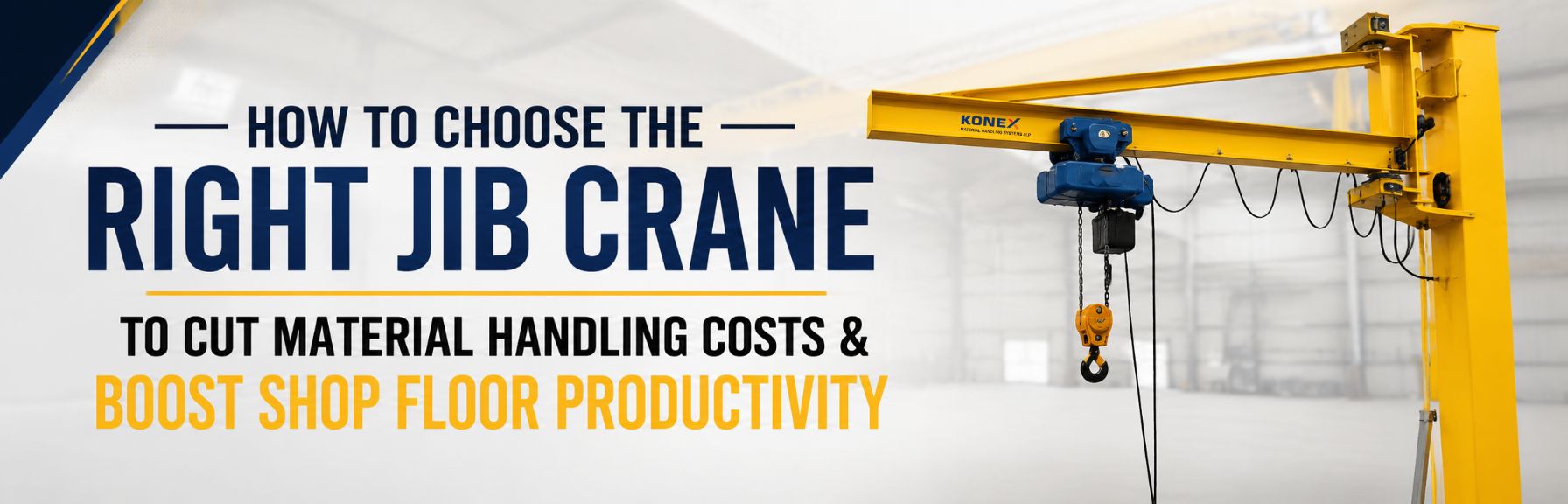
How to Select the Right JIB Crane to Cut Material Handling Costs and Boost Shop Floor Productivity
In modern industrial manufacturing, profitability is rarely lost during actual processing or machining time. Instead, margins are eroded during routine operational delays—when high-capital CNC machines sit idle, skilled operators wait for material handling equipment, or delicate components suffer accidental damage during manual handling.
When a heavy metal casting, precision component, or molding die needs to be loaded into a work center, relying exclusively on a single building-wide overhead crane creates an immediate bottleneck. Operators lose valuable production time, delivery schedules slip, and labor costs rise without adding value to the finished product.
Installing a dedicated JIB Crane at essential work centers resolves these costly workflow delays. Designed specifically for high-frequency, localized material movement, an ergonomic workstation crane empowers operators to move materials independently, safely, and without delay.
As a trusted JIB Crane Manufacturer based in India with extensive global export capabilities, Konex Material Handling System LLP partners with manufacturing enterprises to optimize facility workflows. In this comprehensive guide, we examine how plant managers, operations leaders, and procurement heads can evaluate their facility layout to choose the right lifting equipment, eliminate material handling bottlenecks, and achieve a rapid return on investment.
The True Cost of Material Handling Bottlenecks on the Shop Floor
Before selecting equipment configurations, plant leaders should evaluate the hidden costs that inefficient material handling imposes on factory output. On many production floors, delayed or manual material movement represents a significant unmeasured loss.
+-----------------------------------------------------------------------------------+
|               THE FOUR HIDDEN COSTS OF WORKSTATION MATERIAL DELAYS                |
+-----------------------------------------------------------------------------------+
|  1. Skilled Operator Downtime  -> Personnel waiting for shared main hall cranes   |
|  2. Idle Machinery Capacity    -> Capital-intensive CNCs sitting unoperated       |
|  3. Workpiece Surface Damage   -> Scratches and dents from manual handling moves   |
|  4. Ergonomic Strain & Fatigue -> Physical fatigue leading to reduced shift output |
+-----------------------------------------------------------------------------------+
The Challenge of Shared Overhead Cranes
In a typical manufacturing bay, a single heavy-duty overhead crane services an entire 50-to-100-meter hall. When multiple machine operators require lifting support at the same time, a queue forms. If five operators lose just 12 minutes per shift waiting for the primary crane, your plant loses a full hour of skilled labor every shift. Over a multi-shift operational year, that translates to hundreds of lost production hours per workstation.
Worker Safety and Ergonomic Well-being
Forcing workers to manually position heavy parts or use temporary lifting arrangements increases physical strain and injury risks. Fatigue impacts operator speed toward the end of a shift and contributes to preventable workplace absenteeism.
Protecting High-Value Workpieces and Tooling
Precision parts, injection molds, and specialized tooling require steady, controlled handling. Hurried manual moves or improper lifting angles increase the risk of dropped loads, surface blemishes, and costly rework.
What Is a JIB Crane and How Does It Transform Factory Workflows?
When most procurement managers look for a Jib Crane India supplier, they start with a simple question: “What is the heaviest single item we manufacture?”
If the answer is 1.5 tons, they automatically assume they need a 1.5-ton crane. This is a dangerous misconception.
In industrial material handling, Capacity ≠ Load Weight.
Your crane does not just lift your product. It lifts everything attached to the product to make the lift possible. To calculate the actual capacity your factory needs, you must use the Total Lifted Load (TLL) formula.
      +-----------------------------------+
                      |      PRIMARY OVERHEAD EOT CRANE   |
                      |   (Bay-Wide Bulk Material Handling) |
                      +-----------------------------------+
                                        |
             +--------------------------+--------------------------+
             |                                                     |
  +----------------------+                               +----------------------+
  |    WORKSTATION A     |                               |    WORKSTATION B     |
  | [ PILLAR JIB CRANE ] |                               | [ PILLAR JIB CRANE ] |
  |  360° Localized Lift |                               |  360° Localized Lift |
  +----------------------+                               +----------------------+
Key Operational Advantages:
- Operator Independence: Machine operators manage their immediate work zone without waiting for floor-wide material handling crews or primary bridge cranes.
- Optimized Floor Space: Compact design delivers strong lifting performance while taking up minimal floor space or utilizing existing support columns.
- Faster Production Cycles: Streamlines machine loading and unloading, helping boost daily output across critical production cells.
- Capital-Efficient Upgrade: Delivers targeted lifting capability at a fraction of the cost of adding a second heavy bridge crane.
For industrial facilities planning layout upgrades, explore how our custom material handling solutions can be configured to match your specific plant layout and production goals.
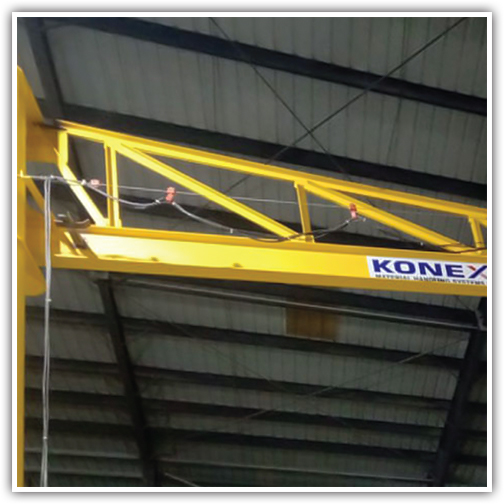
Why Specialized Pillar Systems Outperform Other Workstation Lifting Solutions
While various localized lifting devices exist in the industrial market, freestanding pillar-mounted systems are widely recognized as the gold standard for heavy-duty, versatile workstation material handling.
+---------------------------------------------------------------------------------------------------+
|                        PILLAR-MOUNTED JIB CRANE ADVANTAGES ON THE SHOP FLOOR                      |
+---------------------------------------------------------------------------------------------------+
| Advantage            | Operational Impact                                                         |
+----------------------+----------------------------------------------------------------------------+
| 360° Rotation Arc    | Complete circular coverage for multi-machine loading & pallet staging      |
| Standalone Pillar    | Independent of facility walls; can be placed in island cells & open bays  |
| High Load Capacity   | Superior structural stability for handling heavy components and dies      |
| Tailored Dimensions  | Custom heights and boom reaches tailored to exact machinery clearances    |
+---------------------------------------------------------------------------------------------------+
Layout Flexibility in Open Bays
Because a pillar crane relies on its own robust vertical steel column anchored into the floor foundation, it can be installed in open bays, center-floor assembly islands, and outdoor material receiving zones—locations where building walls or structural columns are out of reach.
Superior Rotation and Coverage
Unlike wall-mounted systems that are restricted to a 180-degree semi-circle, a freestanding pillar unit offers up to a full 360-degree rotation arc. This allows a single crane to service multiple adjacent CNC machines, assembly tables, and material staging pallets positioned all around its central column.
High Stability for Heavy Workpieces
Freestanding pillar designs transfer rotational forces directly into the foundation slab. This solid structural configuration provides exceptional stability for heavier load capacities, making it the preferred choice for machine shop loading, mold changing, and heavy fabrication cells.
At Konex Material Handling System LLP, our dedicated manufacturing focus on pillar-mounted designs allows us to perfect column rigidity, smooth rotational movement, and long-term operating durability.
A Step-by-Step Selection Guide for Operations Leaders
To ensure your equipment investment delivers long-term productivity and safety, follow this practical 5-step decision framework when planning your purchase.
 STEP 1: Define Working Radius & Usable Rotation Reach
    │
  STEP 2: Right-Size Load Capacity & Operational Frequency
    │
  STEP 3: Evaluate Floor Foundation & Concrete Readiness
    │
  STEP 4: Choose Rotation Control (Manual vs. Motorized Slewing)
    │
  STEP 5: Pair with the Ideal Hoist & Control Package
Step 1: Define Working Radius and Operational Reach
Map out the full movement area required at the workstation.
- Arm Reach: Ensure the boom length covers all pick-up points (pallets, staging tables, carts) and load points (machine chucks, assembly fixtures).
- Clearance Planning: Check for potential overhead obstacles like lighting fixtures, piping, ventilation ducts, or overhead crane tracks.
Step 2: Right-Size Weight Capacity and Operational Frequency
Select a weight rating that comfortably handles your heaviest routine workpieces without over-specifying equipment requirements.
- Weight Rating: Standard workstation capacity ranges from 250 kg to 5,000 kg. Be sure to include the weight of lifting clamps, spreaders, or specialized grabs in your calculations.
- Usage Frequency: Determine how many lifts occur per hour. High-frequency operations require robust gear systems and hoist motors built for continuous daily use.
Step 3: Evaluate Building Support and Foundation Readiness
Your factory structure dictates the safest and most efficient installation approach.
- For Freestanding Units: Ensure the floor slab meets recommended concrete depth and quality criteria to support vertical loads and turning forces safely.
- For Wall-Mounted Units: Confirm that structural building columns can handle the cantilever loads and torque exerted by a fully loaded arm.
Step 4: Choose Rotation Movement (Manual vs. Motorized)
Determine how the horizontal arm should move across its path:
- Manual Rotation: Ideal for lighter loads (under 1,000 kg) and standard boom lengths where smooth manual push/pull movement requires minimal operator effort.
- Motorized Rotation: Recommended for heavier loads, long boom reaches, or precision positioning tasks where smooth motor control prevents load swing and worker fatigue.
Step 5: Select the Right Hoist and Control Features
While the swing arm provides horizontal reach, the hoist handles vertical lifting and positioning accuracy.
- Electric Chain Hoists: The industry standard for smooth, reliable, and efficient lifting. Read our detailed guide on selecting the right hoist for workstation efficiency to find the ideal match for your operation.
- Dual-Speed Controls: Essential for delicate positioning tasks—such as setting heavy dies or mounting precision shafts—where micro-adjustments prevent surface impact.
- Pneumatic / Air Hoists: Ideal for rapid repetitive moves or specialized areas like spray booths and chemical preparation zones.
Financial ROI: Quantifying the Value of Localised Lifting
Investing in dedicated workstation lifting equipment is a high-return operational decision. Manufacturing companies deploying a quality JIB Crane in India or across international markets experience fast payback through measurable cost savings:
+-----------------------------------------------------------------------------------+
|                        FINANCIAL RETURN ON INVESTMENT (ROI)                        |
+-----------------------------------------------------------------------------------+
|  Direct Operational Savings:                                                      |
|  • Reduction in operator waiting time and machine idle hours                     |
|  • Decreased component scrap and rework costs from controlled handling           |
|  • Lower electricity consumption (1-3 kW workstation hoist vs 15-40 kW main crane)|
|                                                                                   |
|  Long-Term Business Benefits:                                                     |
|  • Extended operational lifespan for primary hall bridge cranes                   |
|  • Enhanced operator safety and reduced strain-related absenteeism               |
|  • Higher overall equipment effectiveness (OEE) across production cells           |
+-----------------------------------------------------------------------------------+
Operational Example:
- Scenario: A machining cell operator loses 20 minutes per shift waiting for the main building crane to load heavy components.
- Annual Impact: Across a multi-shift operating year, hundreds of valuable machine hours are lost per workstation.
- The Solution: Installing a dedicated workstation crane removes this bottleneck, reclaiming lost production hours and recovering equipment investment costs quickly.
Real-World Applications Across Industrial Sectors
Localized lifting equipment offers versatile support across a wide variety of industrial settings:
Precision Machining and Metal Fabrication
Operators use workstation cranes to transfer raw billets, plates, and machined components smoothly from staging pallets into CNC lathes, milling centers, and presses.
Automotive and Equipment Assembly
In assembly cells, dedicated cranes allow workers to handle gearboxes, engines, and heavy sub-assemblies smoothly without interrupting main bay workflow.
Toolroom, Die, and Mold Handling
Tooling departments rely on precision swing-arm units to lift, flip, and mount heavy stamping dies and injection molds gently with exact control.
Shipping, Staging, and Material Reception
Near packing stations and receiving docks, compact cranes simplify loading and unloading boxed goods, machinery sub-components, and heavy crates.
Why Partner with Konex Material Handling System LLP?
Maximizing factory productivity requires dependable equipment engineered for real-world production environments.
As a leading JIB Crane Manufacturer headquartered in India with robust export capabilities, Konex Material Handling System LLP provides custom material handling solutions designed for safety, operational longevity, and seamless shop floor integration.
----------------------------------------------------------------------+
   |                       THE KONEX ADVANTAGE                               |
   +-------------------------------------------------------------------------+
   |  • Dedicated Focus on Freestanding Pillar-Mounted Crane Systems          |
   |  • Robust Structural Steel Construction & High-Grade Components          |
   |  • Tailored Column Heights, Arm Reaches & Rotation Capabilities         |
   |  • Global Export Logistics & International Quality Compliance            |
   |  • Complete Support Lifecycle: Consultation, Design, Supply & Guidance |
   +-------------------------------------------------------------------------+
Tailored Engineering for Every Layout
Every manufacturing facility has unique structural conditions, height constraints, and operational goals. Our engineering team designs tailored solutions that maximize operational reach while integrating smoothly into your floor layout.
Built for Safety and Durability
Manufactured using high-strength structural steel and quality drive components, Konex lifting systems deliver smooth rotation, low deflection, and reliable long-term performance under demanding operating conditions.
Indian Manufacturing Excellence with Global Reach
Manufactured in India to international standards, Konex products serve industrial enterprises domestically and across worldwide markets. Learn more about our international capabilities on our global export standards page.
To explore our engineering heritage and product range, visit our About Konex page.
Pre-Procurement Assessment Checklist
Before selecting equipment for your facility, review this practical checklist with your plant engineering and operations team:
- [ ] Maximum Load Weight: What is the weight of the heaviest workpiece plus lifting attachments (slings, grabs, magnets)?
- [ ] Working Sweep Arc: Do you require a 180°, 200°, or full 360° rotational reach?
- [ ] Structural Support: Is a certified concrete floor slab or structural building column available at the work station?
- [ ] Height Clearances: What is the exact height to the lowest overhead obstruction (pipes, trusses, lights)?
- [ ] Speed & Control Needs: Does the application require standard movement speeds or dual-speed micro-positioning?
- [ ] Operating Environment: Are there special site requirements (outdoor use, high humidity, or cleanroom conditions)?
Transform Your Shop Floor Productivity with Konex
Decentralizing material movement at the workstation level is one of the most effective ways to eliminate plant bottlenecks, safeguard workforce safety, and lower operational costs. By selecting a workstation crane designed specifically for your facility layout, you transform idle waiting time into productive manufacturing output.
At Konex Material Handling System LLP, we build material handling solutions that keep your operations moving forward efficiently.
Ready to eliminate material handling bottlenecks and increase shop floor throughput?
Contact Konex Engineering Experts Today to discuss your layout requirements or request a custom quote tailored to your plant.
Contact us : info@konex.co.in , +91 98240 11164 | +91 90999 02956
FAQs
A pillar-mounted JIB crane is a freestanding workstation lifting system featuring a vertical steel column anchored to a floor foundation and a horizontal arm that rotates up to 360 degrees. It boosts shop floor productivity by providing dedicated, localized lifting at individual workstations. This eliminates machine operator downtime caused by waiting for shared main hall overhead cranes, keeping CNC machinery running continuously.
A freestanding pillar JIB crane offers full 360-degree rotation and complete structural independence. It can be installed anywhere on the factory floor, including open bay centers, island production cells, and outdoor loading docks, without relying on building support columns. In contrast, wall-mounted cranes are restricted to 180-degree rotation and must be anchored to existing structural building walls or columns.
Installing a workstation JIB crane cuts material handling costs in three primary ways:
- Reduces Labor & Machine Idle Time: Eliminates operator waiting time for central bay cranes.
- Prevents Material & Tooling Damage: Delivers controlled lifting that avoids scratches, dents, and scrap rework during CNC loading or die positioning.
- Lowers Energy Costs: Uses a compact 1–3 kW workstation hoist instead of powering a large 15–40 kW overhead bridge crane for localized lifting tasks.
Konex Material Handling System LLP is a specialized JIB Crane Manufacturer based in India, focusing exclusively on engineering heavy-duty, pillar-mounted lifting systems. Konex supplies customized freestanding cranes across India’s industrial hubs and exports internationally to meet global manufacturing and safety standards.
Pillar-mounted JIB cranes are available in standard load capacities ranging from 250 kg up to 5,000 kg (5 Tons) or more. Engineering factors such as boom reach, under-boom height, and specialized lifting attachments (e.g., magnetic lifters, vacuum lifters, or spreaders) are tailored based on total workpiece weight and duty cycle requirements.
A freestanding pillar JIB crane requires a reinforced concrete floor slab engineered to withstand dynamic overturning forces and load capacities. In facilities with standard industrial floor slabs, heavy-duty expansion anchor bolts or dedicated foundation pads are used to ensure rigid column stability and maximum operational safety.
- Manual Rotation: The operator manually pushes or pulls the load arm. This option is ideal for lighter capacities (under 1,000 kg) and shorter arm spans where manual effort is minimal.
- Motorized Slewing: An electric motor drives the rotational gear mechanism. This is recommended for heavy loads, extended arm reaches, or precise positioning applications where smooth, effortless rotation is required.
Plant managers and procurement leads should evaluate five essential factors before purchasing:
- Operating Radius: The horizontal length required to reach all staging and machine beds.
- Under-Boom Height: Vertical clearance beneath the arm and hoist.
- Weight Capacity: Maximum load weight including lifting tackle and fixtures.
- Concrete Foundation Condition: Depth and strength of the floor slab.
- Lift Speed & Control: Dual-speed controls for delicate tool setting or standard single-speed for basic transfers.
A workstation JIB crane eliminates dangerous manual lifting, twisting, and strain-heavy positioning by transferring the entire weight load to an electrically powered hoist and rotation arm. This protects operators from repetitive motion injuries, spinal strain, and fatigue, leading to higher shift productivity and lower absenteeism.
Yes. Konex Material Handling System LLP custom engineers pillar-mounted JIB cranes to meet specific global layout dimensions, voltage standards, and industrial safety certifications. Konex provides complete export logistics support for international clients across manufacturing, assembly, and heavy engineering industries worldwide.