

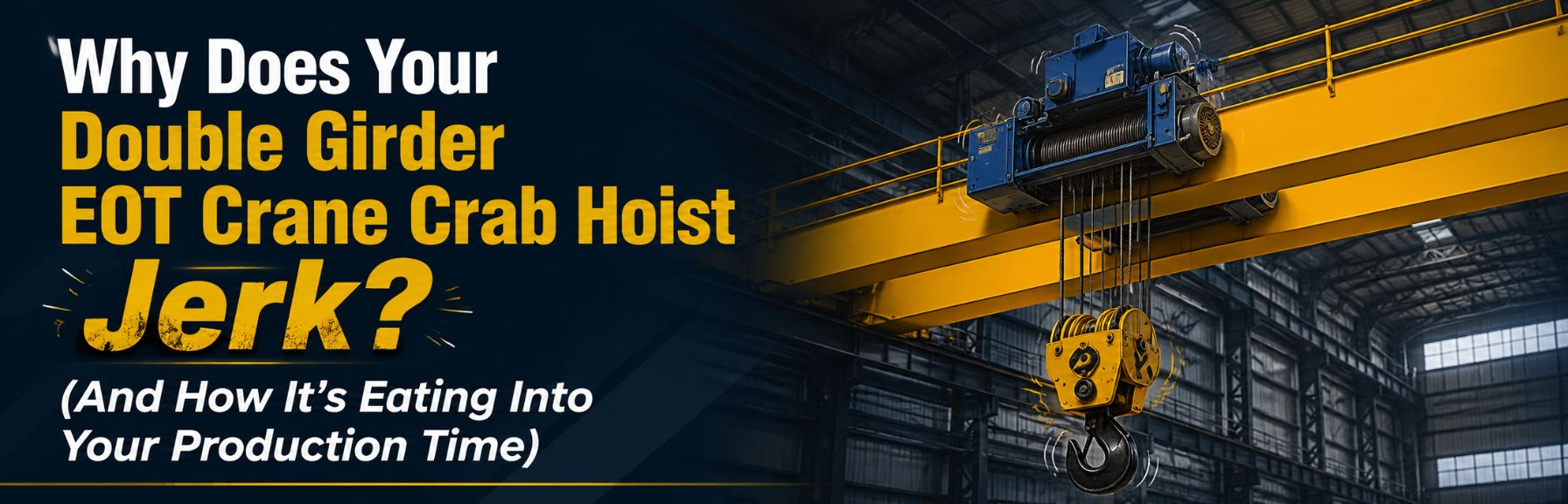
Why Does Your Double Girder EOT Crane Crab Hoist Jerk? (And How It’s Eating Into Your Production Time)
In any high-capacity manufacturing plant, assembly unit, or heavy engineering facility, the smooth flow of materials is the heartbeat of your operations. When you rely on a heavy-duty Double Girder EOT Crane to lift, move, and position loads weighing several tons, you expect precision, stability, and absolute reliability.
But what happens when that smooth operation is interrupted by a sudden, violent jerk as the crab hoist starts, travels, or stops?
At first glance, a slight shudder or a minor jerk in the crab assembly might seem like a small operational nuance—something your operators can “work around.” However, in the fast-paced world of industrial material handling, a jerking crab hoist is a flashing warning light. It is a symptom of underlying mechanical or electrical stress that, if left unaddressed, will directly eat into your daily production time, compromise worker safety, and lead to expensive emergency repairs.
As a leading Double Girder EOT Crane Manufacturer, we at Konex Material Handling System LLP have spent years helping industries across India and in global markets optimise their lifting operations. In this guide, we will break down exactly why your crab hoist is jerking, how this silent productivity killer impacts your bottom line, and the practical steps you can take to restore smooth, profitable operations.
The Danger of the "Jerk": Why Smooth Movement Matters
A Double Girder EOT Crane is designed specifically for high-capacity, heavy-duty applications where precision positioning is critical. Unlike single girder setups, the crab hoist (the trolley unit carrying the hoisting machinery) travels on top of the two parallel girders. This structure allows for maximum lift height and excellent stability.
When the crab hoist operates smoothly, your shop floor runs like clockwork. Loads are picked up cleanly, moved across the bay without swaying, and placed with millimetre-level accuracy.
However, when a jerk occurs:
- Dynamic Shock Loading increases: A sudden lurch can instantly double or triple the physical force exerted on the wire ropes, drum, and structural girders.
- Load swaying is triggered: A jerky start or stop causes the suspended load to swing like a pendulum, forcing the operator to wait for the movement to die down before placing the load.
- Operator fatigue sets in: Dealing with an unpredictable crane forces operators to slow down their work, resulting in longer cycle times and lower hourly output.
If your plant is experiencing this issue, you are not alone. Let’s dive into the core reasons behind this frustrating problem.
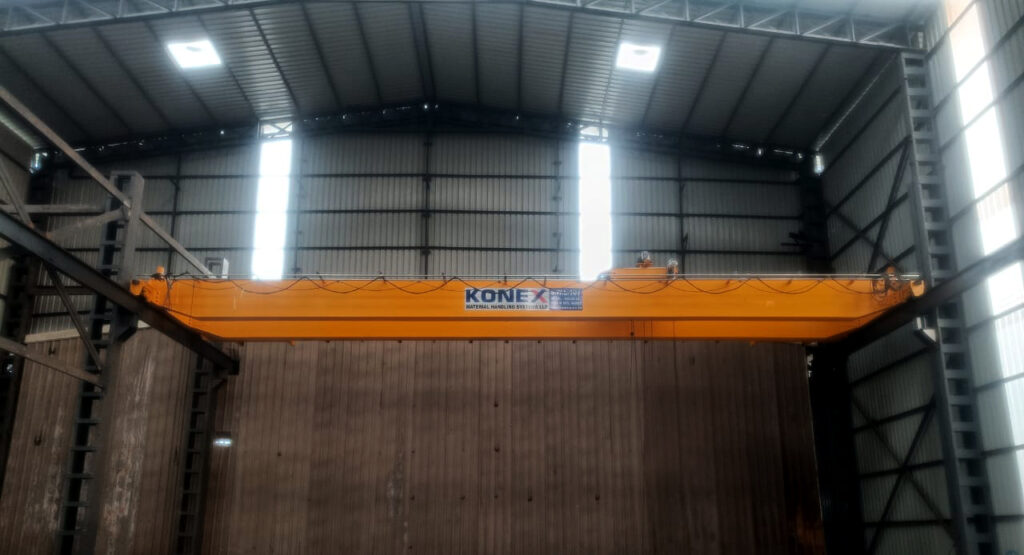
5 Common Reasons Your Double Girder EOT Crane Crab Hoist is Jerking
Identifying the root cause of a jerking crab hoist doesn’t require you to be a design engineer. Most issues fall into a few distinct, easily understandable categories. Here is what is likely happening on your crane runway:
1. Inconsistent Power Delivery and VFD Settings
Modern cranes rely heavily on Variable Frequency Drives (VFDs) to control the speed of the travel motors. The VFD is responsible for providing a smooth “ramp-up” (accelerating from a standstill) and “ramp-down” (decelerating to a stop).
- The Problem: If the VFD parameters are incorrectly calibrated, or if there is a sudden voltage fluctuation in your factory’s power supply, the motor receives uneven current. This causes the motor to hunt for torque, resulting in rapid, jerky movements as it struggles to maintain steady speed.
- The Indian Context: As an experienced EOT Crane Manufacturer India, we frequently see this issue in factories where localized power grids experience frequent voltage drops. Without stable input power or a properly tuned VFD, even the most robust crane will exhibit erratic travel behaviour.
2. Misaligned Crab Runway Tracks and Wheel Wear
Just as a train requires perfectly parallel tracks to run smoothly, the crab hoist relies on the rails mounted on top of the double girders to be straight, level, and clean.
- The Problem: Over months of heavy material handling, structural vibrations or loose mounting bolts can cause these crab tracks to shift slightly out of alignment. If the span between the tracks narrows or widens even by a few millimetres, the crab wheels will bind, slip, and then suddenly “pop” forward. This mechanical binding is felt on the shop floor as a harsh, repetitive jerk.
- What to Look For: Check your crab wheels. If you notice uneven wear on the wheel flanges or shiny metal shavings along the rail head, your tracks are almost certainly misaligned.
3. Brake Slippage and Maladjustment
The braking system on your crab travel motor is designed to bring the lateral movement to a controlled, smooth halt.
- The Problem: If the brakes are set too tight, the crab will stop instantly with a violent shudder, causing the load to swing dangerously. Conversely, if the brakes are too loose, or if the brake linings are contaminated with grease and dust, the wheels will slip before the brakes suddenly grabs. This slip-and-grab cycle creates an incredibly jerky deceleration process.
- Environmental Factors: In dusty or high-humidity manufacturing zones in India, airborne particles can quickly build up inside the brake assembly, accelerating lining wear and leading to sticky, erratic braking behaviour.
4. Backlash in the Gearbox and Worn Couplings
The rotational power of the travel motor is transferred to the crab wheels through a series of gears and couplings.
- The Problem: Over years of continuous operation, the spaces between mating gear teeth (known as backlash) can widen due to natural wear and tear or poor lubrication. When the operator starts the crab or reverses its direction, the motor spins briefly before the gear teeth slam into contact. This sudden impact sends a heavy shockwave through the entire crab assembly, appearing as a sharp jerk.
- Coupling Failure: Similarly, worn-out rubber inserts in flexible couplings lose their dampening capability, translating sudden motor starts directly into mechanical jolts.
5. Wire Rope Spooling and Guide Issues
While crab travel jerking is usually a lateral movement issue, a jerk during the lifting or lowering cycle is tied directly to the hoisting mechanism itself.
- The Problem: If the wire rope does not spool neatly into the grooves of the rope drum—often due to a damaged rope guide or improper initial tensioning—the rope can overlap on itself. As the load is lifted, the overlapped rope suddenly slips off the high spot back into its groove, causing the hook (and the load) to drop slightly and jerk violently.
How a Jerking Crane is Eating Into Your Production Time (And Your Profits)
It is easy to overlook a jerky crane when production deadlines are tight. However, ignoring this issue is a classic case of being “penny-wise and pound-foolish.” Here is a direct look at how a jerking crab hoist quietly drains your plant’s profitability:
[ Jerking Crab Hoist ]
│
├─► Unplanned Micro-Stoppages (Operators slowing down to control load swing)
│
├─► Accelerated Mechanical Wear (Premature failure of gears, wheels, and ropes)
│
├─► High Structural Stress (Micro-cracks in the girder welds)
│
└─► Sudden, Costly Downtime (Total operational halt during peak production)
The Slow-Down Effect (Cycle Time Inflation)
When a crane jerks, the load sways. Your operator cannot safely move a swaying load over expensive machinery or near workers. They are forced to wait for the swing to subside before they can position and lower the hook.
- If every lift takes just 30 seconds longer due to load stabilization, and your crane performs 100 lifts per day, you are losing nearly an hour of pure production time every single day. Over a year, that translates to weeks of lost manufacturing capacity.
The Cost of Premature Component Failure
A jerking motion is essentially a series of mini-collisions happening inside your machine. The shockwaves travel directly through:
- The Gearbox: Leading to chipped teeth and housing cracks.
- The Wheels & Bearings: Causing flat spots and premature bearing seizure.
- The Girders: Creating structural stress on the main welds of your Double Girder EOT Crane.
Replacing these parts out of schedule means unexpected spare parts costs and, worse, unscheduled maintenance downtime that halts your entire production line.
Heightened Safety Hazards
In the B2B industrial sector, safety is directly tied to productivity. A major safety incident can shut down a facility for days, trigger regulatory investigations, and destroy worker morale. A jerking crane increases the risk of dropped loads, rigging failures, and collisions with structures or personnel.
The Plant Manager’s 10-Minute Diagnostic Checklist
Before calling in external service engineers, your maintenance team can perform a quick, non-technical visual inspection to narrow down the source of the jerk. Use this checklist during your next planned break:
- Observe the Startup: Have the operator start the empty crab hoist at a low speed. Does the jerk happen the exact millisecond the motor turns on? If yes, look into VFD ramp settings or gearbox backlash.
- Listen to the Track: Stand at a safe distance on the walkway and listen as the crab travels the length of the girders. Do you hear loud scraping, grinding, or squeaking noises at specific spots? If yes, suspect rail misalignment or flange-to-rail friction.
- Check the Dust: Look at the top of the double girders. Is there an unusual accumulation of fine black powder near the rails? This is a clear sign of wheel shaving caused by tracking issues.
- Test the Stop: Bring the crab to a halt. Does it slide smoothly to a stop, or does it “nose-dive” immediately? If the stop is violent, your travel brakes are adjusted too tightly.
- Examine the Lubrication: Look at the open gears and wheel pinions. Are they dry and caked with dirt, or is there a healthy, clean coat of grease? Lack of lubrication is a primary trigger for jerky mechanical stick-slip.
Prevention Over Cure: How to Maintain a Smooth Glide
Ensuring your EOT Crane India operates without jerks requires a transition from reactive “breakdown maintenance” to proactive, preventive care. Here are the core strategies to implement in your factory:
- Establish a Strict Lubrication Routine: Ensure that the crab travel gears, wheel bearings, and rope drum guides are lubricated with the correct grade of industrial grease at specified intervals.
- Schedule Annual Rail Alignment Audits: Rely on your Double Girder EOT Crane Manufacturer to perform laser-guided rail alignment checks. Even a minor structural shift in your factory building due to soil settling can throw your crane tracks out of true alignment.
- Invest in Operator Training: Teach operators to avoid “plugging” (suddenly reversing the motor direction to stop the crane) and excessive “inching” (repeatedly tapping the control buttons to make tiny movements). Modern crane systems are robust, but abusive operating habits will wear out contactors and brakes prematurely, leading to jerky controls.
Partnering with the Right EOT Crane Manufacturer India
The reliability of your overhead crane starts long before it is installed on your shop floor. It begins during the engineering, design, and manufacturing stages. If a crane is designed with substandard structural tolerances, under-powered motors, or cheap electrical controls, no amount of maintenance will ever make it run completely smooth.
When you partner with an established Double Girder EOT Crane Manufacturer like Konex Material Handling System LLP, you are investing in decades of engineering excellence.
Why Indian and Global Industries Trust Konex:
- Precision Engineering: We design our crab assemblies with precision-machined wheels and perfectly aligned axles, ensuring friction is kept to an absolute minimum.
- Premium Electricals: Our cranes are equipped with high-grade VFDs and heavy-duty motors designed specifically to handle the challenging voltage conditions often found in industrial areas across India and export markets.
- Robust Structural Design: We use advanced welding techniques and high-quality steel to ensure that our double girders remain perfectly rigid under load, eliminating the structural flexing that contributes to crab travel resistance.
- Comprehensive Service & Spares: From initial consultation and custom design to post-installation support and genuine spares, we ensure your material handling systems deliver maximum uptime.
Whether you are operating a steel mill in Gujarat, an automotive assembly plant in Chennai, or exporting heavy equipment to global markets, your lifting systems must be a source of strength, not a bottleneck.
Partnering with the Right EOT Crane Manufacturer India
A jerking crab hoist is not just a minor annoyance; it is a direct threat to your plant’s daily output, safety record, and equipment lifespan. By identifying the root cause—whether it is an electrical calibration issue, a mechanical wear pattern, or tracking misalignment—you can step in before a minor shudder turns into a catastrophic component failure.
Don’t let a faulty crab hoist slow down your production lines.
Is your Double Girder EOT Crane showing signs of jerky travel, unusual vibrations, or tracking issues?
Get in touch with the engineering experts at Konex Material Handling System LLP. Our technical team can assist you with a comprehensive crane health audit, supply genuine replacement parts, or design a custom, ultra-smooth lifting solution built specifically for your factory’s unique needs.
Contact Konex Material Handling System LLP Today for an Expert Consultation
Contact Us : +91 9824011164 | +91 90999 02956
FAQs
A jerking crab hoist is usually caused by incorrect VFD settings, voltage fluctuations, misaligned rails, worn wheels, brake malfunctions, gearbox backlash, or improper wire rope spooling. Identifying the root cause early helps prevent downtime and costly repairs.
Yes. Unstable voltage supply can affect motor performance and VFD operation, causing sudden acceleration, inconsistent travel speed, and jerky crane movements. Industries operating in areas with frequent voltage variations should regularly monitor power quality.
When crab rails become misaligned, the trolley wheels experience binding and uneven movement. This creates jerking, increased wheel wear, higher motor loads, and reduced operational efficiency.
Common signs include uneven wheel wear, excessive noise, metal shavings on rails, vibration during travel, wheel flange damage, and frequent jerking during trolley movement.
Yes. Over-tightened brakes can create sudden stops, while worn or contaminated brake linings may cause slipping and grabbing. Both conditions result in jerky travel and increased load sway.
Excessive backlash occurs when gaps between gear teeth increase due to wear. During startup or direction changes, the gears engage abruptly, creating shock loads and noticeable jerking in the crab assembly.
Absolutely. Jerking movements can cause load swinging, positioning errors, dropped loads, structural stress, and potential accidents. Addressing the issue promptly improves workplace safety and equipment reliability.
Jerky crane operation increases load stabilization time, slows material handling cycles, causes operator fatigue, and leads to production delays. Even small delays per lift can result in significant annual productivity losses.
Regular lubrication, rail alignment inspections, wheel condition monitoring, brake adjustments, VFD tuning, gearbox inspections, and wire rope maintenance are essential for smooth crane performance.
Hook jerking is often caused by improper wire rope spooling, damaged rope guides, worn rope drums, or uneven rope tension. These issues can create sudden load movements during hoisting operations.
Daily visual checks, monthly mechanical inspections, quarterly electrical inspections, and annual comprehensive crane health audits are recommended to identify and eliminate jerking-related problems before they escalate.
If you notice persistent jerking, unusual vibrations, excessive noise, load sway, wheel wear, brake issues, or repeated production disruptions, consult an experienced Double Girder EOT Crane manufacturer such as Konex Material Handling System LLP for a professional crane health assessment and corrective action plan.