

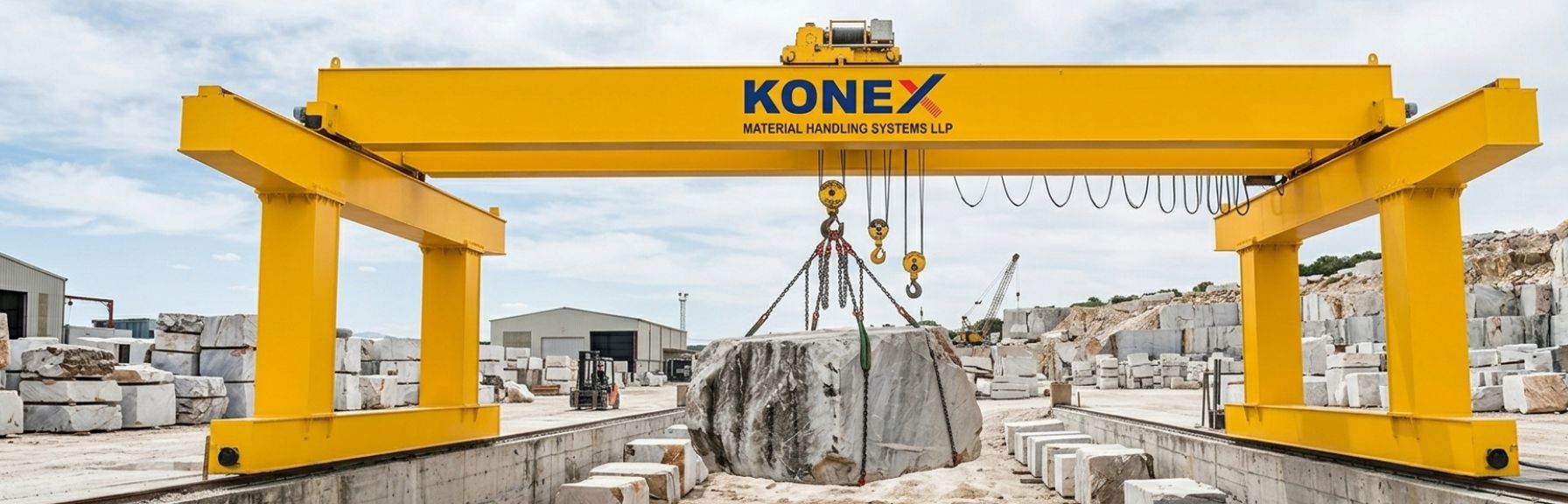
How to Choose the Best Gantry Crane for Heavy Marble Block Handling
In the global natural stone and marble processing sector, profitability is built on a foundation of safety, efficiency, and absolute precision. The raw marble blocks extracted from quarries are massive, irregular, and exceptionally heavy. Safely moving these multi-ton monoliths from transport trailers to processing lines is a task that demands robust engineering and seamless control.
To achieve this level of operational excellence, a specialised gantry crane serves as the literal and metaphorical heavy-lifter of your entire operation.
Whether you operate a sprawling quarry in Rajasthan, a bustling processing hub in Gujarat, or an export-oriented cutting yard in Andhra Pradesh, choosing the right material handling system is a high-stakes business decision. Selecting an under-engineered system can lead to micro-cracks in premium stone, catastrophic drop risks, and expensive operational bottlenecks.
In this comprehensive industry guide, we will walk you through the key factors you must evaluate to choose the best gantry crane for heavy marble block handling. We will also explore why partnering with an experienced gantry crane manufacturer is the single most important step you can take to safeguard your team, protect your inventory, and maximise your long-term return on investment.
The Unique Challenges of Marble Block Handling
Before diving into hardware features, it is crucial to understand why raw stone handling is fundamentally different from moving standard shipping containers, steel coils, or structural concrete.
1. Massive, Unevenly Distributed Weight
Raw marble blocks are excavated from the earth with highly irregular geometries. Unlike manufactured items, their centre of gravity is rarely in the middle. When a crane lifts a 20 or 30-ton block, the irregular distribution of weight places severe torsional stress on the crane structure, trolley, and hook assemblies.
2. High Fragility and Natural Fissures
Despite its immense weight, natural marble is surprisingly fragile before it is processed. Natural veins and structural fissures run through raw blocks. Sudden jerks, micro-vibrations, or load sways during a lift can cause a high-value block to split instantly along these fault lines. This results in costly material wastage and immediate production downtime.
3. Extremely Hostile Operational Environments
Marble processing yards are unforgiving on machinery. The air is continuously filled with abrasive stone dust, and the ground is often wet with water slurry from gang saws and block cutters. This combination of abrasive dust and moisture can quickly corrode unprotected components, accelerate gear wear, and cause electrical failures if the crane is not explicitly built to withstand these conditions.
Critical Factors When Choosing Your Gantry Crane
To ensure your investment delivers decades of trouble-free operation, you must match your crane selection to the unique environmental and physical demands of your yard. Let’s look at the core considerations you must review when consulting with your chosen gantry crane manufacturer.
Choosing the Ideal Configuration: Single vs. Double Girder
One of the first structural decisions you will face is whether to install a single girder or a double girder system.
- Single Girder Systems: While highly cost-effective and perfectly suited for light-to-medium industrial environments, single girder designs have structural limits when it comes to the extreme, uneven weights of raw marble blocks. They are typically reserved for lighter capacities where off-centre forces are minimal.
- Double Girder Systems: This configuration is the industry standard for heavy-duty marble yards. By utilising two parallel girders, the crab hoist trolley travels along the top of the bridge. This setup delivers superior lifting heights, unmatched structural stability, and minimises the physical sway of the load during transit. For handling raw stone, the torsional stiffness of a double girder crane is indispensable.
Maximising Yard Efficiency with Spans and Cantilevers
Your crane’s dimensions should be strategically planned to optimise your yard’s layout.
- The Span: The horizontal distance between the ground-level rails determines how many block storage lanes or cutting stations your crane can service in a single pass.
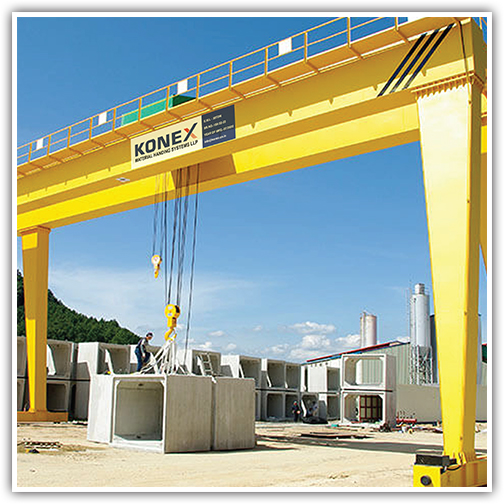
- Cantilevers (Overhangs): Extending the main girders beyond the supporting legs on one or both sides is highly recommended for marble yards. Cantilevers allow the hoist to travel past the rail tracks, enabling you to unload raw blocks directly from incoming trucks parked outside the active rail zone. This layout dramatically frees up storage space within the main runway tracks.
Essential Features for Smooth, Safe Marble Handling
To transform a standard industrial crane into a highly efficient marble-handling powerhouse, several key components must be prioritised.
1. Seamless Speed Control via Variable Frequency Drives (VFDs)
Standard, single-speed motors are highly dangerous in stone handling. Abrupt starts and stops create a pendulum effect, causing the heavy block to swing violently.
By integrating Variable Frequency Drives (VFDs) on all motion paths—including hoisting, cross travel, and long travel—the crane can accelerate and decelerate with absolute smoothness. VFDs provide:
- Micro-speeds: Allowing operators to position heavy blocks onto gang-saw trolleys with millimetre-level precision.
- Jerk-Free Transition: Preventing sudden tension spikes on the wire ropes, which protects the natural stone from cracking.
- Electronic Anti-Sway Control: Modern control systems can actively counteract natural swinging motions, keeping the load steady at all times.
2. Robust Dust and Water Protection
Standard, single-speed motors are highly dangerous in stone handling. Abrupt starts and stops create a pendulum effect, causing the heavy block to swing violently.
By integrating Variable Frequency Drives (VFDs) on all motion paths—including hoisting, cross travel, and long travel—the crane can accelerate and decelerate with absolute smoothness. VFDs provide:
- Micro-speeds: Allowing operators to position heavy blocks onto gang-saw trolleys with millimetre-level precision.
- Jerk-Free Transition: Preventing sudden tension spikes on the wire ropes, which protects the natural stone from cracking.
- Electronic Anti-Sway Control: Modern control systems can actively counteract natural swinging motions, keeping the load steady at all times.
3. Active Safety Systems and Overload Protection
Moving 30-ton loads over complex machinery and ground personnel requires a multi-layered safety strategy. Your equipment must include:
- Overload Limit Switches: To immediately halt hoisting if a block is heavier than the crane’s rated capacity or if the block is accidentally anchored to the ground.
- Rotary Limit Switches: Preventing the hoist hook from over-travelling in both upward and downward directions.
- Audible and Visual Alarms: High-decibel sirens and bright strobe lights that activate automatically whenever the crane is in motion to warn ground crews.
- Storm Anchors and Rail Clamps: Vital for outdoor gantry systems to prevent wind-induced runaway derailments during sudden storms.
Why the Runway Foundation is the Hidden Success Factor
A highly common oversight when installing a heavy-duty gantry system is underestimating the civil foundation. A massive crane carrying a heavy block exerts immense, concentrated wheel loads onto the ground.
If the soil beneath the runway rails is not properly tested and reinforced, even minor settling can cause the tracks to go out of alignment. Misaligned tracks lead to rapid wheel wear, excessive motor strain, structural fatigue, and—in severe cases—derailment risks.
When planning your installation, ensure your civil engineering partner works closely with your crane supplier to design reinforced concrete foundations that can easily support these massive dynamic forces. Additionally, include proper drainage channels along the tracks to prevent marble-cutting water from pooling around the rail sleepers.
Partnering with a Leading Gantry Crane Manufacturer in India
India is one of the world’s premier hubs for natural stone mining and processing. As a result, the region has fostered some of the most advanced material handling engineering talent on the globe.
By choosing a trusted gantry crane manufacturer in India like Konex Material Handling System, you gain access to international-grade engineering paired with deep local expertise in stone yard dynamics.
Why Konex Material Handling System is the Industry’s Preferred Choice
At Konex, we understand that your crane is not just an asset—it is the heartbeat of your production facility. We specialise in designing and manufacturing high-performance double girder crane systems engineered explicitly for the heavy stone, granite, and marble industries.
- The Konex 30-Ton Powerhouse: For busy marble processing yards, our robust 30-ton gantry crane has become the gold-standard solution. This class-leading capacity offers a comfortable safety margin, allowing you to lift standard blocks, handle occasional oversized raw stone, and operate comfortably within the structural fatigue limits of the steel girders.
- Custom Engineering for Global Markets: Headquartered in India, Konex combines robust domestic manufacturing with extensive export capabilities. We ship custom material handling systems to major markets worldwide, including the Gulf region, African nations, and European processing hubs.
- Uncompromising Safety and Quality: Every Konex crane is designed and built in accordance with stringent national and international quality standards, ensuring maximum structural integrity, low maintenance overhead, and a highly competitive total cost of ownership.
Elevate Your Operational Efficiency
Choosing the right material handling system is a long-term investment in your business’s safety and profitability. By focusing on double girder stability, robust weight capacities, precise variable-speed controls, and superior environmental dust-proofing, you safeguard your workforce, secure your premium stone inventory, and keep your processing lines moving without interruption.
Do not let sub-standard lifting equipment limit your output. Partner with an industry authority that understands the challenging demands of the heavy stone industry.
Transform Your Heavy Lifting with Konex MHS
Are you ready to optimise your marble yard’s productivity? Whether you are establishing a new processing plant in India or expanding an international cutting facility, the engineering team at Konex Material Handling System is ready to assist.
Contact us : info@konex.co.in , +91 98240 11164 | +91 90999 02956
FAQs
The best option for heavy marble block handling is typically a double girder gantry crane. It offers higher load capacity, better structural stability, and smoother lifting for irregularly shaped marble blocks. Double girder systems are ideal for safely moving heavy stone blocks in quarries and processing plants.
A double girder gantry crane is preferred because marble blocks are extremely heavy and often have uneven weight distribution. This design reduces load sway, improves lifting height, and provides stronger torsional support, making it safer for handling fragile natural stone.
For most marble processing yards, a 30-ton gantry crane is commonly recommended. It provides sufficient capacity for handling standard marble blocks while offering a safety margin for oversized stone loads and future expansion needs.
Variable Frequency Drives (VFDs) allow the gantry crane to start, stop, and move smoothly without jerks. This is critical for marble handling because sudden movements can cause cracks or damage to expensive stone blocks. VFDs also improve precision during loading and unloading.
A gantry crane for marble yards should include essential safety features such as overload protection, rotary limit switches, anti-sway control, audible alarms, visual warning lights, and storm anchors. These features help protect workers, equipment, and valuable marble inventory.
A single girder gantry crane may handle lighter marble loads, but it is generally not recommended for heavy raw marble blocks. Since natural stone often has uneven weight distribution, single girder cranes may not provide the stability required for safe long-term operations.
The runway foundation is critical because heavy gantry cranes transfer massive wheel loads to the ground. Poor foundation design can cause rail misalignment, increased maintenance costs, and even derailment. Proper reinforced concrete foundations ensure safe and efficient crane performance.
Marble yards typically expose cranes to abrasive stone dust, water slurry, and outdoor weather conditions. These factors can damage motors, electrical panels, and moving components. Choosing a crane with IP-rated protection and corrosion-resistant coatings increases durability.
A well-designed gantry crane improves productivity by enabling faster unloading, safer movement of marble blocks, and precise placement on cutting lines. This reduces downtime, minimizes stone damage, and streamlines operations in quarries and processing facilities.
Konex Material Handling System specializes in heavy-duty gantry cranes designed for industries such as marble, granite, and stone processing. With custom engineering, robust 30-ton solutions, and export capability, the company provides reliable lifting systems for industrial clients across India and international markets.