

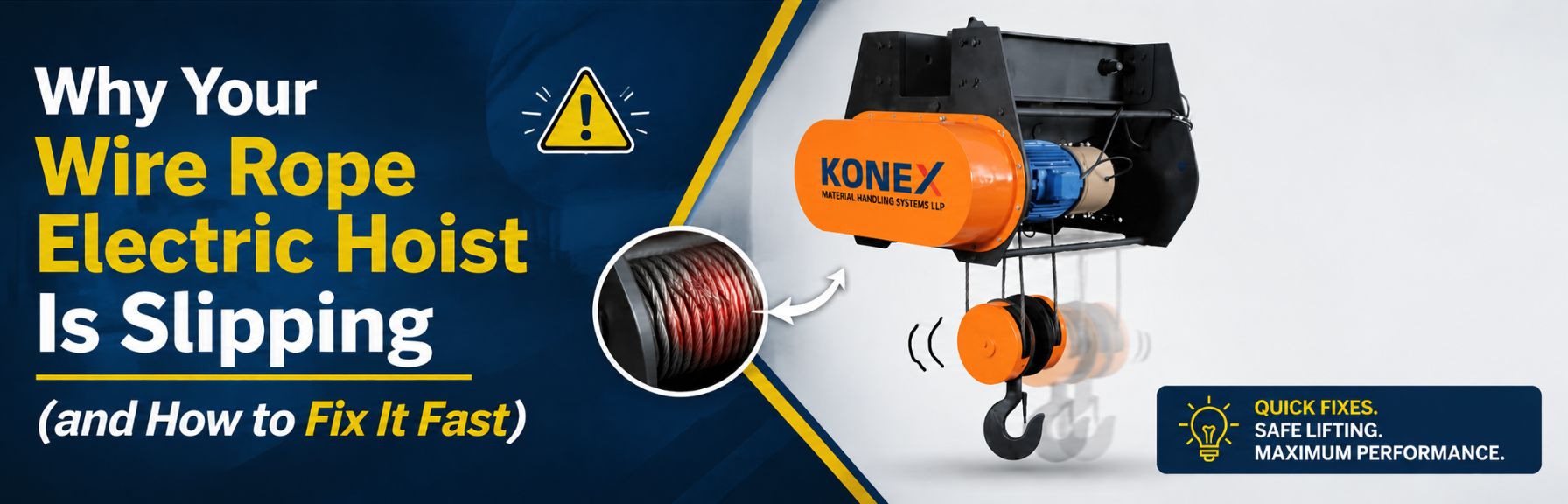
Why Your Wire Rope Electric Hoist Is Slipping (and How to Fix It Fast)
Imagine this: You are in the middle of a high-priority production run. Your overhead crane is moving a critical load across the factory floor. Suddenly, the load halts, stutters, and begins to slowly drift downwards. Your operator releases the button, but the load continues to slide.
In a split second, a routine industrial operation turns into an active safety hazard and an expensive bottleneck.
If you are dealing with a wire rope electric hoist slipping issue, you are not just facing an operational headache. You are dealing with a direct threat to your workplace safety, your machinery’s lifespan, and your company’s bottom line. Unplanned downtime in manufacturing can cost thousands of dollars per hour, and a dropping load can lead to catastrophic workplace accidents.
As a leading Wire Rope Electric Hoist Manufacturer in India with a global footprint, Konex Material Handling System has helped hundreds of factories, warehouses, and infrastructure projects resolve complex lifting challenges. In this comprehensive guide, we will break down exactly why your hoist is slipping, how to diagnose the problem safely, quick fixes to get you back up and running, and how to prevent it from ever happening again.
Understanding the Danger: What is Hoist Slipping?
Before diving into the technical fixes, it is crucial to understand what “slipping” actually means.
When we talk about a wire rope electric hoist slipping, we are referring to a situation where the hoist fails to hold its rated load statically in the air, or struggles to lift/lower the load smoothly without jerky downward movements.
This is a classic crane hoist issue that demands immediate attention. Under no circumstances should a slipping hoist remain in active service. If you notice even a few inches of drift when the brake should be fully engaged, lock out the machine immediately and begin diagnostic protocols.
5 Common Reasons Your Wire Rope Electric Hoist Is Slipping
A high-quality wire rope electric hoist is a highly engineered system where mechanical, electrical, and structural components work in perfect harmony. When slipping occurs, it is usually because one of these key areas has degraded or failed.
Here are the five most common culprits behind hoist slippage.
1. Worn or Misadjusted Electromagnetic/Cone Brakes
The braking system is the primary line of defence holding your load in place. Most modern wire rope hoists utilise an automatic disc brake or a mechanical cone brake system. Over time, these components experience natural wear and tear.
- The Issue: The brake lining (friction material) wears down, much like the brake pads on a commercial truck. If the lining becomes too thin, or if the air gap between the brake magnet and the armature plate becomes too wide, the brake cannot apply enough clamping force to hold the load.
- The Catalyst: High-frequency cycling, constant heavy loads, or operating in dusty, abrasive environments accelerate brake wear.

2. Contamination on the Brake Discs (Oil or Grease)
Even if your brake linings are thick and healthy, they cannot do their job if they lose friction.
- The Issue: Gearbox oil seals can degrade over time, allowing lubricating oil or grease to seep into the brake housing. Once oil gets onto the dry friction surfaces of the brake disc, the friction coefficient drops drastically.
- The Catalyst: Overfilling the gearbox, using the wrong grade of lubricant, or neglecting routine seal inspections.
3. Worn or Damaged Rope Guides and Tensioners
The rope guide is a crucial component that ensures the wire rope winds evenly across the grooves of the drum.
- The Issue: If the rope guide is cracked, worn, or misaligned, the wire rope can jump out of its designated grooves. When this happens, the rope wraps irregularly on top of itself or slips across the drum surface. This uneven spooling causes sudden tension drops, which feel and act like a slip.
- The Catalyst: Side-pulling loads (lifting at an angle instead of vertically) is the number one cause of ruined rope guides and damaged drum grooves.
4. Overloading Beyond the Rated Capacity
Every wire rope electric hoist is engineered to operate safely within a highly specific Safe Working Load (SWL).
- The Issue: Pushing a hoist past its rated capacity places immense strain on the braking and gearing systems. The torque required to hold the overload exceeds the torque capacity of the brake, resulting in a gradual, uncontrollable descent.
- The Catalyst: Lack of weight indicators on the hook, operator error, or trying to pull “stuck” loads out of structural fixtures.
5. Excessive Gearbox Wear or Backlash
The electric motor drives the drum through a series of reduction gears.
- The Issue: If the gears are severely worn, have chipped teeth, or suffer from extreme backlash (play between mating teeth), the physical connection holding the drum static is compromised. While less common than brake failure, gear train degradation is a major structural failure point.
- The Catalyst: Running the hoist with low, contaminated, or incorrect gearbox lubricants.
Step-by-Step Checklist to Diagnose Your Crane Hoist Issue
When troubleshooting a slipping hoist, safety must always come first. Follow this diagnostic checklist to isolate the root cause of the problem.
Step 1: Perform an Immediate Safe Lockout
Never attempt to diagnose a hoist while it is holding a load or connected to power.
- Lower any suspended loads safely to the ground. If the load cannot be lowered safely due to extreme slipping, clear the area beneath it, cordon off the zone, and secure the load using secondary rigging before proceeding.
- Perform a standard Lockout/Tagout (LOTO) procedure on the main electrical isolator.
Step 2: Measure the Brake Air Gap and Lining Thickness
- Remove the brake cover at the rear of the hoist motor.
- Use a feeler gauge to measure the air gap between the brake magnet and the pressure plate. Compare this value with the clearance limit specified in your manufacturer’s manual.
- Inspect the friction lining. If the material is worn close to the metal backing plate, it requires immediate replacement.
Step 3: Inspect for Oil and Grease Contamination
- Look closely at the brake pads and discs. Do you see a shiny film or feel grease on your fingertips?
- Check the integrity of the motor shaft seal and gearbox seal. If there is a wet trail of oil leading from the gearbox to the brake assembly, your seals have failed.
Step 4: Examine the Wire Rope and Drum Alignment
- Shine a flashlight onto the rope drum. Check if the wire rope is seated neatly inside its individual grooves.
- Look for signs of “birdcaging,” kinking, or flattening along the wire rope.
- Inspect the rope guide. Is it moving smoothly along the drum shaft as the drum rotates, or is it loose, cracked, or binding?
How to Fix a Slipping Hoist Fast
Once you have identified the culprit, you need to execute a repair that balances speed with absolute safety. Here is how to address the most common issues:
Issue | Immediate Fix | Actionable Safety Tip |
Brake Air Gap Too Large | Adjust the brake tension spring/locknut to restore the manufacturer-recommended clearance. | Always use a torque wrench to ensure even pressure across the brake assembly. |
Worn Brake Pads | Replace the brake friction discs as a complete set. Never replace just one side. | Use original OEM parts from your Electric Hoist Manufacturer to ensure material compatibility. |
Oil on Brake Surface | Clean the brake discs using a dedicated, non-residue brake cleaner spray. Replace the leaky gearbox seals. | If the brake pads have absorbed oil, cleaning won’t work long-term; they must be replaced. |
Damaged Rope Guide | Replace the broken rope guide and realign the wire rope on the drum. | Retrain operators to avoid side-pulling, which destroys rope guides instantly. |
When to DIY vs. When to Call the Manufacturer
While basic brake adjustments and rope guide replacements can be handled by an in-house, certified maintenance engineer, deeper issues like gearbox rebuilding, structural motor repairs, or safety-critical component swaps should always be handled by professionals.
As an established Wire Rope Electric Hoist Manufacturer, Konex recommends consulting our engineering support team if a basic brake adjustment does not immediately resolve the slip.
The Preventative Maintenance Blueprint: Never Slip Again
The best way to fix a slipping hoist is to prevent it from slipping in the first place. A robust preventative maintenance program drastically reduces unplanned downtime and extends the working life of your machinery.
Daily Operator Inspections
Encourage your crane operators to spend five minutes at the start of every shift checking for visual red flags:
- Listen for unusual grinding, squealing, or clicking noises during lifting.
- Test the hoist with a light load a few inches off the ground to verify that the brakes hold immediately when the buttons are released.
- Check that the wire rope is winding neatly without overlaps.
Monthly Maintenance Milestones
Have your maintenance team conduct deeper checks every 30 days:
- Measure and record brake wear and air gaps to predict when replacements will be needed.
- Check gearbox oil levels and top up with high-grade industrial lubricants.
- Inspect structural rope guides and the hook assembly for cracks, deformation, or wear.
Why Partner with Konex Material Handling System?
When it comes to overhead lifting equipment, compromise is not an option. Your productivity, profits, and, most importantly, human lives rely on the structural integrity of your hoists.
At Konex Material Handling System, we don’t just supply equipment; we engineer peace of mind. As a premier Electric Hoist Manufacturer based in India, we design and build heavy-duty material handling solutions that stand up to the most demanding industrial environments.
What Sets Our Wire Rope Electric Hoists Apart?
- Heavy-Duty Electromagnetic Fail-Safe Brakes: Our hoists are equipped with high-torque, self-adjusting electromagnetic disc brakes designed to automatically engage instantly in the event of a power interruption, preventing any accidental load drops.
- Precision-Engineered Rope Guides: Constructed from high-durability, self-lubricating materials to prevent overlapping and extend wire rope life.
- Robust Gearbox Design: Our alloy-steel, helical-gear reduction units run in continuous oil baths, ensuring whisper-quiet operation, minimal wear, and virtually zero backlash.
- Global Quality Standards, Indian Pricing: We leverage state-of-the-art manufacturing facilities in India to deliver world-class hoists that meet rigorous international safety standards, keeping our global export clients ahead of the curve.
Secure Your Operations Today
A slipping hoist is a loud warning sign that your production line is running on borrowed time. Don’t wait for a minor slip to turn into a major industrial accident.
Whether you need urgent replacement parts, troubleshooting advice, or are looking to upgrade your facility with a brand-new, reliable Wire Rope Electric Hoist, the engineering experts at Konex Material Handling System are ready to assist you.
Contact our Technical Sales Team Today for a Custom Consultation
Let’s build a safer, more efficient floor together. Contact us for a quote, custom specifications, or expert troubleshooting support.
Contact Us : +91 98240 11164 | +91 90999 02956 , info@konex.co.in
Konex Material Handling System LLP – Engineering Safety, Lifting Excellence.
FAQs
A wire rope electric hoist usually slips under load because of worn brake linings, improper brake adjustment, oil contamination on brake discs, damaged rope guides, or overloading beyond its rated lifting capacity. Immediate inspection is necessary to avoid accidents and downtime.
Yes, a slipping wire rope hoist is extremely dangerous because it can cause suspended loads to drift downward unexpectedly, creating a major safety risk for operators, equipment, and nearby workers. The hoist should be stopped and locked out immediately.
The most common cause of hoist slipping is worn or misadjusted electromagnetic brakes. Over time, brake pads wear down, reducing their ability to hold the load securely, especially during frequent heavy-duty operations.
To fix a slipping hoist quickly, first perform a safe lockout procedure, then inspect the brake system, check for oil contamination, verify rope guide alignment, and confirm the load is within rated capacity. Minor issues like brake adjustment may be fixed on-site, but major repairs require expert service.
Yes, overloading is a major reason for electric hoist slipping. When the load exceeds the Safe Working Load (SWL), the brake and gearbox cannot generate enough holding torque, causing the load to descend slowly or jerk downward.
Wire rope hoist brakes should be visually checked daily by operators and thoroughly inspected by maintenance teams at least once a month. Regular brake inspections help detect wear before it leads to slipping or sudden failure.
Yes, oil or grease leaking from the gearbox can contaminate brake discs, reducing friction and causing the hoist to slip. If oil reaches the brake pads, both the seals and the contaminated brake components should be replaced immediately.
Basic issues such as minor brake adjustment or rope guide replacement can be handled by certified maintenance personnel. However, gearbox wear, motor failure, or recurring brake problems should always be inspected by an experienced manufacturer like Konex Material Handling System.
Preventive maintenance is the best solution. Daily load tests, monthly brake inspections, proper lubrication, avoiding side pulling, and never exceeding the rated capacity can significantly reduce the chances of hoist slipping.
Many industries prefer Konex Material Handling System because they provide heavy-duty wire rope electric hoists with fail-safe brakes, precision rope guides, robust gearboxes, and global export-quality lifting solutions.