

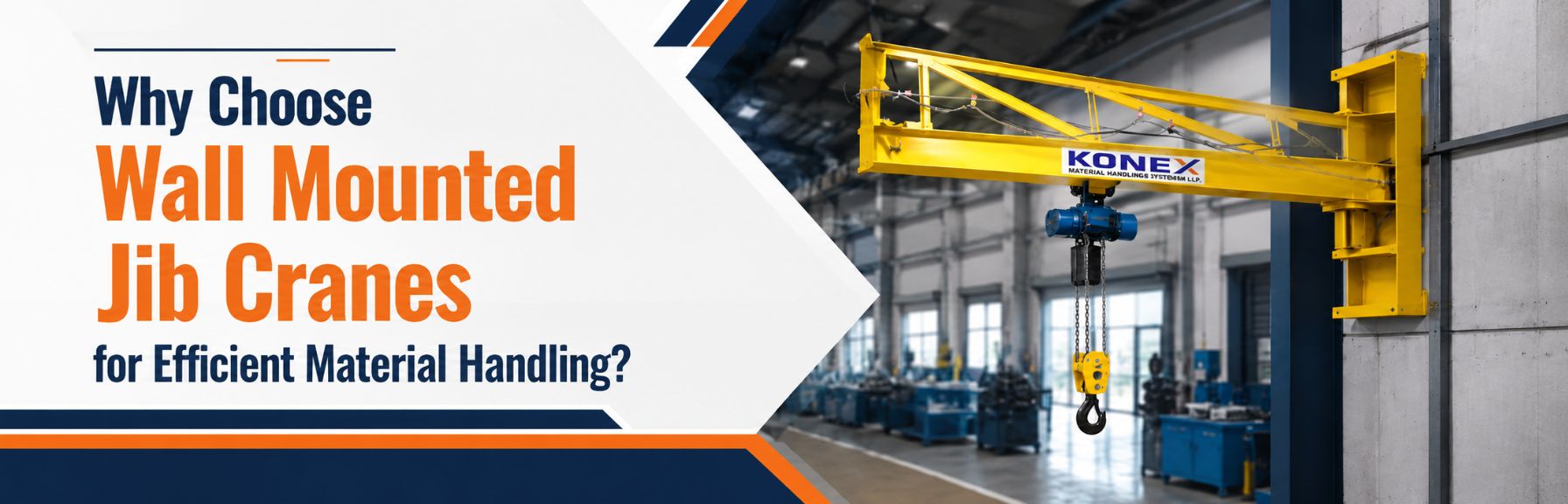
Why Choose Wall Mounted Jib Cranes for Efficient Material Handling?
Moving heavy materials around a factory should not become a daily struggle. Yet, in many workshops and manufacturing units, workers still depend on forklifts, manual lifting, overhead cranes, or temporary lifting arrangements for small and repetitive jobs.
The problem is not always the weight of the material. Sometimes, the real challenge is where the material needs to be lifted and how often the same lifting task is repeated.
This is where a Wall Mounted Jib Crane can make a practical difference.
A wall-mounted jib crane provides dedicated lifting support at a specific workstation or production area without taking up valuable floor space. It can be particularly useful near machines, assembly stations, fabrication areas, maintenance sections, loading points, and other locations where materials need to be lifted and positioned regularly.
For businesses looking for a JIB Crane Manufacturer in India, the important question is not simply whether a jib crane can lift a load. The better question is: Will a wall-mounted jib crane make your material handling process faster, safer, and easier?
In many applications, the answer can be yes.
What Is a Wall Mounted Jib Crane?
A wall-mounted jib crane is a compact lifting solution installed against a suitable building wall or structural column. It has a horizontal arm that supports the lifting equipment and allows the load to be moved within a defined working area.
Unlike a floor-mounted jib crane, it does not require a separate vertical pillar occupying valuable floor space.
This makes it an attractive option for factories where the floor is already occupied by machines, production lines, storage racks, forklifts, or workers.
The U.S. Occupational Safety and Health Administration (OSHA) also describes jib cranes as lifting systems that can be wall, floor, or pillar mounted and highlights their ability to reduce manual lifting, carrying, and positioning of heavy materials.
5 Major Benefits of Wall Mounted Jib Cranes
1. Zero Floor Footprint (Maximum Space Utilization)
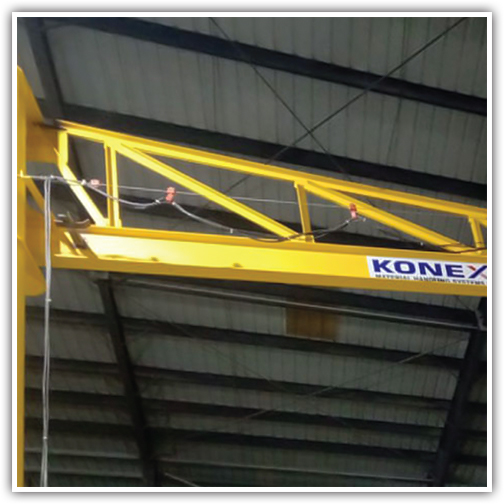
The single biggest advantage of a wall mounted jib crane is that it requires zero floor space. Because it bolts directly onto existing factory pillars or reinforced walls, your plant floor remains entirely clear.
This footprint-free design allows forklifts, automated guided vehicles (AGVs), and foot traffic to move freely beneath the crane’s operating arc. In tight or cluttered machine shops, this extra usable space directly translates into higher operational capacity.
2. High Cost Efficiency and Lower Installation Expenses
Installing a traditional freestanding jib crane requires digging up your factory floor, pouring reinforced concrete foundations, waiting for curing, and installing a vertical pillar. This process is time-consuming and expensive.
With a wall-mounted design:
- No ground excavation or special concrete foundations are needed.
- Installation time is minimal, keeping facility downtime to a minimum.
- Lower raw material requirements mean the initial purchase price is significantly lower than floor-mounted options.
3. Complements Main Overhead Cranes
In large industrial facilities, big EOT cranes handle high-tonnage movement across the entire building length. However, tying up a 20-ton bridge crane to hold a 500 kg motor in place during assembly is inefficient and wasteful.
By installing a series of wall-mounted jib cranes beneath the runway of your main EOT crane, you create localized work zones. The main crane moves raw materials down the bay, while individual operators use their wall-mounted jib cranes for continuous, small-scale lifting without interrupting others.
4. Improved Ergonomics and Worker Safety
Industrial safety standards, such as those recommended by OSHA Crane and Hoist Safety Rules, emphasize reducing manual heavy lifting to prevent muscular injuries.
A wall-mounted crane paired with a smooth-running Electric Chain Hoist allows a single operator to lift, reposition, and lower heavy parts effortlessly. Precision control reduces component damage, lowers fatigue, and fosters a safer working environment.
5. Effortless 180-Degree Rotation & Smooth Operation
Wall bracket cranes provide up to 180 degrees of horizontal rotation. Fitted with high-grade bearings and precision pivot brackets, the boom swings smoothly even when handling maximum rated loads. Operators can easily guide loads into tight spots with minimal physical effort.
Wall Mounted vs. Floor Mounted Jib Cranes: A Direct Comparison
If you are deciding between a wall-mounted crane and a floor-mounted mast crane, this quick breakdown will help you choose the right fit for your facility layout:
Feature | Wall Mounted Jib Crane | Floor Mounted (Freestanding) Jib Crane |
Floor Footprint | Zero (Attaches to building wall/column) | Requires dedicated floor space for base pillar |
Foundation Needed | None (Uses structural building framework) | Yes (Requires deep reinforced concrete slab) |
Rotation Arc | Up to 180 Degrees | Up to 360 Degrees |
Installation Cost | Lower (Fewer structural materials) | Higher (Includes foundation and mast cost) |
Best Used For | Workstations near existing building pillars | Open floor areas away from walls or pillars |
Relocation Ease | Easy to unbolt and move to another column | Difficult (Requires new concrete foundation) |
Where Are Wall Mounted Jib Cranes Commonly Used?
Wall-mounted jib cranes can be useful in many industries because their job is usually localized lifting.
Common applications include:
Manufacturing Units
They can help move components, tools, dies, fixtures, and machine parts around production stations.
Fabrication Workshops
Heavy plates, fabricated components, tools, and assemblies can be positioned more conveniently during fabrication work.
Automotive Industry
They can support repetitive handling of engines, components, tools, and other parts around assembly and maintenance areas.
Machine Shops
A jib crane can assist with loading and unloading heavy components from machines and positioning them at nearby work areas.
Maintenance Departments
Maintenance teams often need to remove motors, pumps, gearboxes, and other heavy components. A dedicated lifting solution can make these jobs easier.
Warehouses and Material Handling Areas
Where lifting is concentrated around a particular loading or handling point, a wall-mounted arrangement can provide useful support without consuming additional floor area.
Why Partner with Konex for Your Material Handling Needs?
At Konex, we understand that no two production floors are identical. A standard, off-the-shelf lifting solution doesn’t always fit the unique dimensions or workflow requirements of your facility.
Here is why leading manufacturers trust Konex for their lifting solutions:
- Custom-Engineered Designs: We manufacture wall-mounted jib cranes tailored to your specific reach, load capacity, and mounting structural constraints.
- Robust Safety Engineering: Every Konex crane is constructed using high-grade structural steel and tested under strict quality standards to ensure long-term durability and operator safety.
- Smooth Operation: Our low-friction pivot bearings make boom rotation fluid and effortless, reducing operator fatigue.
- Comprehensive Support: From initial site assessment and structural evaluation to installation and after-sales service, Konex provides complete end-to-end guidance.
Boost Your Factory’s Workflow Today
A wall mounted jib crane is one of the smartest, most cost-effective upgrades you can make to your factory floor. By removing obstacles from your floor space, reducing load waiting times, and protecting your workforce from physical strain, this compact lifting system pays for itself in increased productivity.
Ready to optimize your factory layout and streamline material movement?
Contact the material handling experts at Konex today for a customized site consultation and quote. Let us help you find the perfect wall-mounted lifting solution for your operational needs.
FAQs
A wall mounted jib crane is a compact lifting system attached to a suitable structural wall or column. Its horizontal jib arm supports a hoist and allows operators to lift, move, and position loads within a defined working area. It is particularly useful for localized lifting tasks at workstations, machines, assembly areas, maintenance sections, and fabrication bays.
The major advantages include better floor-space utilization, reduced manual material handling, faster lifting operations, improved workstation ergonomics, and convenient handling of repetitive loads. Since the crane is mounted to a suitable wall or structural column, it can provide dedicated lifting support without requiring a separate floor-mounted pillar.
Generally, a wall mounted jib crane does not require the dedicated floor foundation associated with a freestanding jib crane. However, the existing wall, column, or supporting structure must have adequate strength and stability to safely withstand the crane’s loads and operating forces. A proper structural assessment should be completed before installation.
A wall mounted jib crane occupies very little floor space because its support is attached to the building structure rather than a floor-mounted pillar. The required operating area depends on factors such as jib arm length, lifting height, rotation range, load size, and the location of the workstation. A site assessment can help determine the appropriate configuration.
Wall mounted jib cranes are commonly used in manufacturing plants, fabrication workshops, machine shops, automotive facilities, maintenance departments, assembly stations, warehouses, and material handling areas. They are especially useful where loads need to be repeatedly lifted and positioned within a specific workstation or production zone.
Yes. A wall mounted jib crane can complement a main EOT crane by handling smaller, repetitive lifting tasks at individual workstations. For example, an EOT crane can transport material across a production bay while wall mounted jib cranes handle localized lifting, assembly, maintenance, or positioning tasks. This can help reduce unnecessary use of the main overhead crane.
Yes. Wall mounted jib cranes can be a practical choice for repetitive lifting when the same type of load needs to be moved regularly within a defined area. Using a dedicated lifting system can reduce dependence on manual handling and allow operators to position materials more efficiently. The crane should be selected according to the actual load, working cycle, reach, and application requirements.
Important factors include the maximum load capacity, required lifting height, jib arm reach, rotation range, duty cycle, type of hoist, available structural support, operating environment, and the dimensions of the working area. Buyers should also consider installation requirements, safety provisions, maintenance support, and whether the crane needs to be customized for a particular workstation.
A properly designed and correctly installed wall mounted jib crane can significantly reduce the need for manual lifting, carrying, and positioning of heavy materials. This can reduce physical strain and improve material handling ergonomics. However, safe operation depends on correct crane selection, structural suitability, installation, inspection, maintenance, operator training, and compliance with applicable safety requirements.
Konex Material Handling System LLP provides customized material handling solutions based on application requirements, available space, load characteristics, and structural conditions. Its wall mounted jib crane solutions can be configured for different industrial workstations and lifting applications, with support covering design, manufacturing, installation, and after-sales requirements. Buyers can contact Konex to discuss their lifting requirements and request a customized quotation.