

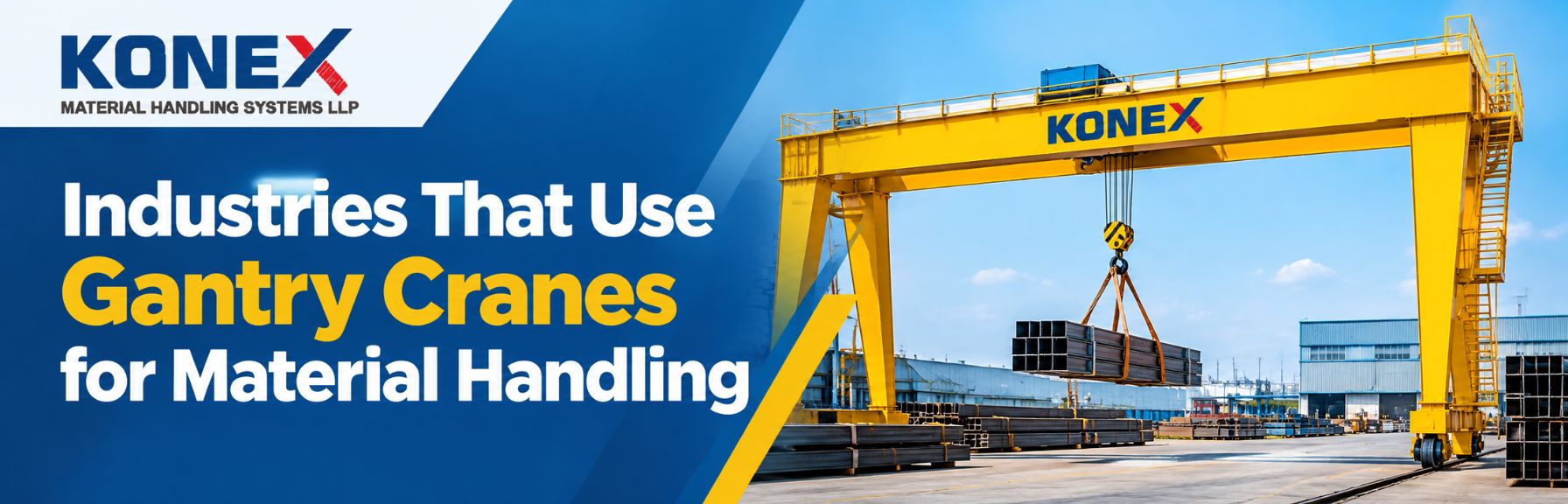
Industries That Use Gantry Cranes for Material Handling
Efficient material handling is the backbone of any successful industrial operation. Whether moving structural steel beams across a fabrication yard, positioning massive concrete slabs on a construction site, or loading freight containers at port terminals, picking the right lifting equipment directly impacts your operational speed, workplace safety, and bottom line.
While overhead EOT cranes are standard inside factories, many facilities face challenges when lifting heavy loads outdoors, in rented premises, or in spaces lacking existing building support columns. This is where a gantry crane becomes an invaluable asset.
As a leading manufacturer of industrial lifting solutions, Konex Material Handling System LLP empowers businesses across India and around the globe with durable, precision-engineered heavy lifting equipment. In this guide, we explore the key industries relying on gantry crane for material handling, the strategic advantages these systems offer, and how choosing the right partner can streamline your plant operations.
What Makes Gantry Cranes Essential for Industrial Material Handling?
Unlike bridge cranes that rely on elevated building structures for support, a gantry system rests on its own rigid legs, running along floor-mounted rails or rubber tires. This self-supporting architecture makes it exceptionally versatile for both indoor workshops and outdoor material handling crane operations.
Industries choose these systems because they eliminate the need to invest in expensive building modifications or runway girders. By taking advantage of floor-based mobility, companies can expand their lifting capabilities anywhere on their premises without compromising structural safety.
Key Industries Utilizing Gantry Cranes for Material Handling
From large-scale infrastructure projects to fast-paced manufacturing plants, diverse sectors rely on gantry crane applications to keep production lines moving efficiently. Here is how key industries utilize these robust systems:
1. Shipbuilding, Marine Yards, and Port Logistics
The maritime industry handles some of the heaviest raw materials and structural units in the world. Shipyards require dependable equipment to move massive hull sections, heavy steel plates, and marine engines between assembly areas and docks.
- Outdoor Yard Lifting: Shipyards rely on large outdoor gantry systems to span wide assembly areas without obstructive support posts.
- Container Loading: Port terminals use specialized gantry setups to stack shipping containers safely and speed up cargo turnaround times.
2. Heavy Steel Fabrication and Metals Manufacturing
Steel stockyards, rolling mills, and fabrication facilities constantly transport heavy metal sheets, structural beams, coils, and pipes.
- Material Transport: A heavy-duty gantry system carries raw steel stock from outdoor storage yards into cutting and welding bays.
- Workplace Safety: Automated and semi-automatic lifting controls reduce manual handling risks, keeping shop floor technicians safe during heavy material movements.
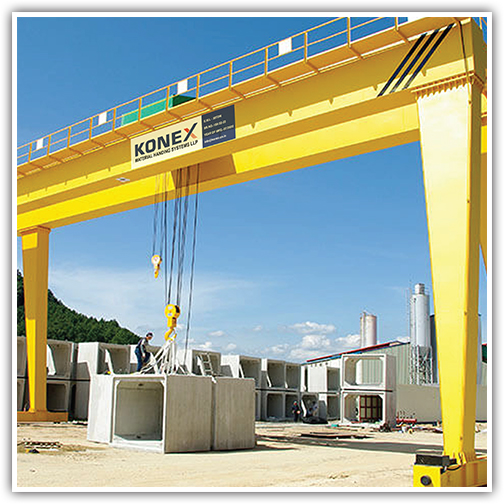
3. Construction and Precast Concrete Manufacturing
The modern construction sector depends heavily on precast concrete beams, pillars, slabs, and bridge girders. These massive elements are manufactured in dedicated casting yards before being transported to project sites.
- Flexible Site Positioning: Gantry systems can move over long casting beds, effortlessly picking up cured concrete components and loading them onto transport trailers.
- No Permanent Structure Needed: Because these systems do not require building walls, construction yards can reconfigure their layout as project demands change.
4. Railway Maintenance and Heavy Transport Terminals
Railway workshops and locomotive manufacturing plants require reliable vertical and horizontal movement to service train engines, bogies, and heavy wheel sets.
- Locomotive Maintenance: Gantry systems lift heavy engine components and rail cars with smooth, stable control.
- Track Assembly: Material yards use gantry setups to organize rail lines, sleepers, and track maintenance equipment efficiently.
5. Energy, Power Plants, and Heavy Machinery Manufacturing
Facilities producing wind turbines, hydro turbines, power transformers, and heavy industrial machinery need reliable equipment capable of handling delicate yet massive assemblies.
- Precise Component Alignment: High-precision hoists allow operators to position heavy power generation equipment with millimeter accuracy.
- Adaptable Work Areas: Energy equipment manufacturing often involves large outdoor assembly pads where overhead building cranes cannot operate.
Key Strategic Advantages for Your Business
Investing in a well-designed gantry system yields long-term operational and financial benefits for expanding companies:
- Maximum Space Flexibility: Can be installed anywhere with a flat concrete pad or rail line, completely independent of building walls.
- Seamless Outdoor and Indoor Adaptability: Engineered with weather-resistant protection for smooth operation in harsh outdoor yard conditions.
- Cost-Effective Expansion: Ideal for rented facilities or temporary job sites, as the entire system can be dismantled, relocated, and reassembled as your business grows.
- Enhanced Workplace Safety: Reduces manual handling, improves operator visibility, and features standard emergency stop mechanisms to protect workers.
Why Partner with Konex Material Handling System LLP?
Selecting the right material handling partner is crucial for long-term operational efficiency and worker safety. Based in Ahmedabad, Gujarat, Konex Material Handling System LLP is a trusted manufacturer delivering high-performance lifting equipment across India, supported by strong global export capabilities.
What Sets Konex Apart:
- Custom Engineering Focus: Every facility has unique spatial and operational demands. Konex custom-designs lifting solutions tailored to your specific load profiles, spans, and duty cycles.
- Proven Manufacturing Quality: Recognized for quality excellence, Konex utilizes modern manufacturing processes and strict testing standards to ensure every system offers maximum uptime and durability.
- End-to-End Operational Support: From initial site assessment and engineering design to prompt installation guidance and dependable long-term technical service, Konex stands by your side.
- Global Export Standard: Engineered to meet rigorous safety and efficiency standards, Konex material handling equipment trusted by expanding industrial clients worldwide.
Upgrade Your Material Handling Operations Today
Optimizing your facility’s material flow directly drives productivity, reduces downtime, and keeps your workforce safe. Whether you are setting up a new production unit, expanding an outdoor storage yard, or upgrading your existing material handling equipment, Konex Material Handling System LLP provides engineered solutions tailored to your operational goals.
Ready to enhance your lifting efficiency?
Connect with our expert engineering team today for a personalized consultation and discover how a custom lifting solution can transform your business.
Contact us : info@konex.co.in , +91 98240 11164 | +91 90999 02956
👉 Click Here to Connect with a Konex Material Handling Expert
FAQs
Gantry cranes are widely used in industries that need to lift and move heavy materials in indoor or outdoor work areas. Common applications include steel fabrication, shipbuilding, ports and marine yards, construction, precast concrete manufacturing, railway workshops, power plants, energy equipment manufacturing, and heavy machinery production. Their self-supporting structure makes them suitable for facilities where overhead building support is unavailable or difficult to modify.
A gantry crane is used for lifting, lowering, and horizontally moving heavy materials, machinery, components, and structures. Typical gantry crane applications include handling steel plates and beams, concrete slabs, machinery components, transformers, railway equipment, ship sections, and heavy fabrication assemblies. Depending on the application, gantry cranes can be used inside workshops, manufacturing facilities, storage yards, construction areas, and other industrial spaces.
Gantry cranes are suitable for outdoor material handling because their load-bearing structure is supported by legs rather than depending entirely on the building structure. They can operate across dedicated floor rails or suitable travel surfaces and can cover large outdoor working areas. With appropriate weather protection and application-specific engineering, they can be used in steel yards, precast concrete plants, construction sites, shipyards, and heavy industrial storage areas.
Industries may consider gantry cranes when lifting operations take place outdoors, in open yards, in temporary work areas, or in buildings where installing overhead crane runways is impractical. Construction, steel fabrication, precast concrete, shipbuilding, railway maintenance, power equipment manufacturing, and heavy engineering are examples of sectors where gantry cranes can be useful. The choice depends on factors such as load, span, travel path, available space, building structure, and operating conditions.
In steel fabrication facilities, gantry cranes are used to move steel plates, beams, coils, pipes, fabricated structures, and raw materials between storage, cutting, welding, assembly, and dispatch areas. They can help reduce manual material movement and improve the organization of large fabrication yards. A properly engineered gantry crane can also provide controlled lifting for heavy steel components during fabrication and assembly operations.
Construction and precast concrete facilities use gantry cranes to lift and transport heavy products such as precast beams, columns, slabs, bridge girders, moulds, and other concrete components. In precast yards, a gantry crane can travel along casting or storage areas and position finished components for handling or loading. Because the crane is self-supporting, it can also be considered for open yards where permanent overhead crane structures are not available.
Yes, gantry cranes are commonly suited to shipyard and marine material handling applications where large and heavy components need to be moved across open working areas. They can be used for handling steel plates, ship sections, structural assemblies, marine equipment, and heavy components. Large gantry systems can cover broad assembly zones while avoiding the need for numerous overhead support columns within the working area.
Railway workshops and heavy transport facilities can use gantry cranes for handling locomotive components, bogies, wheel sets, engines, rails, sleepers, and maintenance equipment. Gantry systems can provide controlled lifting and movement of heavy components during maintenance, assembly, repair, and material storage operations. Their floor-supported design can be useful in workshops and yards where conventional overhead crane infrastructure is limited.
Yes. Gantry cranes can support material handling operations in power plants and energy equipment manufacturing facilities, particularly where heavy equipment or assemblies must be moved through large indoor or outdoor work areas. Applications can include handling transformers, turbine components, generators, heavy machinery parts, and large fabricated assemblies. The crane should be engineered according to the specific load characteristics, operating environment, lifting frequency, and required movement.
The major advantages of a gantry crane include flexible installation, suitability for outdoor operations, reduced dependence on building structures, improved heavy-load handling, and better use of open working areas. Gantry cranes can be particularly useful for companies expanding production yards, operating from rented premises, or handling materials in areas where installing overhead runway structures would be difficult. The actual benefits depend on the facility layout and application requirements.
Choosing the right gantry crane requires evaluating the maximum load, lifting height, span, travel distance, lifting frequency, operating environment, available floor or rail arrangement, material dimensions, and required control features. The application should also be reviewed to determine whether the crane will operate indoors, outdoors, or in changing environmental conditions. Working with an experienced gantry crane manufacturer can help match the crane design with the facility’s actual material handling requirements.
Konex Material Handling System LLP is an Ahmedabad-based manufacturer of industrial material handling equipment serving customers across India with global export capability. Konex provides engineered gantry crane solutions based on the customer’s application, load-handling requirements, available space, and operational needs. Businesses looking for a gantry crane manufacturer in India can discuss their material handling application with the Konex engineering team to determine a suitable crane configuration.