

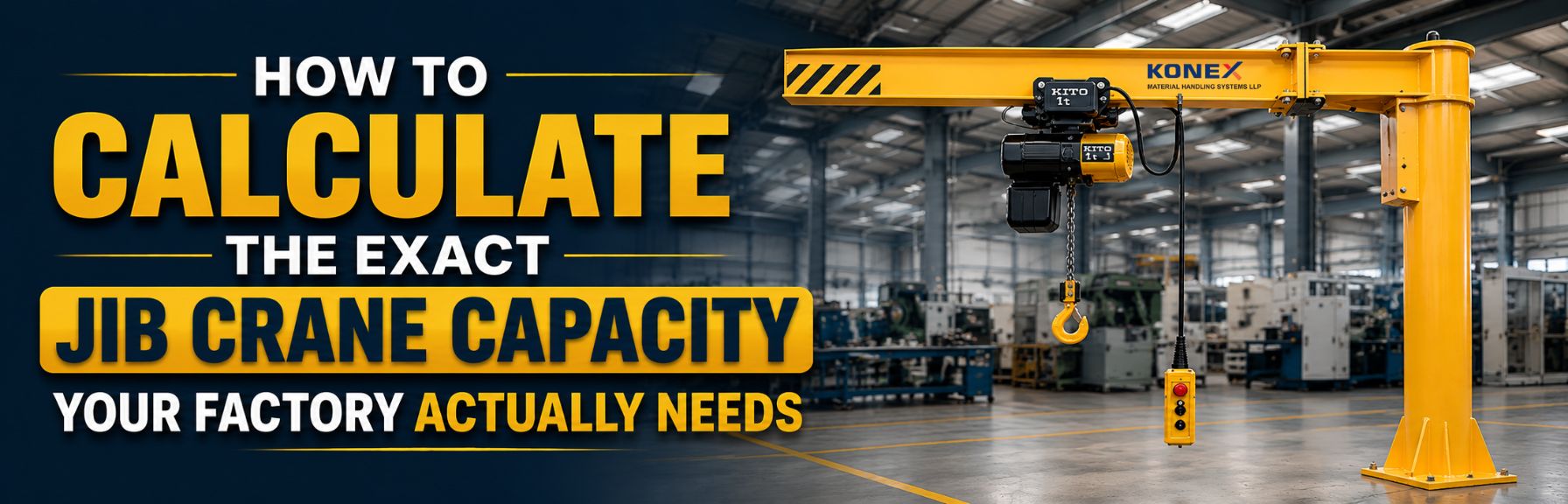
How to Calculate the Exact Jib Crane Capacity Your Factory Actually Needs
Imagine this: You invest thousands of dollars in a brand-new Jib Crane for your assembly line. It is sleek, beautifully engineered, and ready to work. But within three weeks, you notice a bottleneck. Your operators are hesitant because the loads are consistently touching the maximum limit. Or worse, you realise you purchased a massive system operating at only 30% capacity, leaving valuable capital tied up in over-engineered steel.
In the material handling world, guessing your load requirements is a costly mistake.
At Konex Material Handling System LLP, we have spent years helping industrial facilities across India and global markets design, build, and deploy high-efficiency material handling systems. As a leading Jib Crane Manufacturer, we see factory owners make the same critical error time and again: they confuse “what we lift occasionally” with “what we need to lift safely, repeatedly, and efficiently.”
This guide will break down exactly how to calculate the precise Jib Crane capacity your Indian or global factory actually needs. We will keep it simple, practical, and focused entirely on helping you make an investment that boosts productivity, guarantees safety, and saves you money.
What is a Jib Crane, and Why Does Your Factory Layout Need One?
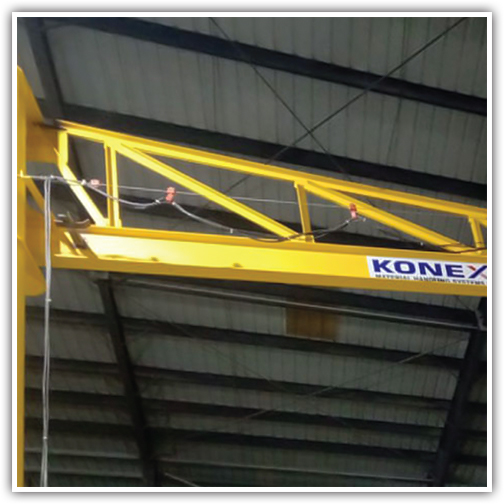
Before diving into the math, let us align on what this equipment does. A Jib Crane is a highly versatile lifting device featuring a horizontal member (known as a boom or jib) support system. This arm is mounted either on a floor-standing pillar or a structural wall.
These cranes are the ultimate localized lifting assistants. While massive overhead bridge cranes are great for moving heavy materials across an entire bay, a jib crane is designed for dedicated workstations. It takes the pressure off your larger crane systems, handling repetitive, localized lifts with extreme precision.
Whether you are looking at wall-mounted units or sturdy Pillar Mounted Cranes, choosing the right capacity is the foundation of a safe and efficient workstation.
The Golden Rule of Crane Capacity: The "Total Payload" Fallacy
When most procurement managers look for a Jib Crane India supplier, they start with a simple question: “What is the heaviest single item we manufacture?”
If the answer is 1.5 tons, they automatically assume they need a 1.5-ton crane. This is a dangerous misconception.
In industrial material handling, Capacity ≠ Load Weight.
Your crane does not just lift your product. It lifts everything attached to the product to make the lift possible. To calculate the actual capacity your factory needs, you must use the Total Lifted Load (TLL) formula.
The Total Lifted Load Formula
Before selecting a crane, you must calculate the total lifted load rather than considering only the weight of the material. The crane’s minimum required capacity should include every component that is lifted during the operation.
Use the following formula:
Total Lifted Load = Weight of the Material + Weight of the Hoist + Weight of the Trolley + Weight of Below-the-Hook Lifting Devices
This calculation ensures that your crane is properly rated to safely handle the complete load, including the payload and all attached lifting equipment.
Let us break these components down:
- The Material/Product: The absolute heaviest piece of raw material, component, or finished product you will ever need to lift at this workstation.
- The Hoist and Trolley: The motorized or manual lifting unit and its rolling carrier. These components can easily weigh anywhere from 50 kg to over 250 kg depending on their design.
- Below-the-Hook Attachments: This includes any specialized grabs, vacuum lifters, spreader beams, magnets, or custom slings needed to hold your product securely. These heavy-duty tools add substantial deadweight to the crane arm.
If your heaviest product is 1.5 tons, but your custom vacuum lifter weighs 300 kg and the electric hoist weighs 150 kg, your crane is actually lifting nearly 2 tons. Purchasing a 1.5-ton crane in this scenario would result in an immediate safety violation and equipment failure.
4 Simple Steps to Calculate Your Ideal Jib Crane Capacity
Calculating the right fit for your facility does not require an advanced engineering degree. Follow these four practical steps to identify your sweet spot.
Step 1: Map Out Your Daily Lift Profiles
Do not just look at your peak lift. Track a typical 24-hour cycle at the target workstation.
- What is your average lift weight?
- How many times per hour does the crane operate?
- What is the absolute maximum weight lifted, even if it only happens once a week?
If 95% of your daily lifts are under 1 ton, but you have a weekly lift that reaches 2.5 tons, you cannot buy a 1-ton crane. However, you also do not necessarily need to jump to a massive, custom 5-ton system. A robust 3-ton Jib Crane—like the highly popular, precision-engineered models we manufacture at Konex Material Handling System LLP—could be your perfect, cost-effective sweet spot.
Step 2: Establish Your Safety Cushion (The Operational Buffer)
In industrial settings, running any machinery at 100% of its rated limit all day, every day, accelerates wear and tear. It increases maintenance costs, causes structural fatigue, and shortens the lifespan of your equipment.
Industry best practices suggest leaving a 15% to 25% safety buffer above your calculated Total Lifted Load.
Example Calculation
Let’s say you need to lift a product weighing 2,000 kg, and the combined weight of the hoist, trolley, and below-the-hook lifting accessories is 350 kg.
- Weight of the material: 2,000 kg
- Weight of the hoist, trolley, and lifting accessories: 350 kg
- Total lifted load: 2,350 kg
To provide an additional margin of safety, apply a 20% safety buffer:
2,350 kg × 1.20 = 2,820 kg
In this example, you should choose a crane with a minimum safe lifting capacity of 2,820 kg. In practice, you would typically select the next standard crane capacity above this value to ensure safe and reliable operation.
In this scenario, a standard 3-ton (3,000 kg) capacity crane is the ideal choice. It accommodates your heaviest load comfortably while keeping your operations well within the safe working limits of the structure.
Step 3: Assess Your Spatial and Environmental Factors
Capacity is not just about vertical weight; it is also about structural dynamics. Where will the crane be installed?
- For Pillar Mounted Cranes (Floor Mounted): Is your concrete floor thick enough to handle the downward force (thrust) and the tipping force (moment) of a fully loaded crane? If your floor is thin, you might need to pour a dedicated concrete foundation.
- For Wall-Mounted Cranes: Can your factory’s existing structural steel columns support both the deadweight of the crane and its maximum lifting capacity?
Step 4: Plan for Future Scalability
A high-quality industrial crane is a long-term asset designed to perform for decades. If you purchase a crane that perfectly fits your needs today, you might limit your business growth tomorrow.
- Are you planning to introduce heavier raw materials next year?
- Will you be upgrading to heavier automated grabbing tools soon?
- Buying a slightly higher capacity now is always more economical than replacing an entire crane system two years down the line because your product lines evolved.
Understanding the Movement: Rotation Options and Their Impact
When designing a workstation layout, how the crane moves is just as important as what it lifts. Weight capacity works hand-in-hand with the crane’s rotation radius.
At Konex Material Handling System LLP, we offer two primary structural designs to fit different factory layouts:
1. Manual 270-Degree Rotation
For most standard applications, particularly those positioned next to walls, support pillars, or in corner workstations, a rotation of up to 270 degrees is perfect. This manual rotation style is highly cost-effective, easy for operators to push, and incredibly reliable for transferring materials from a pallet to a machine bed.
2. Motorized 360-Degree Rotation
If your workstation is in the middle of a busy production floor, or you need to service multiple assembly lines arranged in a circle, a motorized 360-degree rotation crane is the ultimate solution. This design allows the boom to swing in a complete, continuous circle. Because the rotation is motorized, it minimizes operator fatigue and allows for exceptionally smooth, controlled handling of heavy loads up to our standard 3-ton limit.
TYPICAL WORKSTATION COMPARISON

  [ Wall-Mounted / Corner ]          [ Center-Floor Workstation ]

         |\                              _  _  _
         | \  (Up to 270°)              /       \
         |  * |    * |  (Motorized 360°)
         | /                            \  / \  /
         |/                              -  -  -
    Saves floor space,              Maximum coverage area,
    ideal for tight corners.        perfect for circular layouts.
Why Konex Material Handling System LLP is Your Trusted Engineering Partner
Selecting a Jib Crane involves much more than simply choosing a lifting capacity. It requires working with an experienced manufacturer that understands the operational demands and challenges of today’s industrial environments.
As a leading Jib Crane Manufacturer in India with strong global export expertise, Konex Material Handling System LLP provides industry knowledge and engineering support to help optimize your facility’s material handling system. Here’s why manufacturers worldwide rely on our solutions:
- Customized Engineering Solutions: From manual 270° rotation jib cranes to fully motorized 360° rotation systems, we design cranes that integrate seamlessly with your existing facility layout.
- Optimized 3-Ton Performance: Our robust jib crane systems are engineered to handle loads of up to 3 tons, making them ideal for automotive, fabrication, foundries, warehouses, and various industrial applications.
- International Quality Standards: Every crane is built to withstand demanding multi-shift operations while meeting globally recognized safety and performance requirements.
- Comprehensive Engineering Support: We offer more than just equipment. Our engineering specialists collaborate with your project team to evaluate foundation requirements, verify structural column strength, and recommend the most suitable hoist speed and travel configuration for your specific lifting application.
Get a Custom Workstation Assessment Today
Calculating your factory’s exact crane capacity does not have to be a guessing game. By focusing on your Total Lifted Load (TLL), planning for a safe operational buffer, and selecting the right rotation profile, you can protect your workers, streamline your assembly line, and maximize your return on investment.
Stop guessing your material handling requirements. Let the engineering experts at Konex Material Handling System LLP design a high-performance system customized for your operations.
Ready to optimize your production line? Contact our technical sales team today for a free, no-obligation workstation consultation. We will help you select the exact Jib Crane India solution or export configuration to take your factory’s productivity to the next level.
Reach Out to Our Experts:
- Corporate Office: India (Serving Domestic and Worldwide Markets)
- Specialty: Overhead Cranes, Pillar Mounted Systems, Custom Handling Equipment
- Get in Touch: Click below to submit your floor layout drawings, and let us engineer your ideal material handling solution.
Contact us : info@konex.co.in , +91 98240 11164 | +91 90999 02956
FAQs
To calculate the correct Jib Crane capacity, determine the Total Lifted Load (TLL) instead of considering only the product weight. Add together the weight of the material, hoist, trolley, and all below-the-hook lifting devices. Then apply a 15%–25% safety margin and choose the next higher standard crane capacity to ensure safe and efficient operation.
The Total Lifted Load (TLL) formula is:
Total Lifted Load = Material Weight + Hoist Weight + Trolley Weight + Below-the-Hook Lifting Device Weight
This formula helps ensure the selected Jib Crane is rated to safely lift the complete working load, not just the product itself.
A safety buffer prevents the crane from operating continuously at its maximum rated capacity, reducing structural fatigue, maintenance costs, and wear. Most industrial applications recommend selecting a crane with 15%–25% more capacity than the calculated Total Lifted Load.
An undersized Jib Crane can overload the structure, increase the risk of equipment failure, create workplace safety hazards, and violate lifting safety standards. It may also reduce the crane’s service life and lead to costly repairs or downtime.
Yes. The hoist, trolley, slings, vacuum lifters, magnets, spreader beams, grabs, and other below-the-hook devices are part of the lifted load. Ignoring their weight can result in selecting a crane that is too small for safe operation.
A 270-degree Jib Crane is commonly used near walls, columns, or corners where space is limited. A 360-degree Jib Crane provides full circular rotation, making it ideal for central workstations that need maximum coverage and continuous material handling.
A wall-mounted Jib Crane is suitable when the building’s structural columns can support the crane and when floor space must remain clear. A pillar-mounted Jib Crane is installed on its own foundation and is ideal when independent support, greater flexibility, or full rotation is required.
If your factory plans to handle heavier products, install larger tooling, or expand production, choosing a slightly higher-capacity Jib Crane today can reduce future replacement costs and support long-term operational growth without requiring a completely new crane system.
Jib Cranes are widely used in automotive manufacturing, fabrication shops, warehouses, machine shops, foundries, assembly lines, maintenance departments, logistics centers, and heavy engineering facilities for safe and efficient workstation lifting.
Before purchasing a Jib Crane, evaluate:
- Total Lifted Load (TLL)
- Required lifting capacity
- Safety buffer
- Rotation angle (270° or 360°)
- Boom length and lifting height
- Floor or wall structural strength
- Duty cycle and frequency of use
- Future expansion requirements
- Compliance with industrial safety standards
Choosing the right combination of these factors ensures reliable performance, improved productivity, and long-term return on investment.