
How Do Double Girder EOT Cranes Improve Vertical Lifting Height?
In the competitive landscape of Indian manufacturing and global industrial exports, factory space is more than just square footage—it is a strategic asset. For plant managers and factory owners, the challenge isn’t just how much weight you can lift, but how efficiently you can use the vertical envelope of your facility.
When it comes to heavy-duty material handling, the Double Girder EOT Crane stands out as the gold standard for maximising vertical lifting height. At Konex Material Handling System, we understand that every inch of “hook path” translates to better storage capacity, safer maintenance protocols, and streamlined production cycles.
In this guide, we will explore why a Double Girder EOT Crane is the superior choice for high-clearance operations and how it helps businesses across India and the globe reduce downtime while optimising their infrastructure.
The Vertical Challenge in Modern Factories
Traditional lifting solutions often struggle with “headroom”—the distance between the crane’s bridge and the highest point the hook can reach. In many industrial setups, a significant portion of the building’s height is “dead space” occupied by the crane’s own structure.
For a procurement head or a maintenance engineer, this lost height is a hidden cost. It means you can’t stack goods higher, you can’t service tall machinery easily, and you might even need to build a taller (and more expensive) factory shed to compensate.
This is where the engineering of a Double Girder EOT Crane provides a definitive advantage.
Why a Double Girder EOT Crane Maximizes Lifting Height
The primary reason a Double Girder EOT Crane offers better vertical lift compared to single girder alternatives lies in the placement of the hoisting mechanism.
1. The “Top-Running” Advantage
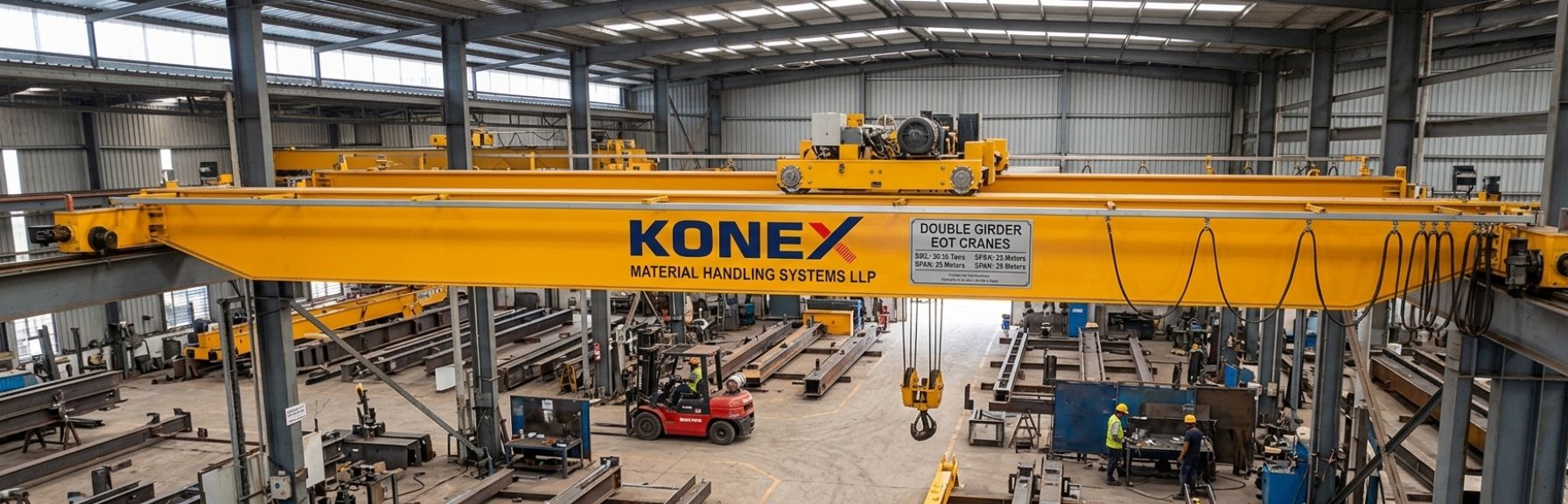
In a single girder setup, the hoist usually hangs underneath the beam. In contrast, in a Double Girder EOT Crane, the crab (hoist unit) travels on top of the two girders. Because the hoist sits above the beams, the hook can be drawn up much higher—often right between the two girders. This design effectively recaptures the height of the crane bridge itself, giving you maximum “floor-to-hook” distance.
2. Reduced Headroom Requirements
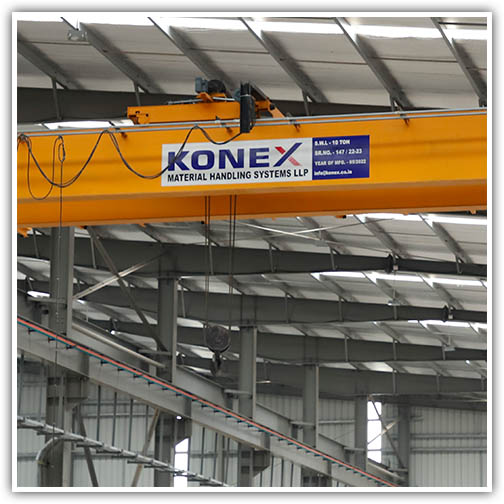
“Headroom” refers to the vertical space required above the crane’s rails. Because the EOT Crane design allows the trolley to sit between or on top of the girders, the entire system can be positioned closer to the roof’s rafters. This is a game-changer for existing factories with low ceilings that need to handle tall loads.
3. Stability at Great Heights
Lifting height isn’t just about the distance; it’s about the stability of the load at that height. A Double Girder EOT Crane provides a wider footprint. This dual-beam support minimizes “hook drift” and swinging, which is critical when you are lifting heavy components to the very top of your facility’s vertical limit.
Why Lifting Height Matters to Your Bottom Line
Choosing the right Double Girder EOT Crane Manufacturer isn’t just a technical decision; it’s a financial one. Here is how improved vertical lift impacts your ROI:
Increased Storage Density
In warehousing and heavy fabrication, vertical space is free, whereas floor space is expensive. By using an EOT Crane that offers maximum lift, you can implement higher racking systems or stack large industrial components vertically, effectively increasing your plant’s capacity without expanding its footprint.
Easier Maintenance of Large Equipment
For maintenance engineers, a few extra feet of hook height can mean the difference between a simple repair and a week-long teardown. High-clearance cranes allow you to lift heavy assemblies over other machines, facilitating faster repairs and significantly reducing operational downtime.
Future-Proofing Your Facility
Your production needs today might change tomorrow. Investing in a Double Girder EOT Crane ensures that if you ever pivot to manufacturing taller products or installing larger machinery, your material handling system won’t become a bottleneck.
Safety and Reliability with Konex Material Handling System
As a leading Double Girder EOT Crane Manufacturer in India, Konex prioritises safety alongside performance. Lifting high means managing higher risks, which is why our designs focus on:
- Structural Integrity: Using high-grade steel to ensure zero deflection at maximum lift.
- Precision Control: Advanced VFD (Variable Frequency Drive) options to ensure smooth vertical movement, preventing sudden jerks that can endanger workers.
- Customisation: We don’t believe in “one size fits all.” We analyse your factory’s shed dimensions to custom-build a crane that offers the absolute maximum lifting height possible for your specific roof profile.
Selecting the Right Double Girder EOT Crane Manufacturer in India
India has emerged as a global hub for industrial engineering, but not all manufacturers are created equal. When searching for a Double Girder EOT Crane Manufacturer, look for a partner who understands the nuances of Indian power conditions, dust levels, and the need for high-uptime reliability.
At Konex Material Handling System, we combine local expertise with global standards. Whether you are a local SME in Maharashtra or a large-scale enterprise exporting to the Middle East or Europe, our cranes are designed to meet international safety and quality benchmarks.
Elevate Your Productivity
The vertical lifting height of your facility is a resource you cannot afford to waste. A Double Girder EOT Crane is more than just a piece of machinery; it is a structural solution that unlocks the full potential of your factory volume.
By choosing an EOT Crane from a trusted Double Girder EOT Crane Manufacturer in India like Konex, you are investing in a system that reduces costs, improves safety, and maximizes your operational throughput.
Ready to optimize your factory’s vertical space?
Contact Konex Material Handling System today. Our engineers are ready to help you design a lifting solution that reaches higher and works harder.
Contact Us : +91 9824011164 | +91 90999 02956
FAQs
A Double Girder EOT Crane is an overhead crane with two parallel girders where the hoist runs on top. This design allows the hook to rise higher between the girders, maximizing vertical lifting height and reducing unused overhead space.
Unlike single girder cranes where the hoist hangs below the beam, a Double Girder EOT Crane places the hoist above the girders. This “top-running” design increases the floor-to-hook distance, enabling higher lifting capacity within the same building height.
Headroom is the vertical space between the crane rail and the highest lifting point of the hook. Lower headroom requirements mean the crane can utilize more vertical space, making Double Girder EOT Cranes ideal for facilities with height constraints.
Yes, by maximizing vertical lifting height, Double Girder EOT Cranes allow factories to stack materials higher. This improves storage density and reduces the need for additional floor space or facility expansion.
Vertical lifting height directly impacts operational efficiency. Higher lifting capability allows easier handling of tall machinery, better space utilization, and faster maintenance processes, reducing downtime and costs.
Yes, they are highly suitable. Their design minimizes headroom usage, allowing installation closer to the roof structure, making them ideal for existing factories with limited ceiling height.
The dual girder structure provides better balance and support, reducing hook sway and load drift. This ensures safer and more precise lifting, especially when handling heavy loads at maximum height.
Industries such as steel manufacturing, heavy fabrication, automotive, warehousing, and power plants benefit the most, as they require handling large and tall components efficiently.
Better lifting height increases storage efficiency, reduces infrastructure costs, and minimizes downtime during maintenance. This leads to higher productivity and a faster return on investment.
Look for a manufacturer with strong engineering expertise, customization capabilities, compliance with safety standards, and experience in handling Indian industrial conditions like dust, voltage fluctuations, and heavy-duty usage.