

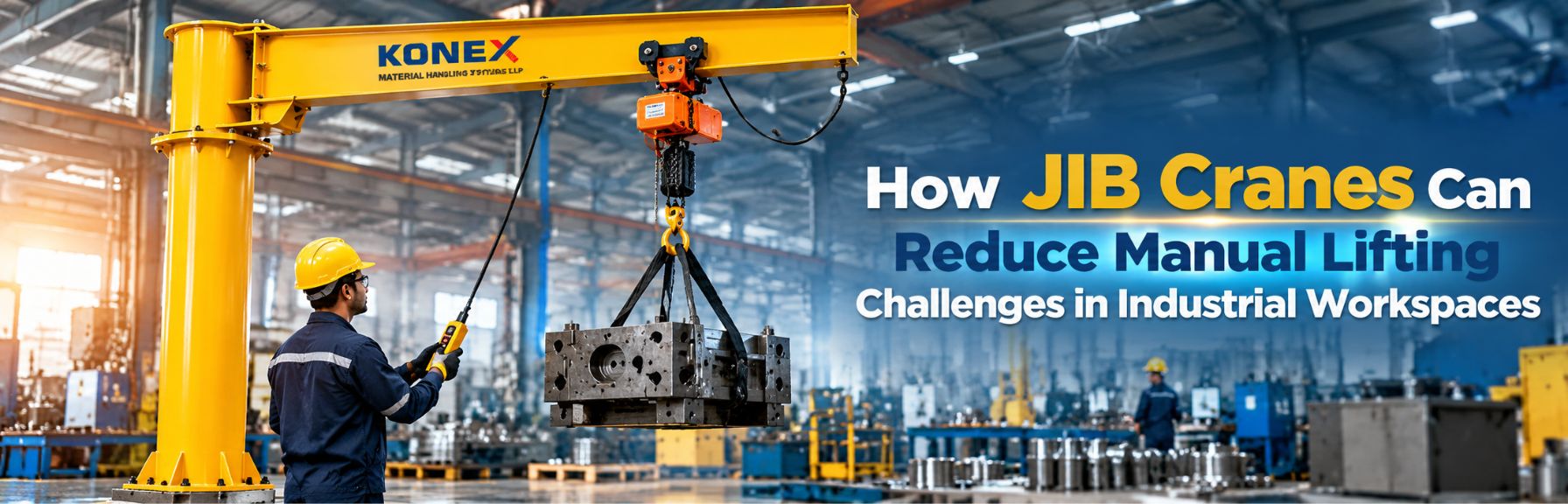
How Modern JIB Cranes Eliminate Manual Lifting Challenges in Industrial Workspaces
In today’s fast-paced manufacturing and industrial environments, operational efficiency depends heavily on how smoothly materials move across the factory floor. While large overhead cranes handle heavy bulk movement across entire bays, a significant portion of daily delay occurs at individual workstations.
Repetitive manual lifting of heavy parts, machinery components, and raw materials remains one of the largest hidden costs in industrial facilities. It causes worker fatigue, increases injury risks, slows down assembly lines, and damages goods.
To solve these localized material handling challenges, forward-thinking operations are turning to localized JIB Cranes. Designed for precise, targeted lifting within a dedicated area, these versatile systems bridge the gap between human labor and large-scale overhead cranes.
The Hidden Impact of Manual Material Handling on Industrial Workspaces
Manual material handling might seem like a natural part of daily shop-floor tasks, but relying on manual effort or waiting for central overhead cranes creates severe operational friction:
- Physical Strain and Safety Hazards: Repetitive bending, twisting, and lifting heavy components leads to musculoskeletal disorders (MSDs), operator exhaustion, and preventable workplace injuries.
- Production Bottlenecks: When machine operators have to pause work to wait for a shared overhead crane just to load a piece of raw material, valuable machine time is wasted.
- Accidental Material Damage: Manual handling of bulky or odd-shaped items increases the likelihood of drops, scratches, and costly product rejections.
- Reduced Workforce Efficiency: Physical fatigue directly impacts concentration and output as shifts progress, leading to reduced overall productivity.
Integrating dedicated lifting equipment at individual work cells eliminates these obstacles, ensuring continuous workflow and a safer environment.
How JIB Cranes Transform Workstation Material Handling
A JIB Crane is a specialized lifting system featuring a horizontal arm (jib or boom) mounted to a wall, column, or floor-mounted pillar. It provides localized lifting coverage within a defined semi-circular or full 360-degree rotation radius.
Here is how implementing these systems directly addresses daily manual lifting challenges:
1. Effortless Ergonomic Lifting
Instead of requiring multiple workers to manually position or lift heavy loads, a single operator can smoothly maneuver materials with complete control. The ergonomic design reduces physical exertion to minimal effort, keeping operators safe and energetic throughout their shift.
2. Immediate Accessibility and Zero Waiting Time
In a busy facility, waiting for a main bridge crane to transport materials can halt production for 15 to 30 minutes at a time. A dedicated workstation crane empowers operators to handle loading, unloading, and positioning instantly, eliminating idle production hours.
3. Precise Load Positioning
Whether loading a CNC machine, assembling delicate components, or moving dies in a molding setup, precision is vital. Modern lifting mechanisms allow micro-adjustments, ensuring parts align accurately without manual forcing or alignment stress.
4. Compact Footprint with Flexible Coverage
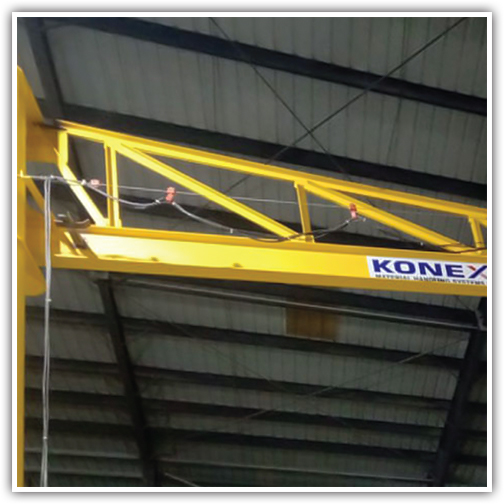
Industrial space is valuable. Wall-mounted and column-mounted designs require zero floor space, while free-standing pillar units can be strategically placed exactly where lifting demand is highest.
Key Industries Benefiting from Workstation Crane Solutions
Properly integrated lifting systems deliver measurable improvements across a wide variety of industrial sectors:
- Machining & Tool Rooms: Effortless loading and unloading of heavy castings, billets, and tooling fixtures directly into machine beds.
- Automotive Assembly: Smooth, repeatable movement of engines, transmissions, and structural body parts along sub-assembly stations.
- Fabrication & Welding Bays: Easy positioning of steel plates, tubes, and fabricated structures for welding and surface treatment.
- Maintenance & Repair Depots: Safe lifting during equipment teardowns, pump repairs, and heavy component overhauls.
- Warehousing & Packaging: Streamlined loading of crates, pallets, and bulk goods into packaging lines.
Choosing the Right Partner: Why Experience Matters
Investing in lifting equipment is a long-term operational decision. To maximize safety, longevity, and operational uptime, partnering with an experienced manufacturer is essential.
Konex Material Handling System LLP stands as a trusted JIB Crane Manufacturer based in India, providing engineered material handling solutions built for rigorous industrial demands. With robust manufacturing capabilities and an expanding global footprint, Konex delivers reliable lifting systems to clients across India and international markets.
What Sets Konex Solutions Apart?
- Problem-Solving Focus: Solutions designed specifically around your floor plan, weight requirements, and operational workflow.
- Commitment to Quality & Safety: Built to rigorous standards ensuring smooth mechanical movement, structural integrity, and long service life.
- Global Delivery Capability: Combining India’s manufacturing excellence with world-class export readiness to serve global industrial markets.
- End-to-End Support: From initial consultation and system selection to installation guidance and long-term service support.
Modernize Your Workstations and Boost Productivity Today
Eliminating manual lifting risks is not just about safety compliance—it is a direct strategy to increase your factory’s output, protect your workforce, and reduce operational downtime. By providing your operators with reliable, localized lifting equipment, you create a faster, safer, and far more productive industrial facility.
Ready to Upgrade Your Workplace Efficiency?
Connect with the engineering team at Konex Material Handling System LLP to discuss your shop-floor requirements. Whether you are upgrading an existing facility in India or sourcing material handling equipment for export projects worldwide, our team is ready to guide you toward the ideal solution.
Contact us : info@konex.co.in , +91 98240 11164 | +91 90999 02956
FAQs
JIB cranes reduce manual lifting by allowing operators to lift, move, and position heavy materials with controlled mechanical assistance. They provide dedicated lifting at workstations, reducing the need for workers to manually carry, push, or position heavy components.
A JIB crane can help address repetitive heavy lifting, worker fatigue, awkward load positioning, workstation bottlenecks, and delays caused by waiting for a shared overhead crane. It is particularly useful where materials need to be moved repeatedly within a defined work area.
An overhead crane is generally suited for moving loads across larger areas, while a JIB crane provides localized lifting at a specific workstation. A dedicated JIB crane can make frequently repeated lifting tasks more accessible without requiring operators to wait for a shared overhead crane.
Yes. JIB cranes can be used for controlled loading and unloading of CNC machines, tooling, fixtures, castings, and other components when the crane is properly selected for the application. Their localized operating area makes them suitable for repetitive workstation lifting tasks.
A properly designed JIB crane can allow a single trained operator to control lifting and positioning of loads that would otherwise require significant manual effort. The actual number of operators depends on the load, lifting equipment, workplace conditions, and applicable safety requirements.
JIB cranes are commonly used at machining stations, tool rooms, welding and fabrication bays, maintenance areas, automotive assembly stations, warehouses, and packaging workstations where localized lifting is required.
A JIB crane can improve productivity by making lifting equipment immediately available at the point of work. This can reduce material-handling delays, simplify repetitive lifting tasks, and help operators maintain a smoother workflow between loading, positioning, assembly, and unloading operations.
The suitable JIB crane depends on the available space, load-handling requirements, mounting conditions, and required coverage. Wall-mounted or column-mounted arrangements can be considered where floor space is limited, while floor-mounted pillar JIB cranes can be positioned close to specific workstations.
Consider the load to be lifted, lifting frequency, required working radius, available installation space, mounting structure, operating environment, and the type of load movement required. An experienced JIB crane manufacturer can evaluate these factors and recommend a configuration suited to the workstation.
An experienced JIB Crane Manufacturer can help match the crane configuration to the actual workstation, load-handling process, available space, and operating requirements. This helps ensure that the lifting system is practical for daily use, properly integrated into the workspace, and aligned with the facility’s material-handling needs.