

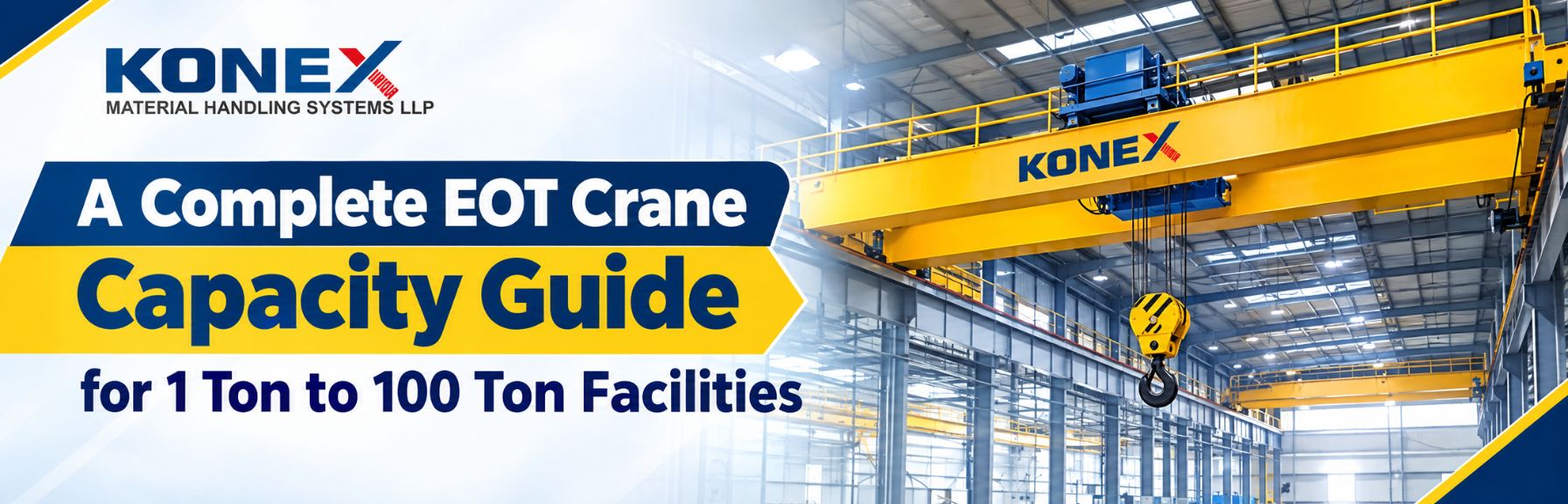
A Complete EOT Crane Capacity Guide for 1 Ton to 100 Ton Facilities
Investing in an electric overhead traveling crane is one of the most vital decisions a plant manager or factory owner can make. Choosing an undersized crane leads to unsafe conditions, premature wear, and costly operational shutdowns. On the other hand, buying a crane that far exceeds your real requirements wastes valuable capital on unnecessary building upgrades and excessive energy consumption.
To make an informed decision, you need a straightforward, practical EOT Crane Capacity Guide that breaks down how lifting demands align with real-world factory workflows.
In this guide, Konex Material Handling System LLP—a premier Indian crane manufacturer with global export capabilities—explores how to evaluate EOT Crane Load Capacity from 1 Ton to 100 Ton. You will learn how to protect your workforce, maximize operational efficiency, and choose a solution that delivers maximum return on investment.
Why Right-Sizing Your Industrial EOT Crane Capacity Matters
When evaluating Industrial EOT Crane Capacity, plant owners often look only at the heaviest item they need to lift today. However, true load planning requires evaluating how your material handling system performs over its entire operating lifespan.
An ideal EOT Crane Capacity balances three fundamental business priorities:
- Safety & Equipment Lifespan: Running a crane continuously at its absolute maximum weight limit accelerates wear on wire ropes, motors, and structural beams. Maintaining a healthy operational buffer extends equipment life and protects workers.
- Structural Harmony: The total EOT Crane Load Capacity directly determines the structural demands placed on your factory pillars, gantry girders, and foundation.
- Future-Proof Scalability: Upgrading or replacing a bridge crane two years after installation costs significantly more than selecting a slightly higher capacity during initial building design.
Understanding these factors is the foundation of any reliable EOT Crane Selection Guide.
Selecting EOT Crane Capacity from 1 Ton to 100 Ton: A Practical Framework
To keep decision-making simple and free of overwhelming technical jargon, material handling needs generally fall into three operational categories. Here is how EOT Crane Capacity from 1 Ton to 100 Ton aligns with typical industrial applications.
Tier 1: Light to Medium Workflows (1 Ton to 10 Ton)
For light assembly lines, machine tool shops, maintenance bays, and auto-component workshops, lifting demands generally remain under 10 tons.
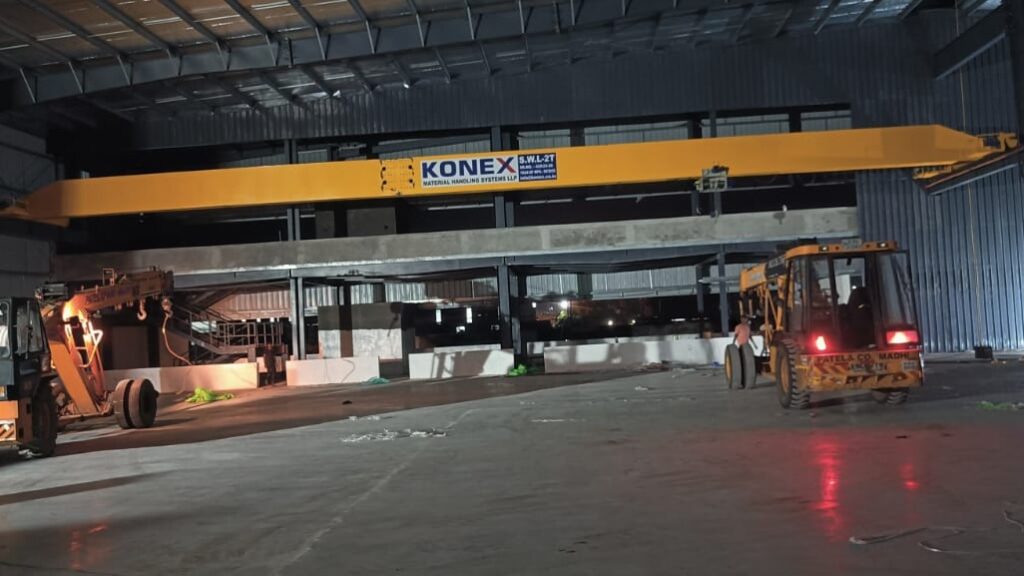
- Recommended Architecture: Single Girder EOT Crane Capacity configurations are ideal for this range. A single bridge girder combined with an efficient electric hoist provides a compact, cost-effective lifting setup.
- Key Operational Advantages: Lighter structure weight, lower demand on building support columns, quick installation, and minimal initial capital expense.
- Common Industry Uses: Plastic injection molding units, small fabrication shops, light warehousing, and automotive repair stations.
Tier 2: Medium to Heavy Duty Manufacturing (10 Ton to 30 Ton)
When weight requirements exceed 10 tons, facility owners enter a versatile range where single or double bridge designs may be used depending on ceiling height and span width.
- Recommended Architecture: While heavy-duty single girder cranes can handle up to 15 tons over short distances, a Double Girder EOT Crane Capacity configuration becomes the standard choice above 15 tons.
- Key Operational Advantages: Improved hook height (since the hoist sits on top of the girders rather than hanging beneath them), superior stability across wider spans, and smoother handling of medium-heavy materials.
- Common Industry Uses: Steel fabrication, paper manufacturing, foundry operations, equipment assembly, and regional logistics hubs.
Tier 3: Heavy Industrial & Process Lifting (30 Ton to 100 Ton)
Extreme industrial environments—such as steel mills, power stations, and heavy machinery plants—require heavy-duty double girder systems built for high-tonnage material movement.
- Recommended Architecture: Dedicated double girder structures equipped with heavy-duty open-winch hoisting mechanisms.
- Key Operational Advantages: Maximum vertical hook reach, extreme structural rigidity, continuous duty operation, and the option to add auxiliary hoists for twin-hook precision handling.
- Common Industry Uses: Steel coil handling, power plant turbine maintenance, shipyard fabrication, and large-scale infrastructure projects.
Simple EOT Crane Capacity Chart for Decision Makers
Use this strategic decision frame to quickly assess which category matches your plant floor needs:
|
Operational Tonnage Range |
Preferred Crane Setup |
Primary Facility Focus |
Main Business Benefit |
|
1 Ton – 5 Ton |
Single Girder EOT Crane |
Light Workshops & Maintenance Bays |
Highly economical, fast installation, low space requirements |
|
5 Ton – 10 Ton |
Single Girder / Compact Double Girder |
General Assembly & Tooling Rooms |
Great flexibility, minimal structural reinforcement required |
|
10 Ton – 30 Ton |
Double Girder EOT Crane |
Heavy Fabrication & Foundries |
Higher hook clearance, safe handling across wide building spans |
|
30 Ton – 100 Ton |
Heavy-Duty Double Girder |
Steel Mills & Power Infrastructure |
Maximum lifting force, heavy duty cycle endurance |
Note: Custom engineering allows customized configurations based on building dimensions, operating hours, and handling needs.
4 Essential Factors Beyond Tonnage When Reviewing EOT Crane Specifications
When consulting an EOT Crane Selection Guide, evaluating weight tonnage alone is not enough. To ensure smooth daily operations, plant managers must review four practical factors:
- Daily Operational Frequency: A 5-ton crane used twice a day for equipment maintenance requires a different operational design than a 5-ton crane moving raw materials 20 hours a day. High-usage operations require heavier-duty components to prevent overheating and premature wear.
- Hook Elevation & Ceiling Headroom: The available distance between your floor and ceiling dictates your hoist position. Double girder cranes provide extra vertical hook travel, making them ideal for facilities with low clearance.
- Building Span & Structure Strength: The distance between support rails affects beam flexing under load. As building spans widen, moving to a double girder setup ensures smooth movement without placing excessive stress on factory columns.
- Special Handling Requirements: If your factory handles long, flexible, or uneven loads (such as steel tubes, timber, or concrete beams), dual hoists or auxiliary lifting attachments help balance and move materials safely.
Evaluating these practical EOT Crane Specifications ensures your material handling system operates safely without unexpected bottlenecks.
Why Leading Global Industries Partner with Konex Material Handling System LLP
Selecting the right lifting equipment is a long-term capital investment that impacts factory safety and output for decades. Partnering with a proven manufacturer ensures your crane is tailored precisely to your operational workflow.
Based in India with strong global export capabilities, Konex Material Handling System LLP designs and manufactures high-performance material handling equipment engineered to international standards.
The Konex Commitment to Excellence:
- Custom Engineering Focus: Every solution is designed around your specific facility geometry, workflow speed, and budget—preventing over-spending while ensuring total reliability.
- Uncompromising Safety Standards: Built with robust overload safeguards, precision control options, and heavy-duty structural steel to protect your team and assets.
- Global Quality Standards: Built in India using state-of-the-art manufacturing techniques, serving industrial facilities locally and across international markets.
- End-to-End Operational Guidance: From site evaluation and load planning to installation, testing, and lifetime maintenance support, our team guides you every step of the way.
Plan Your Facility's Lifting Strategy Today
Avoid the risks of under-specifying or the wasted capital of over-specifying your lifting equipment. Let the engineering experts at Konex Material Handling System LLP help you select the ideal crane solution tailored to your operational goals.
Ready to Optimize Your Plant Floor Efficiency?
- Speak with Our Engineering Consultants: Discuss your plant layout, load requirements, and daily handling goals with our technical team.
- Request a Custom Layout & Capacity Proposal: Receive an actionable recommendation designed to maximize safety, workflow speed, and operational return on investment.
+91 9824011164 | +91 90999 02956
FAQs
Choose an EOT crane capacity based on your maximum lifting load, lifting frequency, span, hook height, building structure, and future material-handling requirements. The crane should provide an appropriate operational margin rather than being selected only for today’s heaviest load.
A 1 Ton to 5 Ton EOT Crane is generally suitable for light manufacturing, maintenance bays, workshops, assembly areas, and small fabrication facilities. A single girder EOT crane is often a practical and economical choice for these applications.
For 5 Ton to 10 Ton EOT Crane Capacity, either a single girder or compact double girder configuration may be considered depending on span, lifting frequency, headroom, and building conditions. The final selection should be based on the complete application rather than load capacity alone.
A Double Girder EOT Crane is generally preferred when lifting requirements become heavier, spans are wider, greater hook height is required, or the crane will operate under demanding duty conditions. For many heavy industrial applications above approximately 15 tons, double girder construction provides greater structural stability.
10 Ton to 30 Ton EOT Crane Capacity is commonly used for steel fabrication, foundries, paper mills, equipment manufacturing, heavy assembly, and industrial warehouses. Double girder EOT cranes are often preferred in this range because of their rigidity and suitability for heavier-duty operation.
For 30 Ton to 100 Ton EOT Crane Capacity, heavy-duty double girder EOT cranes are typically considered. These cranes are suitable for demanding applications such as steel mills, power plants, heavy machinery manufacturing, shipyards, and large infrastructure projects.
No. EOT crane capacity is only one part of crane selection. Buyers should also evaluate lifting frequency, duty cycle, hook height, building span, available headroom, runway structure, travel speed, load characteristics, and any special lifting requirements.
Crane span is the distance between the runway rails supporting the crane. A wider span can increase structural and operational demands, so the crane design must be selected according to the building dimensions and load requirements. Double girder configurations may be more suitable for wider spans and heavier applications.
Hook height determines how high the crane can lift and position a load. If your factory has limited headroom or needs maximum usable lifting height, the hoist and girder arrangement should be carefully selected to achieve the required hook elevation without interfering with the building structure.
Operating frequency does not simply increase the crane’s rated tonnage, but it significantly affects the crane duty classification and component selection. A crane lifting 5 tons occasionally has different requirements from a 5-ton crane operating continuously throughout multiple shifts.
Yes. An EOT crane can be engineered around specific load capacity, span, lifting height, operating frequency, building dimensions, load type, control requirements, and available headroom. Custom engineering helps avoid both under-specification and unnecessary investment.
Konex Material Handling System LLP can help evaluate your load requirements, factory layout, span, hook height, operating frequency, and application before recommending a suitable EOT crane configuration. The company provides customized material-handling solutions for industrial applications in India with global export capabilities.