

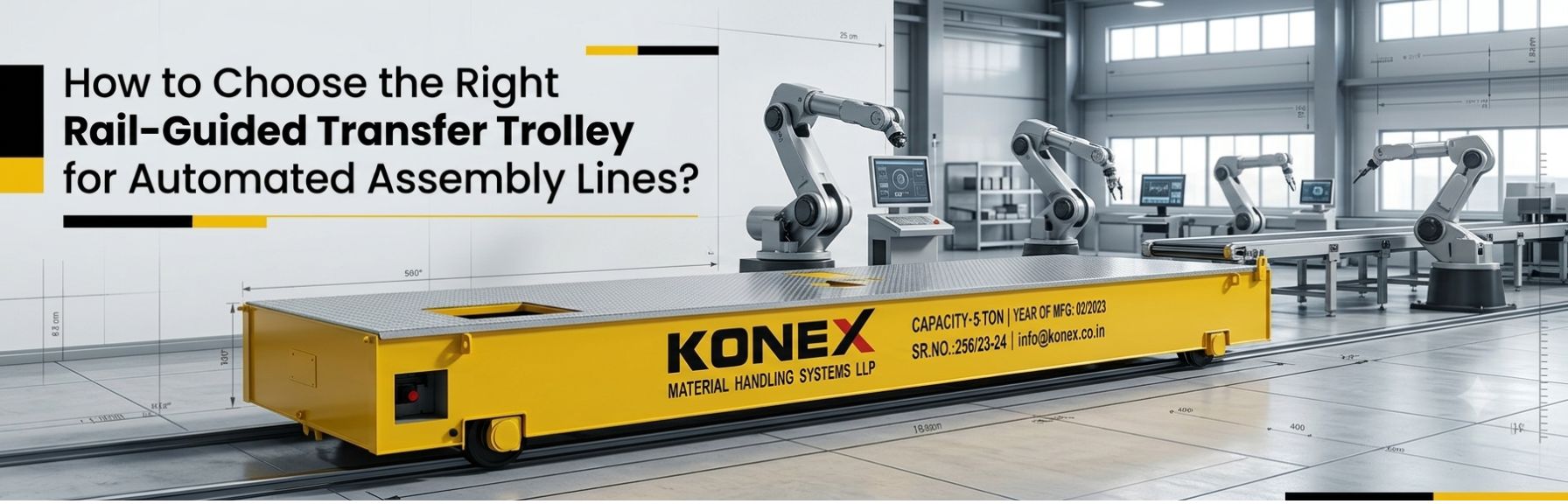
How to Choose the Right Rail-Guided Transfer Trolley for Automated Assembly Lines
In today’s hyper-competitive manufacturing landscape, efficiency isn’t just an advantage—it is a necessity. As assembly lines become more automated and production schedules grow tighter, the way you move heavy materials across your factory floor can make or break your operational success. If you are still relying on outdated transport methods, manual labor, or congested forklift traffic, you are likely losing valuable time and money.
This is where a high-quality transfer trolley changes the game. Specifically, a rail-guided system offers unparalleled stability, safety, and integration capabilities for modern plants. But with so many options available on the market, how do you select the perfect equipment for your specific facility?
In this comprehensive guide, we will walk you through exactly how to choose the right rail-guided transfer trolley for your automated assembly lines. We will explore key considerations, operational benefits, and why partnering with a reputable Transfer Trolley Manufacturer is the best investment you can make for your facility’s future.
The Hidden Costs of Inefficient Material Handling
Before diving into how to choose the right equipment, it is crucial to understand the problem you are solving. Many facility managers underestimate the hidden costs of poor material handling.
When heavy components are moved inefficiently, several issues arise:
- Production Bottlenecks: Assembly lines sit idle waiting for parts to arrive, killing your throughput rate.
- Safety Hazards: Relying heavily on traditional forklifts for massive, bulky items increases the risk of workplace accidents, leading to costly downtime and liability.
- Product Damage: Inconsistent or jerky movements during transport can damage expensive raw materials or semi-finished goods.
- Labor Inefficiency: Wasting skilled human resources on manual material pushing or complex rigging takes them away from value-adding tasks.
Implementing an industrial transfer trolley eliminates these bottlenecks. By establishing a fixed, automated, and highly reliable transport route, you ensure that materials flow seamlessly from one workstation to the next.
What is a Rail-Guided Transfer Trolley?
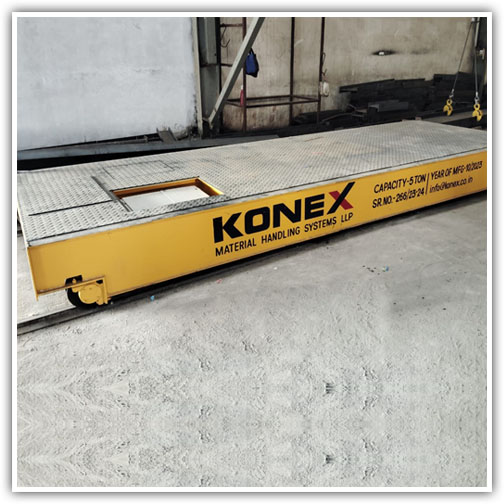
At its core, a rail-guided transfer trolley is a heavy-duty, motorized material handling cart designed to move massive loads along a fixed, pre-defined track or rail system on your factory floor.
Unlike free-roaming vehicles, rail-guided trolleys operate on a set path. This makes them incredibly predictable and stable, which is exactly what highly automated assembly lines require. They act as the vital arteries of a manufacturing plant, seamlessly feeding heavy components—such as steel coils, automotive chassis, large molds, or heavy machinery parts—directly into the production sequence without disrupting surrounding operations.
5 Undeniable Benefits of a Rail-Guided System for Assembly Lines
Why are modern factories rapidly adopting rail-guided systems over traditional transport methods? Here is why an industrial transfer trolley india and globally is becoming the industry standard:
1. Pinpoint Accuracy and Predictability
Because they run on fixed tracks, rail-guided trolleys deliver materials to the exact same spot, every single time. This millimeter-perfect positioning is crucial for automated assembly lines where robotic arms or automated cranes rely on parts being in precise locations.
2. Massive Load Capabilities
Whether you need to move 40 tons, rail-guided systems are built to handle the most extreme weights. The rails distribute the heavy load evenly across your factory floor, preventing structural damage to your concrete foundations.
3. Unmatched Workplace Safety
With a fixed route, workers always know where the trolley will be. Equipped with modern safety sensors, these systems eliminate the unpredictable movement of forklifts, drastically reducing the chances of collisions and workplace injuries.
4. Seamless Automation Integration
The beauty of a modern transfer trolley is its ability to “talk” to your existing factory systems. They can be integrated into your central control system, automatically dispatching themselves when a workstation signals that it is ready for the next component.
5. Continuous Workflow
By operating on a continuous, reliable loop or shuttle system, these trolleys ensure your assembly line never starves for parts. They keep the rhythm of production flowing flawlessly, maximizing your overall factory output.
How to Choose the Right Rail-Guided Transfer Trolley: Key Factors
Selecting the right material handling equipment is a major capital investment. To ensure you get the maximum return on investment (ROI) and a system perfectly tailored to your needs, you must evaluate several crucial factors.
1. Analyze Your Load Requirements (Weight, Size, and Shape)
The very first step is understanding exactly what you are moving. Do not just look at the average weight; you must design your system for the absolute maximum load you will ever need to transport.
Furthermore, consider the physical dimensions and shape of the materials. Are you moving flat steel plates, cylindrical coils, or oddly shaped machinery? A top-tier Transfer Trolley Manufacturer will customize the deck of the trolley to suit your specific load. For example, moving steel coils requires a V-deck or U-deck design to prevent the load from rolling off during transit.
2. Determine the Travel Path and Distance
Take a hard look at your factory layout. How far does the trolley need to travel? Is it a straight line from Point A to Point B, or does the rail system need to navigate curves, intersections, or multiple assembly bays?
For straight, repetitive, and long-distance transfers, a rail-guided trolley is flawless. If your route requires complex switching mechanisms or turntables to change directions, you must communicate this early on so the system can be engineered to handle cross-bay transfers smoothly.
3. Choose the Right Power Source
How will your trolley get its power? The right choice depends on your operating environment and travel distance. While we won’t get bogged down in heavy technical jargon, here are the simple options you should consider:
- Battery-Powered: Excellent for environments where cables might get in the way or where the trolley needs to travel across areas where laying permanent power lines is difficult. They are clean, quiet, and highly flexible.
- Cable-Reel Powered: Ideal for shorter, straight-line distances where heavy, continuous power is needed. A cable rolls out and retracts as the trolley moves.
- Low-Voltage Rail Powered: This uses the tracks themselves to conduct power. It is brilliant for highly automated, high-frequency continuous operations because there are no batteries to charge or cables to manage.
Your manufacturer will help you assess your factory’s specific layout to recommend the most cost-effective and reliable power method.
4. Consider the Operating Environment
Where will the transfer trolley be operating? A trolley working in a clean, climate-controlled automotive assembly plant will have different requirements than one working in a harsh steel mill, a dusty foundry, or an outdoor shipping yard.
If your trolley will be exposed to extreme heat, corrosive chemicals, heavy dust, or outdoor weather conditions, it must be built with specialized, durable materials and protective enclosures. Make sure you clearly communicate your environmental conditions so the equipment can be robustly protected.
5. Level of Automation and Control
How do you want your operators to control the equipment?
- Manual Pendant Control: An operator walks alongside the trolley with a remote control.
- Wireless Remote: The operator controls the trolley from a safe distance, providing a better vantage point for massive loads.
- Fully Automated: The trolley is integrated directly into your assembly line’s computer system. It moves automatically based on production sensors, stopping and starting without any human intervention.
For automated assembly lines, moving toward a fully automated or semi-automated setup provides the highest efficiency and lowest long-term labor costs.
6. Essential Safety Features
Safety is non-negotiable. When moving tons of material, the equipment must protect your workforce and your facility. Look for a system that includes:
- Laser scanners or radar to detect obstacles on the tracks.
- Automatic braking systems if an object or person enters the trolley’s path.
- Loud audible alarms and bright flashing warning lights during operation.
- Easily accessible emergency stop buttons on all sides of the equipment.
Why Partner with a Top Transfer Trolley Manufacturer in India?
As manufacturing hubs continue to evolve globally, procurement managers are increasingly looking toward India for their heavy machinery needs. Searching for a Transfer Trolley Manufacturer india has become a strategic move for businesses worldwide.
Why? Because the Indian manufacturing sector has matured to offer a perfect blend of world-class engineering, high-grade steel fabrication, and highly competitive pricing. Companies operating out of India are producing heavy-duty, automated material handling solutions that rival European and American brands in quality, but at a fraction of the capital expenditure.
Whether you are looking for an industrial transfer trolley india to upgrade a domestic facility, or you are an international plant manager looking for reliable exports, Indian manufacturers provide robust, custom-engineered solutions with dedicated global after-sales support.
Konex Material Handling System LLP: Your Trusted Transfer Trolley Manufacturer
Choosing the right equipment is only half the battle; choosing the right partner is what guarantees long-term success.
At Konex Material Handling System LLP, we don’t just sell equipment; we engineer operational efficiency. As a leading Transfer Trolley Manufacturer, we specialize in designing, fabricating, and exporting custom rail-guided material handling solutions tailored specifically to the unique demands of your automated assembly lines.
Why Choose Konex?
- Custom Engineering: We understand that no two factories are the same. We design your transfer trolley around your exact load requirements, facility layout, and automation needs.
- Uncompromising Quality: Built with premium-grade materials, our trolleys are designed to withstand the harshest industrial environments, ensuring years of maintenance-free operation.
- Advanced Safety Integration: We build our systems with the latest safety technologies to ensure total compliance and peace of mind on your factory floor.
- Global Export Capability: Based in India, we proudly export our world-class material handling solutions to manufacturing facilities across the globe, offering competitive pricing without sacrificing an ounce of quality.
- End-to-End Support: From the initial consultation and custom design phase to installation guidance and lifelong support, our team is with you every step of the way.
We pride ourselves on turning complex material handling challenges into smooth, reliable, and profitable automated workflows.
Ready to Optimize Your Assembly Line?
If inefficient material transport is holding your production back, it is time to upgrade to a system built for the future of manufacturing. Investing in the right rail-guided transfer trolley will streamline your operations, protect your workforce, and deliver a rapid return on investment.
Do not leave your factory’s efficiency to chance. Partner with the experts who understand heavy-duty industrial automation.
Transform your material handling today. Contact Konex Material Handling System LLP for a free consultation. Our engineering team is ready to analyze your specific operational challenges and design a custom transfer trolley solution that drives your business forward.
Reach out to us now to request a tailored quote and discover the Konex difference!
Contact Us : +91 98240 11164 | +91 90999 02956 , info@konex.co.in
FAQs
A rail-guided transfer trolley is a motorized material handling system designed to transport heavy loads along fixed tracks within a manufacturing facility. It is commonly used in automated assembly lines, steel plants, automotive factories, warehouses, and heavy engineering industries to ensure safe, accurate, and efficient material movement.
To choose the right rail-guided transfer trolley, evaluate factors such as load capacity, load dimensions, travel distance, track layout, power source, operating environment, automation requirements, and safety features. Working with an experienced manufacturer ensures a customized solution that matches your production needs.
The ideal load capacity depends on the maximum weight your facility needs to transport. Most industrial transfer trolleys can handle loads ranging from a few tons to several hundred tons. It is recommended to select a trolley designed for your highest anticipated load rather than average operating weight.
Rail-guided transfer trolleys offer better safety, higher load capacity, precise positioning, reduced labor costs, and seamless integration with automated systems. Unlike forklifts, they operate on fixed routes, minimizing accidents, material damage, and production bottlenecks.
The best power source depends on your operational requirements. Battery-powered trolleys provide flexibility, cable-reel systems are suitable for shorter routes, and low-voltage rail-powered trolleys are ideal for continuous, high-frequency automated operations. A professional manufacturer can recommend the most efficient option for your facility.
Yes. Modern rail-guided transfer trolleys can be fully integrated with PLC systems, robotic workstations, conveyors, sensors, and factory automation software. This enables automatic material transport, reducing manual intervention and improving production efficiency.
Essential safety features include obstacle detection sensors, laser scanners, automatic braking systems, emergency stop buttons, audible alarms, flashing warning lights, and anti-collision technology. These features help protect workers, equipment, and transported materials.
Yes. Industrial transfer trolleys can be customized for harsh environments such as steel plants, foundries, outdoor yards, chemical facilities, and high-temperature manufacturing areas. Specialized materials, protective coatings, and sealed electrical systems improve durability and reliability.
Automated transfer trolleys improve production flow, reduce labor dependency, enhance workplace safety, minimize product damage, and increase overall operational efficiency. They also help manufacturers achieve faster ROI by eliminating material handling bottlenecks.
Konex Material Handling System LLP specializes in custom-engineered rail-guided transfer trolley solutions designed for automated assembly lines and heavy industrial applications. The company offers customized designs, advanced safety features, premium-quality manufacturing, global export capability, and comprehensive technical support to help businesses optimize their material handling operations.