

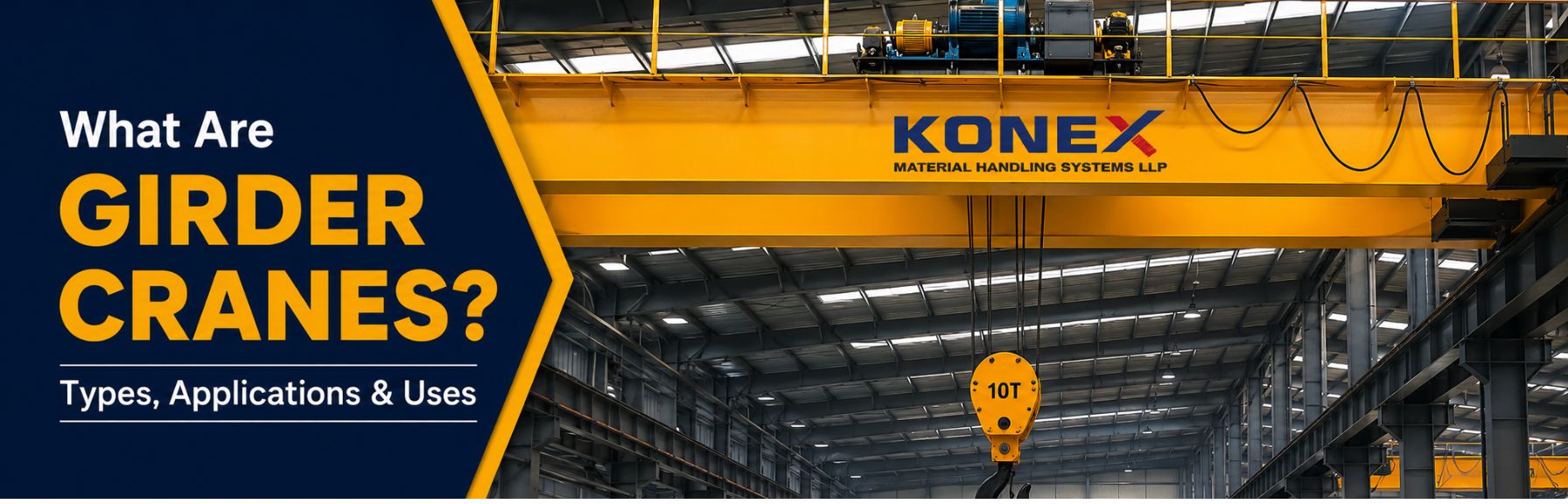
What Are Girder Cranes? Types, Applications & Uses
Material handling is one of the most important parts of any manufacturing facility, warehouse, fabrication shop, engineering plant, power plant, or industrial unit. When heavy materials need to be lifted, shifted, loaded, unloaded, or positioned safely, a girder crane becomes one of the most reliable solutions.
This guide answers all those questions in simple language. Whether you are a factory owner, plant manager, maintenance head, procurement professional, or project engineer, this article will help you understand girder cranes and choose the right solution for your business.
According to Konex Material Handling Systems LLP, one of the leading crane manufacturers in India, selecting the correct crane is not only about lifting capacity. It is about improving productivity, reducing manual handling, increasing safety, and supporting future business growth.
What Is a Girder Crane?
A girder crane is an overhead lifting system that uses one or more horizontal steel beams, known as girders, to support a lifting mechanism called a hoist.
The crane moves materials from one location to another inside a facility while reducing manual effort and improving operational efficiency.
In simple terms, a girder crane acts like a moving lifting system installed above the work area. Instead of forklifts constantly moving around the floor, the crane lifts and transports loads through the air, saving space and improving workflow.
These cranes are commonly installed in:
- Manufacturing plants
- Engineering workshops
- Steel processing units
- Warehouses
- Automotive facilities
- Power plants
- Cement plants
- Fabrication units
- Chemical industries
- Logistics centers
Modern industrial facilities depend heavily on girder cranes because they help move heavy materials quickly, safely, and accurately.
Why Are Girder Cranes Important?
Many industries still rely on forklifts, chain pulley blocks, and manual labor for material movement. While these methods may work for smaller operations, they often create bottlenecks as production increases.
A properly designed girder crane helps businesses:
- Move heavy materials faster
- Improve workplace safety
- Reduce labor dependency
- Minimize product damage
- Increase production efficiency
- Utilize factory space more effectively
- Handle larger and heavier loads
- Improve workflow between departments
For growing industries, a girder crane is often an investment that directly impacts productivity and profitability.
Main Types of Girder Cranes
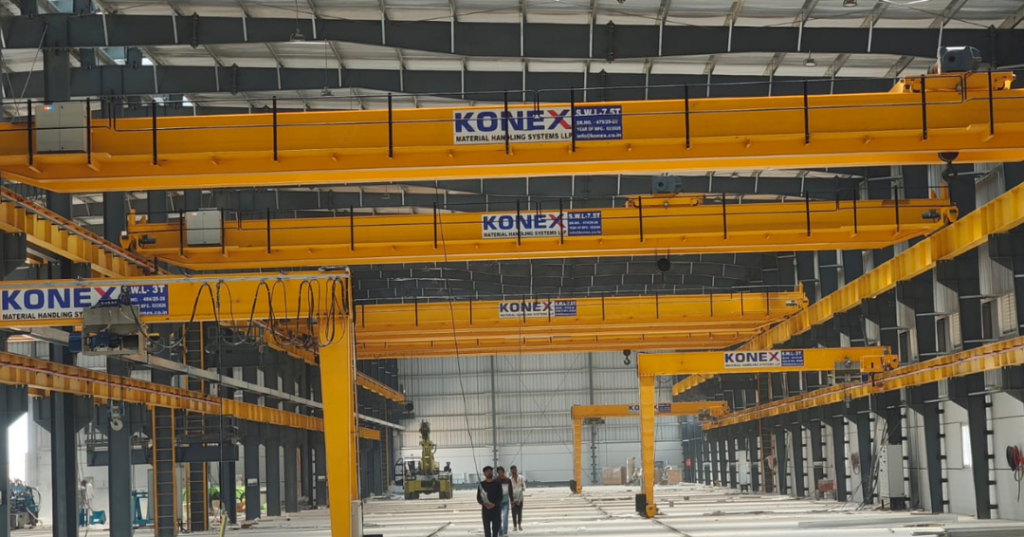
When discussing girder cranes, two major categories dominate the market:
1. Single Girder EOT Crane
A Single Girder Crane uses one main beam across the span of the crane. The hoist travels beneath this beam and performs lifting operations.
This is one of the most popular crane types used across India because of its affordability and practical design.
Best Applications
- Light manufacturing units
- Warehouses
- Packaging industries
- Assembly operations
- Maintenance workshops
- Small and medium factories
Advantages of Single Girder Cranes
- Lower initial investment
- Faster installation
- Reduced building load
- Lower maintenance requirements
- Ideal for moderate lifting needs
- Suitable for facilities with limited space
When Should You Choose a Single Girder Crane?
If your business primarily handles light to medium loads and you need an economical lifting solution, a Single Girder EOT Crane is often the best choice.
2. Double Girder EOT Crane
A Double Girder Crane uses two parallel beams instead of one. This design allows the crane to handle heavier loads, larger spans, and higher lifting heights.
Industries that perform demanding lifting operations generally prefer Double Girder Cranes because of their strength, stability, and long-term reliability.
Best Applications
- Steel plants
- Power plants
- Heavy engineering industries
- Large manufacturing facilities
- Infrastructure projects
- Shipyards
- Foundries
- Cement plants
Advantages of Double Girder EOT Cranes
- Higher lifting capacity
- Greater lifting height
- Better stability
- Suitable for continuous operation
- Longer service life
- Ideal for heavy-duty applications
When Should You Choose a Double Girder EOT Crane?
If your operation involves heavy machinery, steel structures, large components, or continuous production cycles, a Double Girder EOT Crane is usually the preferred solution.
Single Girder vs. Double Girder Crane: Side-by-Side Comparison
Making a smart buying decision requires weighing immediate purchase costs against long-term operational needs. Here is how the two primary overhead crane types compare across critical criteria:
Decision Criteria | Single Girder EOT Crane | Double Girder EOT Crane |
Maximum Lifting Capacity | Up to 15 – 20 Tons | Heavy duty from 10 Tons up to 100+ Tons |
Optimal Span Width | Short to medium spans (Up to 25m) | Long spans (20m to 40m+) |
Usable Hook Height | Standard (limited by hoist hanging below beam) | Maximum (hoist travels on top of girders) |
Building Column Load | Lower structural deadweight | Higher deadweight; requires sturdy columns |
Equipment & Capital Cost | Budget-friendly & economical | Higher initial cost; high heavy-duty ROI |
Maintenance & Walkways | Simple servicing from floor or ladder | Can feature built-in service platforms |
Applications Across Key Industries
Overhead girder cranes serve as the logistical backbone for modern manufacturing. Here is how different sectors use them to streamline operations:
Steel & Metal Fabrication Shops
Moving heavy steel coils, thick plates, raw billets, and welded structural assemblies requires robust equipment. Double girder cranes fitted with magnetic lifters, C-hooks, or specialized grabs handle raw materials with total control.
Automotive & Component Assembly
Precision movement is critical when positioning vehicle bodies, stamping dies, and heavy engines. Single girder cranes equipped with precision VFD drives allow operators to align components down to the millimeter without dangerous jerks.
Warehousing & Logistics Hubs
High-density vertical storage requires fast, reliable lifting. Overhead cranes allow facilities to stack raw material and machinery components tightly, turning unused vertical air space into prime storage real estate.
Infrastructure & Precast Concrete
Precast wall panels, bridge girders, and reinforced concrete pipes are extremely heavy and awkwardly shaped. Heavy-duty gantry and double girder systems allow rapid loading of flatbed transport trucks in both indoor and outdoor production yards.
Key Business Benefits: Why Invest in an Overhead Girder Crane?
Installing a well-engineered girder crane system from an experienced manufacturer offers clear financial and operational advantages:
- Reclaims Floor Space: By moving loads overhead, you clear out floor aisles previously reserved for mobile cranes or forklifts, allowing you to install extra production lines or machinery.
- Improves Workplace Safety: Manual handling and forklift accidents account for a large share of factory injuries. Overhead lifting keeps heavy loads suspended safely away from ground crews.
- Speeds Up Production Cycles: Instead of navigating crowded floor paths, overhead cranes transport heavy materials directly from station A to station B in a fraction of the time.
- Protects Valuable Goods: Soft-start VFD controls and high-performance wire rope electric hoists prevent abrupt stops, sway, and impact damage during movement.
How to Select the Right Crane for Your Facility
Before placing an order or requesting quotes from crane builders, evaluate these key operational parameters to ensure you receive a system matched to your exact needs:
1. Rated Load Capacity (SWL)
Determine the heaviest load you intend to lift regularly, and add a safety buffer for future operational growth. If your average load is 8 tons, a 10-ton Safe Working Load (SWL) rating provides safe performance without straining the system.
2. Building Span & Hook Travel
Measure the exact distance between the center lines of your runway rails (span). Additionally, measure the required vertical hook travel from the factory floor to your highest stacking height.
3. Understanding Crane Duty Cycles
Cranes are categorized into duty classes based on their daily operating hours and average load percentage. Indian Standards (such as IS 3177 and IS 807) and international codes (FEM/ISO) classify cranes from Class 1 to Class 4 (M3 through M8):
- Light Duty (Class 1 / M3-M4): Maintenance bays, intermittent lifting.
- Medium Duty (Class 2 / M5): General manufacturing and fabrication workshops.
- Heavy Duty (Class 3 & 4 / M7-M8): 24/7 continuous duty in steel mills and foundries.
Matching the right duty cycle prevents motor overheating, gear wear, and unplanned operational downtime.
4. Available Building Headroom
Measure the vertical clearance between the top of your runway rail and the lowest roof obstruction (trusses, lighting fixtures, or pipelines). If headroom is tight, a specialized low-headroom single girder crane can deliver maximum hook height without structural building modifications.
Why Partner with Konex Material Handling Systems LLP?
Choosing the right crane manufacturer is just as important as selecting the correct crane specifications. Located in Ahmedabad, Gujarat, Konex Material Handling Systems LLP provides custom turnkey material handling solutions designed for reliability and long-term performance.
- Custom Engineering: Every crane is engineered to fit your exact floor layout, ceiling clearance, and load handling requirements.
- Rigorous Quality Standards: Manufactured using tested steel and built to national and international design standards.
- Complete Turnkey Service: From initial site inspection and structural layout design to fabrication, installation, load testing, and ongoing Annual Maintenance Contracts (AMC).
- Responsive After-Sales Support: Fast availability of genuine spare parts and field technician services keeps your production lines running smoothly.
Ready to Upgrade Your Material Handling Efficiency?
Whether you are designing a new industrial facility, expanding an existing workshop, or replacing an outdated lifting setup, the technical team at Konex Material Handling Systems LLP is ready to help you design a reliable, high-ROI crane system.
- Consult an Expert: Contact the Konex Engineering Team to schedule a site evaluation or get a custom quote tailored to your facility.
FAQs
A girder crane is an overhead lifting system used to move heavy materials safely within industrial facilities. It is commonly used in manufacturing plants, warehouses, fabrication shops, power plants, steel industries, automotive factories, cement plants, and engineering workshops. Girder cranes help improve productivity, reduce manual handling, and increase workplace safety.
A Single Girder Crane uses one main beam and is ideal for light to medium-duty lifting applications. A Double Girder Crane uses two beams, allowing it to handle heavier loads, larger spans, and higher lifting heights. Single Girder Cranes are generally more economical, while Double Girder Cranes are preferred for demanding industrial operations such as steel plants and power plants.
Industries that frequently handle heavy materials benefit the most from girder cranes. These include steel manufacturing, power generation, automotive production, cement plants, warehouses, logistics centers, fabrication units, chemical industries, engineering workshops, and infrastructure projects.
The right girder crane depends on several factors, including lifting capacity, span width, lifting height, duty cycle, available building space, and future production requirements. Consulting an experienced crane manufacturer like Konex Material Handling Systems LLP can help ensure the crane matches your operational needs.
A girder crane offers several benefits, including faster material movement, improved workplace safety, reduced labor dependency, better use of factory space, lower product damage risk, and increased production efficiency. It also supports long-term business growth by streamlining material handling operations.
The lifting capacity of a girder crane depends on its design and application. Single Girder Cranes are commonly used for lighter loads, while Double Girder Cranes can handle heavy industrial loads ranging from 10 tons to 100 tons or more. Custom crane solutions can be designed for specific project requirements.
Double Girder EOT Cranes provide higher lifting capacity, better stability, greater hook height, and reliable performance for continuous operations. These features make them ideal for power plants, steel mills, foundries, heavy engineering facilities, and other industries where large equipment and heavy components need to be handled regularly.
Yes. Modern girder cranes can be customized based on lifting requirements, available headroom, span dimensions, operating conditions, and industry-specific applications. Konex Material Handling Systems LLP designs customized crane solutions to match unique operational needs across different industries.
A well-designed and properly maintained girder crane can provide reliable service for many years. Factors such as crane quality, operating conditions, usage frequency, preventive maintenance, and timely inspections play a major role in extending crane lifespan and minimizing downtime.
Konex Material Handling Systems LLP is a trusted manufacturer of Single Girder EOT Cranes, Double Girder EOT Cranes, Gantry Cranes, JIB Cranes, Wire Rope Electric Hoists, and Transfer Trolleys. The company offers custom-engineered solutions, quality manufacturing, professional installation, and responsive after-sales support to help industries improve material handling efficiency and operational productivity.