
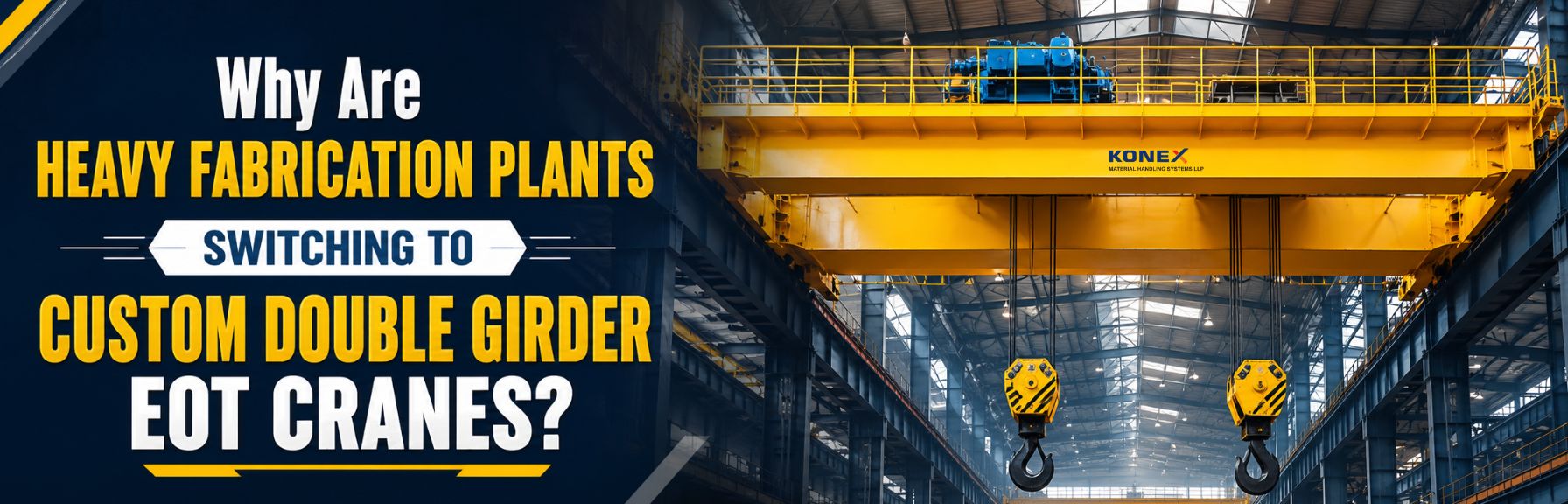
Why Are Heavy Fabrication Plants Switching to Custom Double Girder EOT Cranes?
In the highly competitive world of heavy fabrication, operational efficiency and workplace safety are not merely metrics to track—they are the direct drivers of your plant’s profitability. Modern fabrication yards, structural steel facilities, and heavy engineering plants are handling increasingly complex, heavy, and asymmetrical loads. From massive wind turbine towers and pressure vessels to complex structural steel columns, the sheer physical scale of raw materials and finished products is pushing older material handling systems to their breaking point.
To keep pace with these demanding production schedules, a major operational shift is occurring across the industry. Savvy plant managers, operations heads, and business owners are abandoning standard, off-the-shelf lifting systems. Instead, they are actively upgrading their facilities with a customized Double Girder EOT Crane (Electric Overhead Traveling Crane) engineered specifically for their unique workflow challenges.
If your facility is currently struggling with limited hook height, dangerous load swing, or cranes that constantly overheat during peak shifts, this comprehensive guide will explain why making the switch to custom lifting solutions is the smartest operational decision you can make today.
As an industry-leading Double Girder EOT Crane Manufacturer, Konex Material Handling System LLP has spent years helping heavy fabrication plants across India and global export markets transition from standard lifting restrictions to custom-engineered operational freedom. Below, we break down the operational, safety, and financial reasons behind this industry-wide transition.
What is a Double Girder EOT Crane? (And Why the Layout Matters)
Before looking at the operational benefits, it is crucial to understand exactly what makes a Double Girder EOT Crane structurally unique, without getting bogged down in heavy engineering jargon.
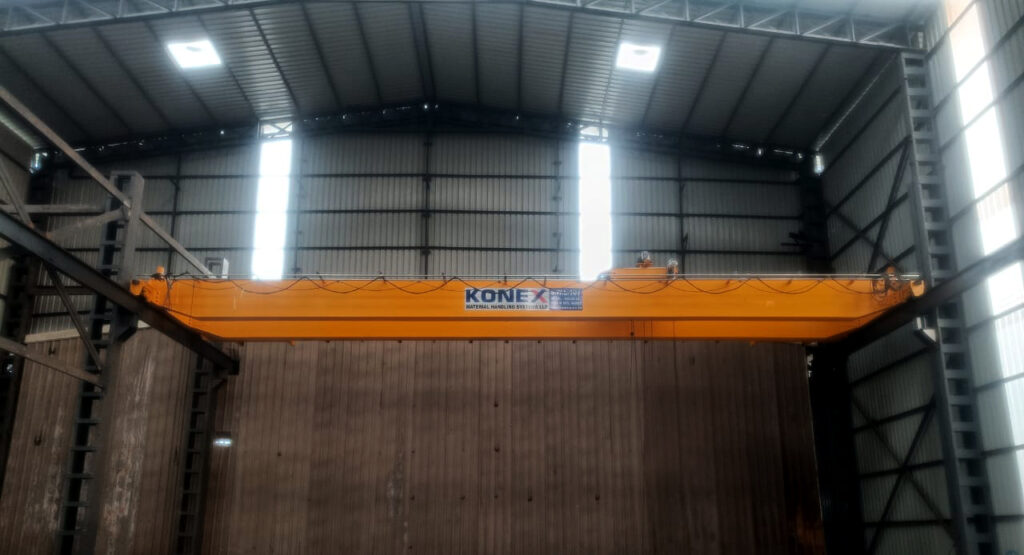
Unlike a single girder crane—which features a single bridge beam with a hoist mechanism hanging directly underneath it—a double girder overhead crane consists of two parallel bridge beams spanning the runway. Instead of hanging below, the hoisting mechanism (commonly called the crab or trolley) rides directly on top of these twin girders.
[SINGLE GIRDER]                     [DOUBLE GIRDER (CRAB ON TOP)]

       ================== [Girder]          ==================  ================== [Girders]
               ||                                    | [Crab Hoist] |
               [] [Hoist Below]                      +======||======+
               |                                            |
               v                                            v
         (Less Hook Height)                         (Maximized Hook Height)
This fundamental difference in physical layout changes everything on the shop floor:
- Superior Hook Height: Because the crab hoist sits on top of the parallel girders, the hook can be drawn up much higher—right up between the two beams. This allows you to lift loads significantly closer to your facility’s ceiling.
- Massive Load Capacity: Distributing the structural load across two girders rather than one allows these systems to easily handle heavy weights, typically ranging from 10 tons to well over 100 tons, with unmatched stability.
- Enhanced Rigidity: The two girders provide lateral stiffness, virtually eliminating structural twisting and minimizing the “bounce” often experienced when lifting heavy equipment with a single girder system.
For heavy fabrication facilities, these physical characteristics translate directly into faster cycle times, safer material handling, and improved production throughput.
5 Critical Reasons Heavy Fabrication Plants Are Switching to Custom Double Girder EOT Cranes
Every heavy fabrication plant is structured differently. Layouts vary, building column strengths differ, and the physical shape of the loads being lifted is rarely uniform. Standard, mass-produced cranes often fail in these environments because they are engineered for generic, predictable warehousing duties, not specialized industrial manufacturing.
Here is why custom-engineered double girder solutions are rapidly becoming the global standard.
1. Eliminating Dangerous Load Swing and Boosting Stability
Lifting a standard, balanced shipping container is straightforward. Handling a 30-ton, awkwardly shaped, pre-fabricated structural steel girder is an entirely different challenge. Because these loads are rarely symmetrical, they are highly prone to swaying and twisting during transit.
When a crane experiences load swing, it introduces severe hazards:
- It puts ground workers in direct danger of crushing injuries.
- It risks damaging expensive welding machinery, structural columns, and finished products.
- It places undue lateral stress on your building’s crane runways.
By partnering with a specialized Double Girder EOT Crane Manufacturer like Konex Material Handling System LLP, you get access to custom stability features that eliminate this risk entirely.
Because the crab hoist on a double girder crane travels on a wide, dual-track base, it inherently minimizes structural deflection. Furthermore, custom cranes can be integrated with advanced control mechanisms, such as Variable Frequency Drives (VFDs) for ultra-smooth starting and stopping, and specialized anti-sway software tailored to your average lift heights. Operators can position massive weldments within millimeters of their target, eliminating guesswork and dramatically speeding up assembly times.
2. Maximizing Vertical Airspace (Without Costly Building Expansion)
In modern manufacturing, floor space is expensive, but vertical airspace is free. Standard single girder cranes require significant “headroom”—the vertical distance between the top of your crane runway and the lowest obstruction on your ceiling. Because their hoist hangs below the bridge, you lose valuable vertical clearance.
By upgrading to a custom-configured Double Girder EOT Crane, you effectively reclaim that lost vertical space. Because the hoist travels on top of the bridge, you can gain anywhere from 1 to 3 meters of extra hook height within your existing building footprint.
This reclaimed height allows heavy fabrication plants to:
- Manufacture much taller pressure vessels, industrial tanks, and wind towers.
- Stack raw steel plates and finished products higher, freeing up valuable floor space for new assembly stations.
- Safely lift completed assemblies over active work-in-progress zones on the shop floor, removing material flow bottlenecks.
Instead of investing millions of rupees or dollars in raising your factory roof or constructing a new bay, a custom structural engineering consultation with an experienced EOT Crane Manufacturer can unlock this hidden capacity in your current facility.
3. Seamless Integration with Non-Standard Plant Layouts
No two heavy fabrication plants in India or globally share the exact same floor plan. Older facilities may feature low ceiling clearances, narrow column spacing, or restricted floor access. Conversely, newer mega-plants might require exceptionally long runway spans to cover multiple production lines at once.
Standard, pre-built cranes force you to compromise and adapt your workflow to the machine’s physical limitations. A custom double girder crane, however, is engineered entirely around your facility’s physical realities.
When you partner with Konex Material Handling System LLP, every detail of your crane is custom-built:
- Custom Spans: Whether your building requires a narrow 10-meter span or a massive 45-meter span, the crane is calculated to distribute load forces safely across your existing building columns.
- Dual Hoisting Units: You can equip a single double girder bridge with two independent hoisting units. This is a game-changer for lifting exceptionally long items, like structural steel pillars, where two distinct lifting points are required to maintain perfect balance.
- Tailored Control Options: Depending on your shop floor visibility, you can choose from ergonomic traveling cabins that move alongside the load, or state-of-the-art wireless radio remote controls with feedback displays that keep operators at a safe, highly visible distance.
4. Built to Withstand High-Duty Cycles and Brutal Environments
Heavy fabrication is a harsh environment for machinery. The air is often filled with abrasive dust from sandblasting, metallic particles from grinding, and fumes from painting booths. Additionally, heavy fabrication is not a “once-a-shift” operation. Cranes are running continuously across multiple shifts, lifting near-capacity loads all day, every day.
Standard cranes are built for light, intermittent duty (Class M3 or M4). Using them in a heavy fabrication plant leads to rapid motor overheating, worn brake linings, and structural fatigue.
A custom double girder crane is engineered from day one to handle demanding industrial duty cycles (such as Class M5, M7, or Class I, II, III requirements). These systems feature:
- Heavy-Duty Box Girder Construction: Built using high-tensile steel plates that are continuously box-welded to resist structural twisting and flexing over decades of heavy service.
- Weatherproof & Dustproof Enclosures: Electrical control panels and motors are rated to IP55 or IP66 standards, ensuring dust, moisture, and corrosive vapors cannot cause electrical shorts or failures.
- Hardened Steel Wear Components: From high-grade forged steel wheels to heavy-duty gearboxes, every moving part is chosen to minimize friction and wear, drastically reducing your lifetime maintenance costs.
5. Advanced Safety Features & Smart Crane Diagnostics
In heavy industrial operations, safety is paramount. A single lifting accident can cause devastating injuries, ruin your brand’s reputation, halt your operations, and lead to massive legal liabilities.
Standard cranes come with basic safety features. Custom double girder systems allow you to integrate modern, smart safety technologies that protect your workers, your machinery, and your bottom line:
- Overload Limit Switches: Instantly prevent the crane from lifting any load that exceeds its rated capacity, protecting both the crane and the building structure from overload damage.
- Dual-Braking Systems: Provide an extra layer of redundancy. If the primary brake fails, a secondary holding brake immediately engages to hold the heavy load safely in mid-air.
- Collision Avoidance Systems: If you operate multiple overhead cranes on a single runway, advanced laser sensors prevent them from accidentally colliding with one another.
- Smart Diagnostics and Monitoring: Digital display panels and telemetry systems track motor temperatures, run-time hours, and brake wear, notifying your maintenance team before a component fails. This shifts your maintenance from reactive firefighting to planned, predictive servicing.
Standard vs. Custom Double Girder EOT Cranes: An Operational Comparison
For procurement teams and financial decision-makers, evaluating material handling equipment often comes down to upfront capital expenditure versus long-term ROI. While standard, mass-produced cranes are tempting due to lower initial purchase prices, they frequently result in higher lifetime costs due to frequent breakdowns and operational bottlenecks.
The table below contrasts standard overhead cranes with custom-engineered double girder solutions in a heavy-duty environment:
|
Operational Metric |
Standard Overhead Cranes |
Custom Double Girder EOT Cranes |
|
Lifting Capacity & Span |
Limited to predefined ranges; struggles with exceptionally heavy, asymmetrical, or wide-span loads. |
Engineered precisely to your exact building dimensions and lifting capacities (up to 100+ tons). |
|
Hook Height & Airspace |
Lower hook height; the hoist hangs below the single girder, wasting valuable vertical workspace. |
Maximized hook height; the crab hoist rides on top of the parallel girders, reclaiming vertical room. |
|
Environmental Durability |
Standard components; high risk of motor overheating and electrical failures in dust-heavy environments. |
High-duty cycle components, continuous box-welded structures, and IP-rated dustproof enclosures. |
|
Workflow Compatibility |
Forces you to adapt your manufacturing processes and floor layouts to the crane’s physical limitations. |
Built to match your workflow, offering custom features like dual hoists, auxiliary hooks, and tailored spans. |
|
Safety Integration |
Basic, standard safety controls with limited option to add smart, automated safety sensors. |
Fully integrated smart safety systems including anti-sway, dual redundant brakes, and laser collision avoidance. |
|
Maintenance Accessibility |
Difficult to service; often requires renting scissor lifts or building scaffolding to access components. |
Exceptionally easy and safe; the space between the twin girders acts as a built-in maintenance walkway. |
By choosing a custom solution, you are purchasing an industrial tool designed specifically to resolve your plant’s precise operational bottlenecks. The small difference in initial capital investment is typically recovered within the first 12 to 24 months through improved plant productivity, reduced maintenance costs, and zero crane-related downtime.
How a Custom Double Girder EOT Crane Directly Boosts Your Plant's Bottom Line
Investing in heavy industrial machinery must always make financial sense. Beyond the physical and structural advantages, switching to a custom Double Girder EOT Crane is a strategic business move that delivers measurable, long-term ROI in three distinct ways:
1. Accelerated Material Flow and Higher Production Throughput
In any heavy fabrication plant, your production speed is dictated by how quickly raw materials can move through the cutting, welding, assembly, and painting bays. If your skilled welding and assembly teams are constantly waiting for a crane to become free, or if moving an awkwardly shaped load takes an hour of slow, cautious, and manual rigging due to crane instability, your production line stalls.
A stable, precise, and fast custom double girder crane cuts material handling times in half. By minimizing load sway and allowing operators to place materials with pinpoint accuracy, you can move more tonnage per shift, clear out production bottlenecks, and confidently meet tight project delivery deadlines.
2. Drastically Lower Maintenance Costs and Safe Servicing
Unplanned crane downtime is an absolute production killer. If your main overhead crane goes down, your entire shop floor grinds to a halt—you can neither load raw steel plates onto your cutting beds nor load finished fabrications onto transport trucks.
Because custom cranes utilize robust, high-durability components selected specifically for your plant’s harsh environment, they require significantly fewer maintenance interventions.
When maintenance is required, a double girder system is inherently safer and easier to service than a single girder crane. The two parallel girders allow for the installation of a sturdy, permanent maintenance walkway/platform complete with safety handrails. Technicians can walk directly on the crane to inspect the hoist, motors, and electrical panels safely, eliminating the need to rent costly scissor lifts or erect temporary scaffolding.
 [SAFETY WALKWAY INTEGRATION]

                 Walkway with Handrails (Safe Access)
                    _______[___]_______
                   |   |         |   |
              ==================  ==================
              [Girder 1]                  [Girder 2]
3. Enhanced Operator Confidence and Reduced Fatigue
Operating an overhead crane carrying 50 tons of fabricated steel is a high-stress, high-responsibility job. When operators are forced to use jerky, outdated, or underpowered cranes, operator fatigue sets in rapidly, raising the risk of expensive operational errors.
Providing your rigging and operations teams with a highly responsive, smooth, and predictable custom crane increases their work confidence. It reduces physical and mental fatigue, creating a safer, happier, and far more productive workforce while assisting you in retaining skilled, certified rigging talent.
Choosing the Right EOT Crane Manufacturer: What to Look For
The ultimate success of your facility’s transition to a custom crane depends entirely on the design and manufacturing capabilities of your chosen partner. A heavy-duty crane is not a simple, off-the-shelf commodity; it is a complex, integrated engineering system that must coordinate perfectly with your building’s structural columns and foundation.
When looking for an EOT Crane Manufacturer to design and install your custom system, ensure they meet the following critical criteria:
- In-House Engineering Capabilities: A reliable partner does not rely on guesswork. They should have a dedicated, highly qualified team of structural and electrical engineers capable of performing advanced finite element analysis (FEA) to ensure structural integrity.
- Strict Quality Compliance: Your crane must be designed and manufactured in accordance with rigorous Indian and international standards (such as IS 3177, IS 4137, FEM, and DIN standards) to ensure absolute safety and compliance with workplace safety regulations.
- Proven Track Record: Choose a manufacturer with a history of successful installations in demanding heavy industrial sectors, such as steel mills, heavy engineering, wind energy, and infrastructure.
- Comprehensive After-Sales Support: Material handling equipment requires periodic safety inspections and preventive maintenance. Your manufacturer must offer dependable, rapid-response after-sales service, commissioning support, and an abundant supply of genuine spare parts to minimize potential downtime.
Unlock Your Plant's Potential with Konex Material Handling System LLP
As a premier Double Girder EOT Crane Manufacturer based in India with extensive global export capabilities, Konex Material Handling System LLP is committed to helping heavy fabrication industries elevate their material handling capabilities.
We do not just sell cranes; we design customized material handling solutions that resolve your plant’s specific layout restrictions, environmental challenges, and safety concerns. Our team of experienced engineers works closely with your operations team to design, manufacture, install, and commission high-performance double girder cranes that deliver exceptional reliability and long-term return on investment.
Are you ready to transform your plant’s material handling efficiency, eliminate production bottlenecks, and establish a safer shop floor?
Contact Us : +91 9824011164 | +91 90999 02956
FAQs
Custom Double Girder EOT Cranes are designed according to the plant’s layout, lifting capacity, span, hook height, and operational requirements. They provide better stability, higher lifting capacity, increased safety, and improved productivity compared to standard cranes.
Custom Double Girder EOT Cranes are widely used in heavy fabrication plants, steel industries, engineering workshops, shipyards, power plants, wind turbine manufacturing, cement plants, infrastructure projects, and large manufacturing facilities where heavy material handling is essential.
The major advantages include higher lifting capacity, greater hook height, better load stability, reduced load swing, longer spans, higher-duty performance, easy maintenance access, and the ability to handle continuous heavy-duty operations.
Yes. An experienced Double Girder EOT Crane manufacturer can design a crane that fits your existing building dimensions, runway structure, ceiling height, lifting capacity, and workflow without requiring major structural modifications.
Custom cranes can include advanced safety features such as overload protection, anti-sway systems, dual braking systems, limit switches, collision avoidance sensors, emergency stop functions, and smart monitoring systems that significantly reduce operational risks.
Double Girder EOT Cranes are commonly available from 5 Tons to 100 Tons or more, depending on the application. The lifting capacity is customized based on the material weight, production process, and future operational requirements.
A custom crane enables faster material movement, precise load positioning, reduced handling time, minimized downtime, smoother operations, and better workflow management, resulting in increased production output and lower operating costs.
Important factors include lifting capacity, span, hook height, duty classification, building dimensions, working environment, operating frequency, safety requirements, future expansion plans, and the experience of the crane manufacturer.
Routine inspections should be performed daily by operators, while preventive maintenance should follow the manufacturer’s recommendations. Periodic inspections help identify wear, ensure safe operation, reduce unexpected breakdowns, and extend the crane’s service life.
{"@context":"https:\/\/schema.org","@type":"FAQPage","mainEntity":[{"@type":"Question","name":"Why do heavy fabrication plants prefer custom Double Girder EOT Cranes over standard cranes?","acceptedAnswer":{"@type":"Answer","text":" Custom Double Girder EOT Cranes are designed according to the plant’s layout, lifting capacity, span, hook height, and operational requirements. They provide better stability, higher lifting capacity, increased safety, and improved productivity compared to standard cranes.<\/p>"}},{"@type":"Question","name":"What industries commonly use custom Double Girder EOT Cranes?","acceptedAnswer":{"@type":"Answer","text":" Custom Double Girder EOT Cranes are widely used in heavy fabrication plants, steel industries, engineering workshops, shipyards, power plants, wind turbine manufacturing, cement plants, infrastructure projects, and large manufacturing facilities where heavy material handling is essential.<\/p>"}},{"@type":"Question","name":"What are the main advantages of a Double Girder EOT Crane?","acceptedAnswer":{"@type":"Answer","text":" The major advantages include higher lifting capacity, greater hook height, better load stability, reduced load swing, longer spans, higher-duty performance, easy maintenance access, and the ability to handle continuous heavy-duty operations.<\/p>"}},{"@type":"Question","name":"Can a Double Girder EOT Crane be customized for an existing factory building?","acceptedAnswer":{"@type":"Answer","text":" Yes. An experienced Double Girder EOT Crane manufacturer can design a crane that fits your existing building dimensions, runway structure, ceiling height, lifting capacity, and workflow without requiring major structural modifications.<\/p>"}},{"@type":"Question","name":"How does a custom Double Girder EOT Crane improve workplace safety?","acceptedAnswer":{"@type":"Answer","text":" Custom cranes can include advanced safety features such as overload protection, anti-sway systems, dual braking systems, limit switches, collision avoidance sensors, emergency stop functions, and smart monitoring systems that significantly reduce operational risks.<\/p>"}},{"@type":"Question","name":"What lifting capacities are available for Double Girder EOT Cranes?","acceptedAnswer":{"@type":"Answer","text":" Double Girder EOT Cranes are commonly available from 5 Tons to 100 Tons or more<\/strong>, depending on the application. The lifting capacity is customized based on the material weight, production process, and future operational requirements.<\/p>"}},{"@type":"Question","name":"How does a Double Girder EOT Crane help increase production efficiency?","acceptedAnswer":{"@type":"Answer","text":" A custom crane enables faster material movement, precise load positioning, reduced handling time, minimized downtime, smoother operations, and better workflow management, resulting in increased production output and lower operating costs.<\/p>"}},{"@type":"Question","name":"What factors should be considered before purchasing a custom Double Girder EOT Crane?","acceptedAnswer":{"@type":"Answer","text":" Important factors include lifting capacity, span, hook height, duty classification, building dimensions, working environment, operating frequency, safety requirements, future expansion plans, and the experience of the crane manufacturer.<\/p>"}},{"@type":"Question","name":"How often should a Double Girder EOT Crane be inspected and maintained?","acceptedAnswer":{"@type":"Answer","text":" Routine inspections should be performed daily by operators, while preventive maintenance should follow the manufacturer’s recommendations. Periodic inspections help identify wear, ensure safe operation, reduce unexpected breakdowns, and extend the crane’s service life.<\/p>"}},{"@type":"Question","name":"Why choose Konex Material Handling System LLP for a custom Double Girder EOT Crane?","acceptedAnswer":{"@type":"Answer","text":" Konex Material Handling System LLP specializes in designing and manufacturing customized Double Girder EOT Cranes tailored to specific industrial applications. The company offers engineering expertise, high-quality manufacturing, reliable installation, safety-focused designs, and dependable after-sales support to help customers achieve maximum operational efficiency and long-term return on investment.<\/span><\/p>"}}]}