

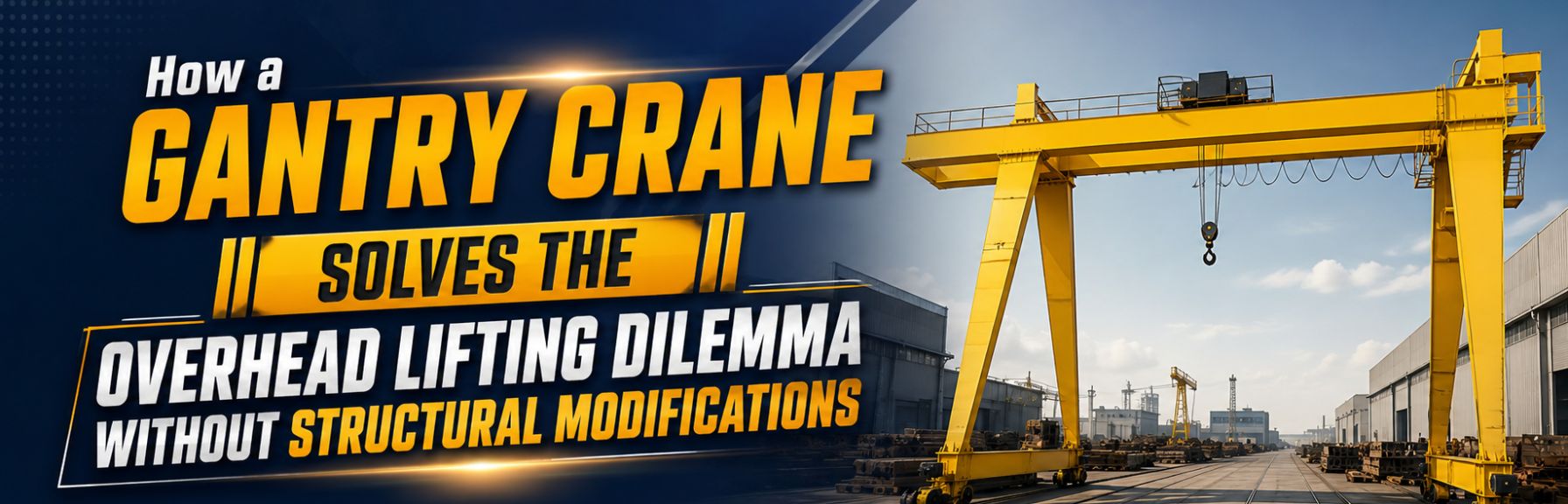
How a Gantry Crane Solves the Overhead Lifting Dilemma Without Structural Modifications
If you manage an industrial facility, warehouse, or manufacturing plant, you are likely no stranger to the overhead lifting dilemma. As your production volumes scale, handling heavy machinery, steel coils, fabricated assemblies, and dies becomes a critical bottleneck.
The traditional solution? An overhead bridge crane.
However, installing a traditional overhead crane often introduces a major structural roadblock. Your facility’s columns may not be rated to handle the immense wheel loads. If you occupy a leased or rented facility, your landlord will almost certainly veto any permanent structural modifications. Even if you own the building, the cost of engineering, installing runway columns, reinforcing foundations, and enduring weeks of operational downtime can decimate your capital expenditure (CapEx) budget.
So, how do you achieve safe, efficient, and heavy-duty overhead lifting without touching your building’s structural framework?
The answer lies in a highly versatile, self-supporting material handling solution: the Gantry Crane.
In this comprehensive guide, we will analyze how investing in a gantry system from a leading crane manufacturer in India like Konex Material Handling System LLP bypasses the headaches of structural modifications, slashes your upfront costs, and future-proofs your facility’s material handling strategy.
The Overhead Lifting Dilemma: Why Building Modifications are a Costly Trap
For decades, industrial operations assumed that overhead material handling required heavy-duty bridge cranes tied directly to the building’s building columns. However, modern factory layouts, leased commercial properties, and quick-turnaround production lines require a much more agile approach.
To understand why a self-supporting system is the smarter business decision, let’s look at the hidden costs and compliance challenges of structural modifications:
- The Leased Facility Constraint: According to commercial real estate standards, any permanent structural alteration to a leased building requires complex landlord approvals, architectural sign-offs, and often a restoration clause requiring you to tear down the crane runway when your lease ends.
- Foundation Reinforcement Costs: Standard factory floors (typically 5 to 6 inches of concrete) are rarely rated for the localized point loads exerted by overhead runway columns. Installing an overhead bridge crane often requires cutting the existing concrete floor, excavating, and pouring deep, reinforced concrete footings.
- Complex Engineering Audits: Before a traditional crane can be mounted, structural engineers must audit your facility to evaluate its load-bearing capacity. This is guided by structural design codes like the American Society of Mechanical Engineers (ASME B30 Series) or local equivalents such as the Bureau of Indian Standards (BIS). If the building fails the audit, the reinforcement costs can quickly outpace the cost of the crane itself.
- Catastrophic Operational Downtime: Pouring foundations and erecting steel runway structures can take weeks. During this time, your production floor becomes a construction zone, bringing your core operations to a grinding halt.
Enter the Gantry Crane: The Self-Supporting Lifting Champion
Unlike bridge cranes that rely on external building columns for support, a gantry crane is a completely self-supporting overhead lifting system. It features a bridge beam supported by two or more structural legs that transfer the vertical lifting load directly to the floor.
Because the load-bearing legs travel on either floor-mounted tracks or heavy-duty polyurethane/rubber wheels, the entire system operates independently of your building’s walls, pillars, or ceiling.
The “Grantry Crane” Search Factor: Addressing Common Industrial Inquiries
Note for Procurement Teams: When searching for these systems, buyers often search using regional dialects or common typographical variants such as a grantry crane. Whether you refer to it as a gantry, portal crane, or an A-frame system, the fundamental engineering remains the same: it is designed to relieve your building structure of all stress.
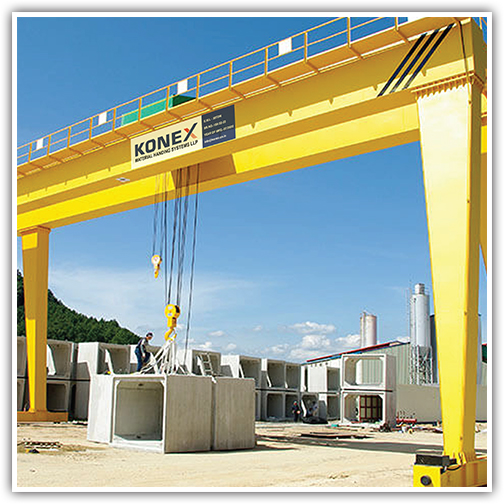
How a Gantry Crane Solves Your Facility's Structural Pain Points
Choosing a self-supporting gantry system over an overhead crane offers distinct operational and financial advantages, particularly for high-growth enterprises in India and global industrial hubs.
1. Zero Loading Stress on Your Building Structure
The primary benefit of a gantry system is that it requires absolutely zero structural connection to your building. The weight of the crane, hoist, trolley, and the active load are distributed down through the gantry’s vertical legs.
- For stationary A-frame gantry systems, the weight is distributed over stable, wide base plates resting on your existing floor.
- For rail-mounted gantry systems, the wheel loads are distributed evenly along floor tracks, eliminating point-load concentrations on your factory foundation.
2. Rapid Installation with Zero Downtime
While a traditional bridge crane takes weeks of structural prep and on-site welding, a gantry crane can be assembled, tested, and commissioned in a fraction of the time. Konex Material Handling System LLP engineers pre-fabricated, modular gantry systems that are bolted together directly on your shop floor. This means you can go from delivery to fully operational within days, keeping your production schedules perfectly on track.
3. Ultimate Portability and Facility Relocation
In the modern B2B landscape, business agility is a competitive advantage. If your business outgrows its current facility or relocates to a new industrial park, a traditional runway crane must be abandoned or scrapped at a heavy loss. A portable or trackless gantry crane can be easily disassembled, loaded onto a truck, and reassembled at your new location. Your capital asset remains 100% salvageable and moves wherever your business grows.
4. Highly Customizable Layout Options
Every manufacturing layout is unique. Gantry systems offer exceptional configuration flexibility to match your exact floor plan:
- Full Gantry Cranes: Run on floor rails, ideal for heavy-capacity lifting across long, straight travel paths.
- Semi-Gantry Cranes: One leg runs on a floor-mounted rail, while the other side runs on an elevated runway attached to wall columns. This is a perfect hybrid solution if you want to maximize floor space without putting full load-bearing stress on a single wall structure.
- Portable Gantry Cranes: Mounted on durable polyurethane caster wheels, allowing workers to manually wheel the crane to different work cells as needed.
Where Gantry Cranes Deliver the Highest ROI
Industrial sectors around the world rely on these robust lifting systems to streamline workflows without compromising floor safety or building integrity. According to safe-work guidelines by agencies like the Occupational Safety and Health Administration (OSHA), using dedicated, rated lifting equipment dramatically reduces manual material handling injuries.
Here are the key industries where gantry systems excel:
- Heavy Machinery Manufacturing & Assembly: Effortlessly position heavy motors, gearboxes, and welded components during assembly line operations.
- Die and Tool Handling: Injection molding and metal stamping facilities use portable gantry systems to swap out heavy, highly expensive dies quickly and safely.
- Warehouses and Logistics Hubs: Ideal for loading and unloading flatbed trucks in outdoor yards where no structural building ceiling exists.
- Fabrication and Welding Shops: Enable welders to flip, position, and hold large structural steel frames safely at optimal welding angles.
- Maintenance & Repair Bays: Move a portable gantry directly over a broken-down vehicle or generator, perform the repair, and roll the crane back to a storage area when finished.
Key Decision Matrix: Traditional Overhead Crane vs. Gantry Crane
To help your procurement and engineering teams make an informed decision, here is a comparative overview of how these two systems match up:
Feature | Traditional Overhead Crane | Gantry Crane System |
Structural Impact | High. Demands structural integrity audits and building column modifications. | None. Self-supporting; exerts zero stress on building structures. |
Upfront Capital Cost | Extremely high (crane cost + runway steel + engineering + foundation work). | Low to Moderate (cost-focused strictly on the crane asset itself). |
Relocation Capability | Practically zero. Difficult and expensive to salvage. | High. Modular design allows for easy disassembly and relocation. |
Installation Time | 2 to 6 weeks of active on-site civil and structural work. | 1 to 3 days for standard configurations. |
Floor Space Footprint | Keeps floor space 100% clear (elevated on runways). | Requires track pathways or leg clearance on floor boundaries. |
Partnering with Konex Material Handling System LLP: India's Trusted Crane Manufacturer with Global Reach
When dealing with heavy material handling, structural integrity and safety are non-negotiable. Designing a system that functions without structural building support requires deep engineering expertise, precise load-distribution calculations, and high-quality fabrication.
As a premier crane manufacturer in India, Konex Material Handling System LLP has established itself as an industry leader, delivering cutting-edge material handling solutions across India and exporting to highly regulated global markets.
Why Industrial Leaders Choose Konex:
- Custom-Engineered Solutions: We do not believe in one-size-fits-all. Our engineering team designs custom spans, heights, capacities, and travel speeds tailored specifically to your facility’s floor conditions.
- Robust Compliance Standards: All Konex cranes are engineered in strict compliance with national and international quality standards, ensuring your plant complies with safety audits and operational insurance requirements.
- High-Grade Materials & Fabrication: From heavy-duty structural steel profiles to precision-machined hoist components, Konex systems are built to withstand harsh industrial environments, ensuring years of trouble-free operation with low maintenance costs.
- End-to-End Execution: From initial site assessment and conceptual CAD design to fabrication, delivery, installation, and load-testing, Konex manages the entire lifecycle of your project.
How to Specify Your Gantry System
When reaching out to our material handling experts at Konex, having the following basic parameters ready will help us fast-track your custom design and quotation:
- Lifting Capacity (Tonnage): What is the maximum weight you need to lift? Standard systems range from 1 ton for portable models to upwards of 100+ tons for heavy double-girder industrial systems.
- Span Length: What is the clear width required between the vertical legs of the crane?
- Height Under Boom (HUB): How high does the bottom of your hoist beam need to be to clear your tallest piece of machinery or truck bed?
- Travel Style: Will your system run on fixed floor rails (ideal for straight, repeated paths), or do you require the flexibility of heavy-duty polyurethane caster wheels to move freely across your workshop floor?
- Operating Environment: Will the crane operate indoors or outdoors? Outdoor systems require specialized weatherproofing, epoxy coatings, and wind-resistant braking systems.
Secure Your Free Overhead Lifting Feasibility Consultation
Don’t let building structural limits or high civil construction costs hold your production efficiency hostage. By opting for a self-supporting gantry crane, you protect your capital budget, preserve your building’s integrity, and equip your workforce with a world-class, highly secure lifting asset.
Our engineering team at Konex Material Handling System LLP is ready to help you analyze your floor layout, calculate loads, and design the ultimate material handling system to unlock your facility’s true throughput potential.
Transform Your Material Handling Today
Are you ready to eliminate the overhead lifting bottleneck in your facility without investing in expensive building modifications?
Contact Konex Material Handling System LLP today.
- Send an Inquiry: Contact our engineering desk for a tailored quotation.
- Schedule a Site Visit: Let our material handling specialists evaluate your facility (available across India and for global projects).
- Explore Our Portfolio: Discover our wide range of custom gantry cranes, semi-gantry systems, and heavy-duty overhead lifting equipment.
Contact us : info@konex.co.in , +91 98240 11164 | +91 90999 02956
👉 Click Here to Connect with a Konex Material Handling Expert
FAQs
A gantry crane is a self-supporting overhead lifting system supported by one or two legs that travel on floor-mounted rails or wheels. It lifts and moves heavy materials without relying on the building’s roof or structural columns, making it ideal for factories, warehouses, and outdoor applications.
Yes. A gantry crane is designed to operate independently of your building’s structure. It eliminates the need for runway beams, reinforced columns, or roof modifications, making installation faster and more cost-effective.
A gantry crane offers several advantages, including lower installation costs, no structural building changes, quick installation, easy relocation, minimal downtime, and flexible operation for indoor and outdoor applications.
Gantry cranes are widely used in manufacturing plants, steel fabrication shops, warehouses, logistics centers, automotive industries, power plants, construction sites, shipyards, engineering workshops, and maintenance facilities.
The most common types include Full Gantry Cranes, Semi Gantry Cranes, Portable Gantry Cranes, Single Girder Gantry Cranes, Double Girder Gantry Cranes, and Adjustable Height Gantry Cranes. The right type depends on your lifting capacity, workspace, and operational needs.
Gantry cranes are available in capacities ranging from 1 Ton to over 100 Tons. The lifting capacity depends on the crane design, span, hoist selection, and application requirements.
Yes. Most gantry cranes feature a modular design that allows them to be dismantled, transported, and reinstalled at another location. This makes them an excellent choice for leased factories or expanding businesses.
A standard gantry crane can typically be installed within 1 to 3 days, depending on its size and configuration. This significantly reduces production downtime compared to conventional overhead crane installations.
Yes. Outdoor gantry cranes are specifically designed with weather-resistant coatings, corrosion protection, wind-resistant braking systems, and durable electrical components to ensure reliable performance in harsh environments.
To select the right gantry crane, you should provide details such as lifting capacity, span length, lifting height, travel distance, operating environment (indoor or outdoor), duty cycle, and the type of materials being handled.
Choose a gantry crane based on your maximum load capacity, available floor space, lifting height, frequency of operation, mobility requirements, and future expansion plans. Consulting an experienced gantry crane manufacturer can help you select the most suitable solution.
Konex Material Handling System LLP provides custom-engineered gantry cranes designed to meet specific industrial requirements. With high-quality manufacturing, industry-standard compliance, expert installation, load testing, and reliable after-sales support, Konex delivers efficient and long-lasting material handling solutions for businesses across India and international markets.