

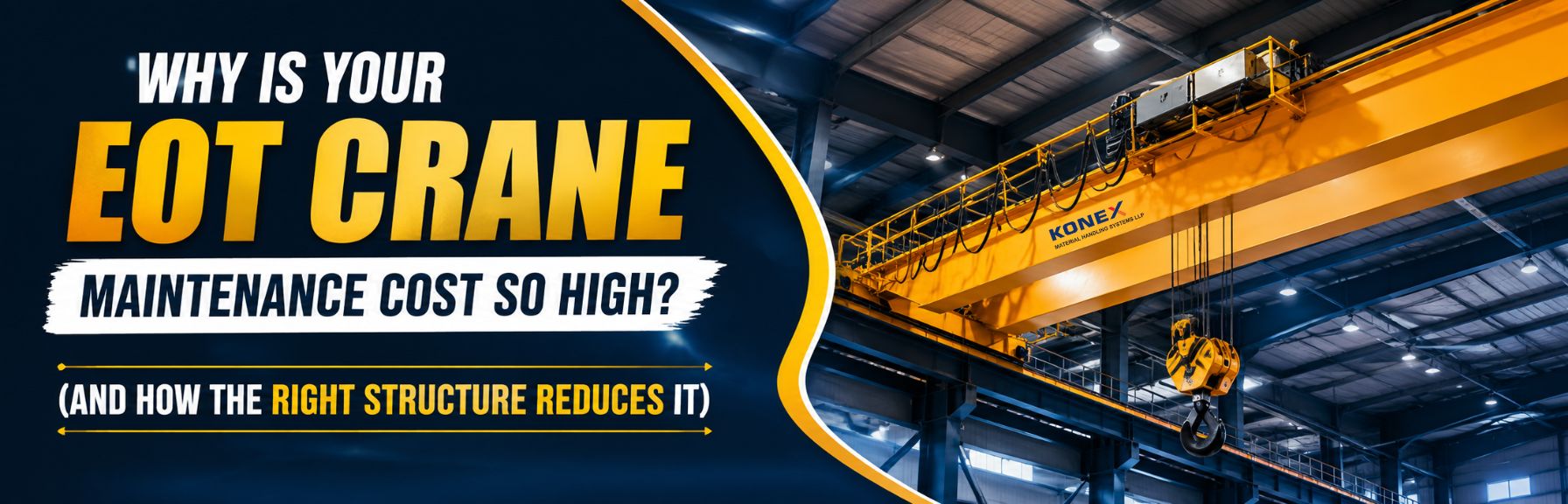
Why is Your EOT Crane Maintenance Cost So High? (And How the Right Structure Reduces It)
In heavy manufacturing, warehousing, and infrastructure industries, operational efficiency is closely tied to the reliability of your material handling equipment. Among these systems, the EOT Crane (Electric Overhead Traveling Crane) serves as the primary driver of your production floor.
Yet, for many plant managers, operations heads, and procurement directors, a recurring question causes ongoing budget frustration: Why is our EOT crane maintenance cost so high?
If you find yourself constantly replacing worn-out crane wheels, troubleshooting structural alignment issues, dealing with motor burnouts, or facing unexpected downtime, the root cause is rarely just “wear and tear.” More often than not, the culprit lies in structural design, poor customization, or selecting the wrong crane configuration for your specific operational duty cycle.
In this comprehensive guide, we will break down the hidden factors that drive up your maintenance costs, explain how structural design directly impacts your bottom line, and show you how partnering with an expert EOT Crane Manufacturer can transform your material handling setup from a cost center into a high-performance asset.
The Hidden Culprits Behind Spiraling EOT Crane Maintenance Costs
To solve the problem of high maintenance costs, you must first diagnose the root causes. Frequent breakdowns and component failures are usually symptoms of deeper, systemic issues.
+---------------------------------------------------------------------------------+
|                         THE HIGH-MAINTENANCE CYCLE                              |
|                                                                                 |
|   Poor Structural Design  -->  Crane Structural Deflection  --> Wheel Wear      |
|            ^                                                        |           |
|            |                                                        v           |
|   Increased Downtime      <--  Frequent Motor/Hoist Failures <-- Misalignment   |
Improper Girder Selection and Structural Deflection
The structural backbone of any EOT Crane is its girder system. When a crane is under-designed or built with subpar steel, it experiences excessive structural deflection (sagging or bending under load).
While some deflection is normal and engineered into the system, excessive deflection puts immense strain on the hoist, the trolley travel mechanism, and the end carriages. This structural strain forces your drive motors to work harder, leading to overheating, electrical component failures, and premature motor burnout.
Runway and Crane Alignment Issues
If your crane runway is not perfectly aligned, or if the crane structure itself is out of square, the crane will “skew” as it travels down the bay. This causes the crane wheel flanges to grind heavily against the sides of the runway rails.
This friction, known as rail tracking or wheel binding, leads to:
- Rapid, uneven wear on expensive crane wheels.
- Severe damage to the runway rails.
- Excessive structural stress on the end carriages and connections.
- Wasted energy as the motors fight structural friction.
According to global crane design standards, such as those set by the Crane Manufacturers Association of America (CMAA), even minor alignment deviations can increase lateral forces by up to 50%, accelerating structural degradation.
Incorrect Duty Cycle Classification
A common mistake made during procurement is purchasing a crane based solely on its maximum lifting capacity, rather than its duty cycle. An EOT Crane designed for light-duty operations (Class 1 or Class 2/Class A or B) that is run continuously in a heavy-duty production environment (Class 4 or Class 5/Class D or E) will quickly fail.
The structural steel, bearings, gearboxes, and motors will be constantly overworked, leading to catastrophic structural fatigue and high maintenance bills.
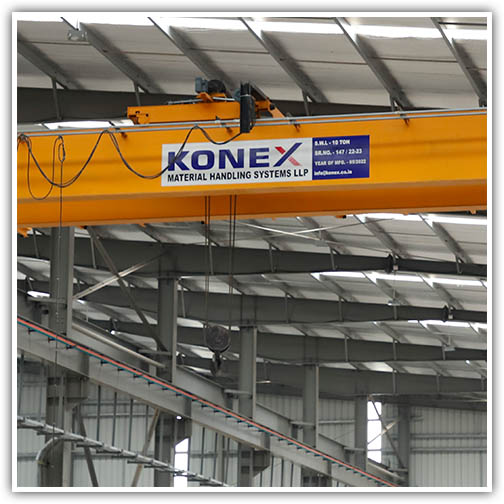
Single Girder vs. Double Girder EOT Cranes
Reducing your maintenance costs starts with choosing the correct structural configuration for your application. As a leading EOT Crane Manufacturer, we categorize structural choices into two main types: Single Girder and Double Girder systems. Choosing the right one is critical to maintaining a healthy balance between initial capital expenditure and long-term operating costs.
When to Choose a Single Girder EOT Crane
A single girder configuration features one bridge beam supported by two end carriages. The hoist and trolley run along the bottom flange of this single girder.
- Best Suited For: Light to medium duty applications, spans up to 25 meters, and lifting capacities up to 15-20 tons.
- Maintenance Advantages: Fewer moving parts, simpler electrical systems, lighter wheel loads (which reduces wear on the building’s runway structure), and lower initial investment.
- The Maintenance Risk: If a Single Girder EOT Crane Manufacturer uses low-grade steel profiles instead of robust, box-plate fabricated girders for longer spans, the girder can twist under diagonal loads. This structural twisting leads to rapid trolley wheel wear and frequent hoist jams.
When to Choose a Double Girder EOT Crane
A double girder configuration utilizes two bridge beams. The crab (hoist and trolley mechanism) travels on top of rails mounted to the top of these girders.
- Best Suited For: Heavy-duty applications, high lifting capacities (up to 100+ tons), longer spans, and operations requiring maximum lift height.
- Maintenance Advantages: Extremely rigid structural design, excellent resistance to lateral forces, easier access for maintenance technicians (via walkways and handrails built directly onto the girders), and highly stable load handling that protects mechanical components.
- The Maintenance Risk: A double girder crane is a highly complex machine. If you do not partner with an experienced Double Girder EOT Crane Manufacturer, you risk alignment issues between the two parallel girders, which can cause uneven wheel load distribution and premature wear on one side of the crane.
How Structural Engineering Directly Influences Your Maintenance Budget
To understand how a well-engineered crane structure lowers your overhead costs, let’s examine the mechanical connection between structural physics and maintenance expenses.
WELL-ENGINEERED STRUCTURAL DESIGN (Box Girder Rigidity)
                               |
                               v
               Eliminates Structural Deflection
                               |
                               v
        Perfect Crane Runway and Wheel-to-Rail Alignment
                               |
                               v
  +----------------------------+----------------------------+
  |                                                         |
  v                                                         v
Reduced Friction on Wheels & Rails            Consistent Load on Motors & Drives
  |                                                         |
  v                                                         v
90% Fewer Wheel Replacements                  Minimal Motor Overheating & Wear
Rigidity Prevents Component Wear
When a crane lifts a load, structural deflection causes the bridge girder to sag. This deflection changes the angle at which the hoist trolley sits on the rail.
If the girder is not rigid enough, the trolley wheels will ride on their edges rather than their flat treads. This uneven contact concentrates stress, leading to rapid wheel chipping, bearing failure, and track deformation.
A rigid structure, built to meet stringent Indian Standards such as IS 3177 and IS 807 (governing design, manufacture, and structural guidelines for cranes in India), ensures the crane remains square and level under all rated loads. This alignment keeps wheels flat on the tracks, distributing forces evenly and reducing wear.
True Alignment Saves Drive Motors and Gearboxes
When an EOT Crane India is constructed with precise, laser-aligned end carriages and wheel assemblies, the entire system glides smoothly down the runway.
In contrast, a poorly aligned structure experiences significant travel resistance. To overcome this friction, travel motors draw more electrical current. Over time, this constant electrical overload degrades motor winding insulation, leading to short circuits, motor burnouts, and frequent gearbox gear stripping.
By investing in structural precision, you eliminate this unnecessary drag, protecting your expensive drive systems and reducing your power consumption.
Duty-Matched Engineering Prevents Structural Fatigue
Steel is elastic, but only up to a point. Every time a crane lifts a load, the structural steel experiences stress cycles. Over millions of cycles, microscopic cracks can develop, particularly around weld joints. This is known as structural fatigue.
An expert manufacturer engineers the crane’s structure with structural safety factors matched exactly to your operation’s duty cycle. This preventative design ensures the steel never reaches its fatigue limit, avoiding expensive structural repairs or complete crane replacement down the road.
Engineering Low-Maintenance EOT Cranes
At Konex Material Handling System LLP, we believe that the best way to reduce maintenance costs is to engineer them out of the crane from the very beginning. As a premier EOT Crane Manufacturer based in India with global export capabilities, we combine robust Indian manufacturing heritage with international design standards to deliver highly reliable material handling solutions.
Here is how our structural engineering and manufacturing processes actively reduce your ongoing maintenance expenses:
Precision Box-Girder Fabrication
We design our bridge girders using advanced computer-aided engineering (CAE) and finite element analysis (FEA). This process allows us to optimize the steel plate thickness, internal diaphragm spacing, and weld details.
Instead of relying on standard, off-the-shelf steel beams for heavy-duty applications, we fabricate custom box-plate girders that offer superior torsional rigidity and minimal deflection under load.
Laser-Aligned Wheel Assemblies
To eliminate runway skewing and rail wear, Konex cranes utilize advanced wheel blocks with precision-machined, through-hardened steel wheels.
Our end carriages are fabricated and bored in a single setup on large boring machines to ensure perfect parallel alignment of the wheel axles. We verify this alignment using laser measuring systems, guaranteeing that your crane travels straight, smooth, and friction-free from day one.
Compliance with Global and Indian Standards
We strictly adhere to Indian Standards (IS 3177 and IS 4137 for mechanical and electrical safety) as well as international standards (such as ISO 9001:2015 quality management and international crane design codes).
This dual focus makes us a trusted Single Girder EOT Crane Manufacturer and Double Girder EOT Crane Manufacturer for both domestic Indian markets and demanding global export destinations.
Low-Maintenance Component Integration
We source our motors, gearboxes, wire ropes, and electrical control panels (including Variable Frequency Drives – VFDs) from globally recognized suppliers.
By pairing these premium components with our robust structural frames, we ensure that every part of the crane works in harmony, greatly reducing wear, vibration, and component fatigue.
How Quality Structure Lowers Long-Term Costs
To illustrate the financial impact of choosing a well-engineered crane, let us compare a standard, budget-focused crane structure with a precision-engineered crane structure over a typical 10-year operating life cycle.
Cost & Operational Factors | Standard Crane Structure (Low Initial Cost Focus) | Precision-Engineered Crane (Konex Quality Focus) |
Initial Capital Investment | Lower | Moderate to High |
Structural Deflection Rate | High (leads to structural twisting) | Minimal (well within IS/ISO safety limits) |
Runway Wheel Life Expectancy | 1 to 3 Years (due to skewing/wear) | 7 to 10+ Years (perfect alignment) |
Travel Motor & Gearbox Failure | Frequent (due to friction & overload) | Extremely Rare (smooth, low-drag travel) |
Annual Maintenance Expenditure | High (frequent spare parts & repairs) | Very Low (mainly routine lubrication/inspections) |
Downtime & Production Loss | High (unplanned breakdowns) | Negligible (planned preventive maintenance only) |
Total Cost of Ownership (10 Years) | Extremely High | Significantly Lower (Up to 40% Savings) |
As this comparison shows, choosing a crane based solely on a low initial purchase price can quickly become an expensive mistake once high maintenance and downtime costs start accumulating.
How Plant Managers Can Reduce Maintenance Costs Today
If you already have an EOT Crane running in your facility and want to bring down your maintenance expenses, follow this actionable, step-by-step structural health checklist:
- Conduct a Runway Survey: Use laser-alignment specialists to check your runway rails for span, elevation, straightness, and alignment. Correcting minor rail shifts can immediately halt rapid wheel wear.
- Monitor Wheel Wear Patterns: Inspect your crane wheels for flange wear. Wear on only one side of the flange is a clear sign of crane skewing or runway misalignment.
- Upgrade to Variable Frequency Drives (VFDs): If your crane uses direct-on-line (DOL) starting for travel motors, the sudden starting and stopping forces place high stress on the structural welds and gearboxes. Installing VFDs ensures smooth acceleration and deceleration, protecting the crane’s structure from mechanical shock.
- Implement Structural Inspection Protocols: Regularly inspect critical weld joints, especially around the connection plates between the bridge girder and end carriages. Look for paint flaking or hairline cracks, which indicate high stress or structural fatigue.
- Adhere strictly to Lubrication Schedules: Ensure that wire ropes, open gears, and wheel bearings are lubricated according to the manufacturer’s guidelines. Dry components increase friction, which feeds back into structural vibration and stress.
Partner with Konex: Your Trusted EOT Crane Partner in India and Beyond
At Konex Material Handling System LLP, we build more than just material handling equipment—we build long-term reliability.
As a leading EOT Crane India specialist, we understand the heavy industrial environments of our clients. Our engineering team designs custom crane systems that meet your exact operational requirements, ensuring your facility runs smoothly, safely, and cost-effectively.
Whether you need a versatile single girder setup or a heavy-duty double girder system, Konex provides:
- In-house structural engineering and design expertise.
- State-of-the-art manufacturing facilities in India.
- Rigorous quality assurance and testing procedures.
- Reliable global export capabilities to support your projects worldwide.
Get a Free Crane Structural Audit and Consultation Today
Stop letting high maintenance costs eat into your plant’s profitability. Let our engineering team help you identify the root causes of your crane issues and design a long-lasting, low-maintenance solution tailored to your workflow.
Contact Konex Material Handling System LLP Today to Schedule Your Consultation
Contact Us : +91 9824011164 | +91 90999 02956
FAQs
Your EOT crane maintenance cost usually increases because of poor structural design, crane misalignment, overloaded duty cycles, worn wheels, inadequate lubrication, or delayed preventive maintenance. Selecting the correct crane structure and performing scheduled inspections can significantly reduce long-term maintenance expenses.
A well-engineered crane structure minimizes girder deflection, wheel misalignment, vibration, and mechanical stress. This reduces wear on motors, gearboxes, wheels, rails, and bearings, resulting in lower maintenance costs and longer equipment life.
For light to medium-duty applications, a Single Girder EOT Crane generally requires less maintenance because it has fewer components. For heavy-duty operations, a properly designed Double Girder EOT Crane provides better structural stability, reducing wear and maintenance over its operating life.
Excessive wheel wear is commonly caused by runway misalignment, crane skewing, structural deflection, overloaded operation, improper installation, and poor wheel-to-rail alignment. Regular alignment checks help extend wheel life.
An EOT crane should undergo:
- Daily visual inspections
- Monthly operational inspections
- Quarterly preventive maintenance
- Annual comprehensive inspections by qualified engineers
Regular inspections help detect issues before they lead to costly breakdowns.
Yes. Installing a Variable Frequency Drive (VFD) provides smooth acceleration and deceleration, reducing shock loads on motors, gearboxes, brakes, wheels, and structural components. This improves crane performance while lowering maintenance costs.
To reduce the total cost of ownership:
- Choose the correct crane capacity and duty class.
- Invest in a structurally engineered crane.
- Perform preventive maintenance.
- Maintain proper lubrication.
- Inspect runway alignment regularly.
- Replace worn components before failure occurs.
These practices reduce downtime and extend crane life.
A quality EOT crane should comply with recognized standards such as IS 3177, IS 807, IS 4137, and applicable ISO/FEM design standards. Compliance ensures structural safety, operational reliability, and reduced maintenance requirements.
Replacement is often more economical when the crane experiences frequent structural failures, excessive maintenance costs, repeated motor or gearbox failures, severe corrosion, outdated controls, or when repair costs approach a significant percentage of a new crane’s value.
Choose an EOT crane manufacturer that provides:
- Custom crane engineering
- Box-girder structural design
- Precision wheel alignment
- High-quality components
- Compliance with IS and ISO standards
- Strong after-sales support
- Preventive maintenance services
- Proven experience in your industry
A well-designed crane from an experienced manufacturer delivers lower maintenance costs, higher reliability, and a longer service life.