

Single Girder EOT Crane Manufacturer in India
Move Heavy Loads with Precision, Safety, and Maximum Efficiency
The Single Girder EOT Crane by Konex Material Handling System LLP is engineered to provide reliable, safe, and highly efficient overhead lifting for modern industrial facilities. Designed to optimize both your floor space and your investment, this system combines a high-strength single-bridge girder with a low-headroom wire rope hoist.
Unlike heavy, multi-girder setups, our single girder system minimizes the deadweight on your factory’s support structures. This allows you to install a robust, heavy-lifting solution in existing pre-engineered buildings (PEBs) without undergoing expensive structural or foundation reinforcements.
Whether you are running a steel fabrication shop, an automotive assembly plant, a machinery manufacturing unit, or a heavy warehouse, this versatile overhead crane ensures smooth, precise, and trouble-free material handling day after day.
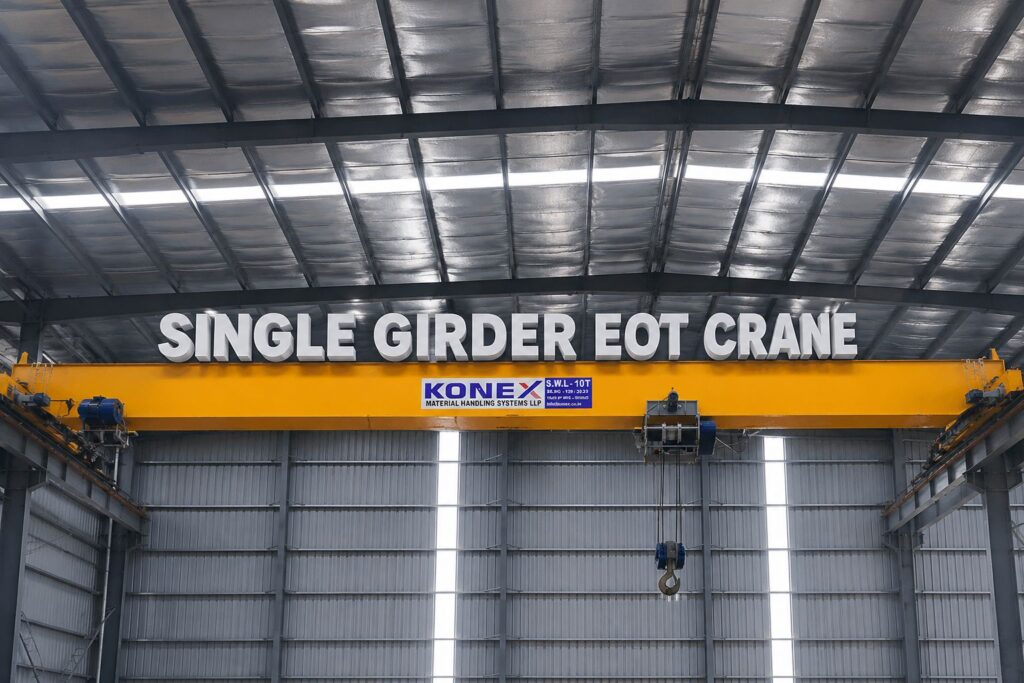
Why Choose a Single Girder EOT Crane?
For safe working loads up to 10 tons, a single girder system is often the most practical, cost-effective, and space-saving choice for industrial operations.
- Lower Initial Capital Investment: Requires less steel to manufacture, reducing the initial purchase cost of the crane.
- Reduced Building Load: The lightweight design exerts minimal wheel load on your gantry rails, columns, and building foundations, saving on factory construction costs.
- Maximum Hook Coverage: Designed to let the hoist hook travel closer to your factory walls, recovering valuable floor space that would otherwise be unreachable.
- Lower Maintenance Costs: With fewer moving parts and simpler mechanical structures, scheduled maintenance is fast, easy, and inexpensive.
- Fast Site Installation: The streamlined structure allows for rapid assembly, testing, and commissioning, ensuring minimal downtime for your facility.
Key Features of Konex Single Girder Cranes
Every system we build is designed to deliver safe operations, reliable performance, and a long service life.
+-----------------------------------------------------------------------------------+
|                              KEY PERFORMANCE VALUE                                |
+-------------------------+-------------------------+-------------------------------+
|    SPACE SAVING DESIGN  |   SMOOTH MOTION (VFD)   |     SAFETY INTEGRATION        |
| Compact hook approaches | Zero load swing, precise | Built-in overload sensors,    |
| maximize floor utility. | placement of heavy loads| limit switches & buffers.     |
+-------------------------+-------------------------+-------------------------------+
1. Space-Saving Structural Design
By utilizing a compact profile and a low-headroom hoist design, our cranes maximize your vertical lifting height. This is crucial for factories with low ceilings or overhead truss limitations, allowing you to lift tall loads over machinery safely.
2. Smooth, Jerk-Free Movement
We integrate Variable Frequency Drives (VFDs) as a standard feature for cross travel and long travel motions. This ensures smooth acceleration and deceleration, completely eliminating the violent jerks and dangerous load swings common in older, direct-start crane systems.
3. Heavy-Duty Structural Build
We use high-quality, certified structural steel (conforming to IS 2062 standards) for our main bridge girders and end carriages. All critical load-bearing joints undergo rigorous structural testing to ensure they handle heavy daily workloads without flexing or sagging over time.
4. Advanced Safety Protection
Our cranes are equipped with dual-stage limit switches, digital overload protection sensors, and emergency stop systems. This ensures absolute protection for your operators, your loads, and your factory floor.
Core Components & Build Quality
To understand what makes Konex one of the most trusted single girder eot crane suppliers, let’s look at the simple, rugged engineering behind our core components.
            [TYPICAL BRIDGE & HOIST LAYOUT]

         +==================== BRIDGE GIRDER ====================+
         |                                                       |
   +-----+-------------------+                           +-------+-----+
   |  [=]|                   |  <- Low-Headroom Hoist    |  [=]  |
   |     |    +---------+    |     Running on lower      |       |
   |     |    | (O) (O) |    |     flange of girder.     |       |
   +-----+----+----+----+----+---------------------------+-------+-----+
   |     |         |                                     |       |
[==|==]  |         |                                     |  [==|==]
  (Wheel)          v                                        (Wheel)
              (Hook Block)
A. The High-Rigidity Bridge Girder
The main bridge girder is the structural backbone of the crane. Depending on your building’s span and runway height, we offer two main designs:
- Standard I-Beam Profiles: Perfect for shorter spans and standard heights. It provides a compact, lightweight, and cost-effective design.
- Fabricated Box Girders: Used for longer spans where structural bending must be kept to a minimum. These are fabricated from high-strength steel plates. We place internal steel support plates inside the box structure to resist twisting and bending forces caused by rapid travel movements.
All major structural welding is carried out using automatic welding machines to ensure deep, high-quality joints. We also perform non-destructive tests (such as dye testing and ultrasonic scans) on critical welds to guarantee there are no hidden internal flaws.
B. End Carriages & Smooth-Running Wheels
The end carriages support the main girder and guide the entire crane along your factory runway rails.
- Rugged Frames: Fabricated from heavy-duty steel channels or box sections, they are connected to the main girder using high-tensile bolts. This allows for easy shipping and fast installation on-site.
- Hardened Steel Wheels: Our wheels are forged from carbon steel alloys. The wheel surfaces are induction-hardened to prevent premature wear on both the wheels and your runway rails.
- Self-Aligning Bearings: Equipped with heavy-duty roller bearings housed in easy-access blocks, making routine grease lubrication simple and fast.
C. Low-Headroom Wire Rope Hoist
Our standard 10 Ton Single Girder EOT Crane features a specialized low-headroom wire rope hoist. This compact design sits close to the bottom of the bridge girder, allowing the lifting hook to rise much higher.
- Precision Rope Drum: Features machined spiral grooves that guide the wire rope neatly into place, preventing overlapping and extending the life of the rope.
- Heavy-Duty Rope Guide: A durable, self-lubricating guide holds the wire rope securely in its groove, even if there is a slight diagonal pull.
- Fail-Safe Hoist Motor & Brake: Equipped with a high-torque motor and an automatic electromagnetic disc brake. If the power cuts out, the brake engages instantly to hold the load securely in place.
D. Electrical Systems & Variable Frequency Drives (VFD)
All electrical controls are housed in a dust-proof, moisture-proof sheet metal panel mounted directly on the crane.
- Standard VFD Control: Standard on both cross travel (hoist moving along the girder) and long travel (crane moving along the building). This provides smooth speed control, eliminates structural shocks, and prevents loads from swinging during transit.
- Safe Cable Festoon System: Power is supplied to the moving hoist via flexible, flat copper cables suspended on rolling trolleys inside a protective C-track. This system prevents cables from tangling or wearing out.
Capacity & Customization Options
As a leading Single EOT Crane Manufacturer, Konex Material Handling Systems LLP provides extensive customization to meet unique lifting requirements. Whether you need a compact crane for a low-clearance facility or a longer span for wide workshops, we deliver optimized solutions.
Customization Options Include:
- Crane span and height adjustment
- Variable travel speeds (cross and long travel)
- Different types of hoists (chain or wire rope)
- Control systems (pendant, wireless remote, or cabin)
- Motor and gearbox configurations
Available in lifting capacities up to 10 tons, our solutions are backed by strong engineering and trusted customer support.
Ideal Applications Across Industries
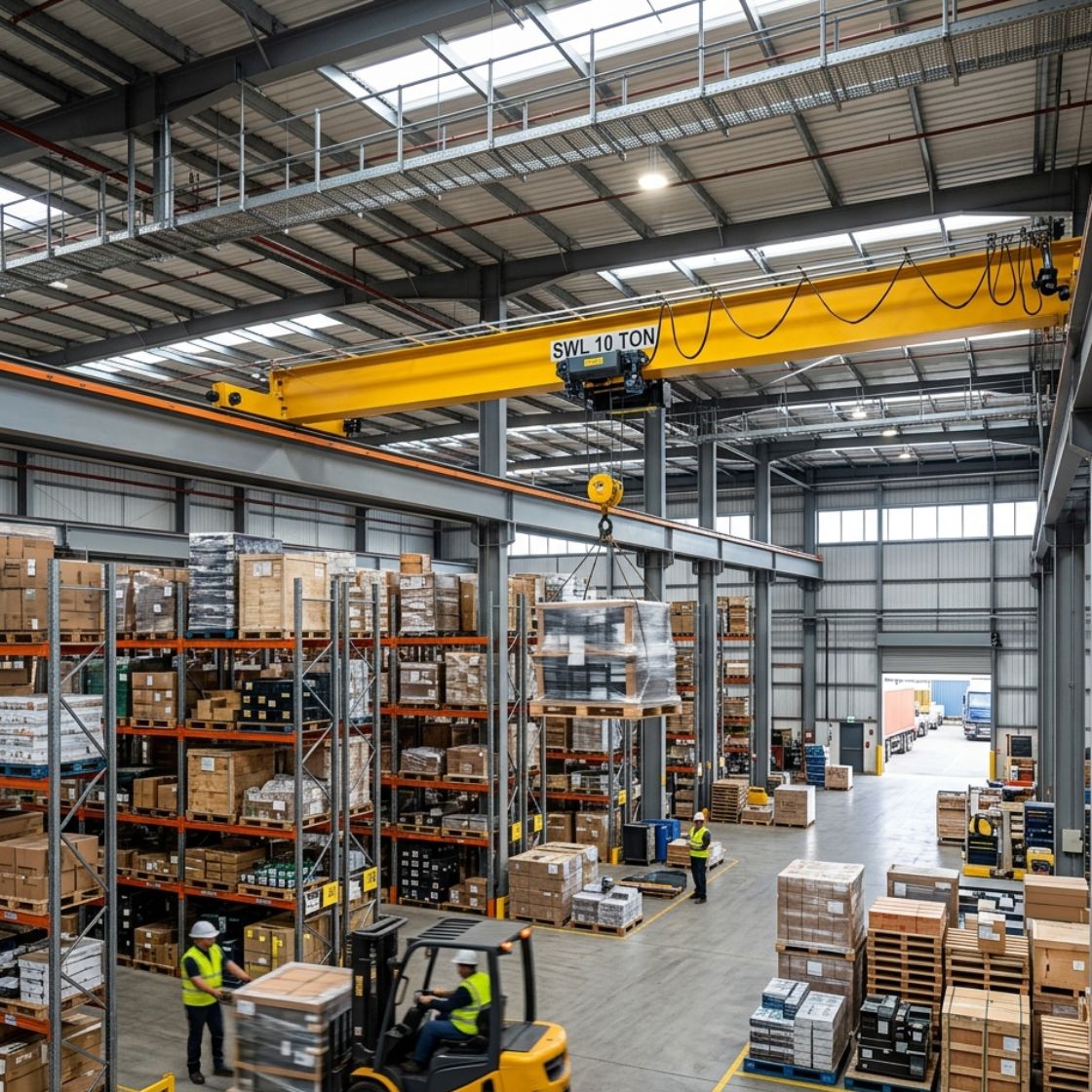
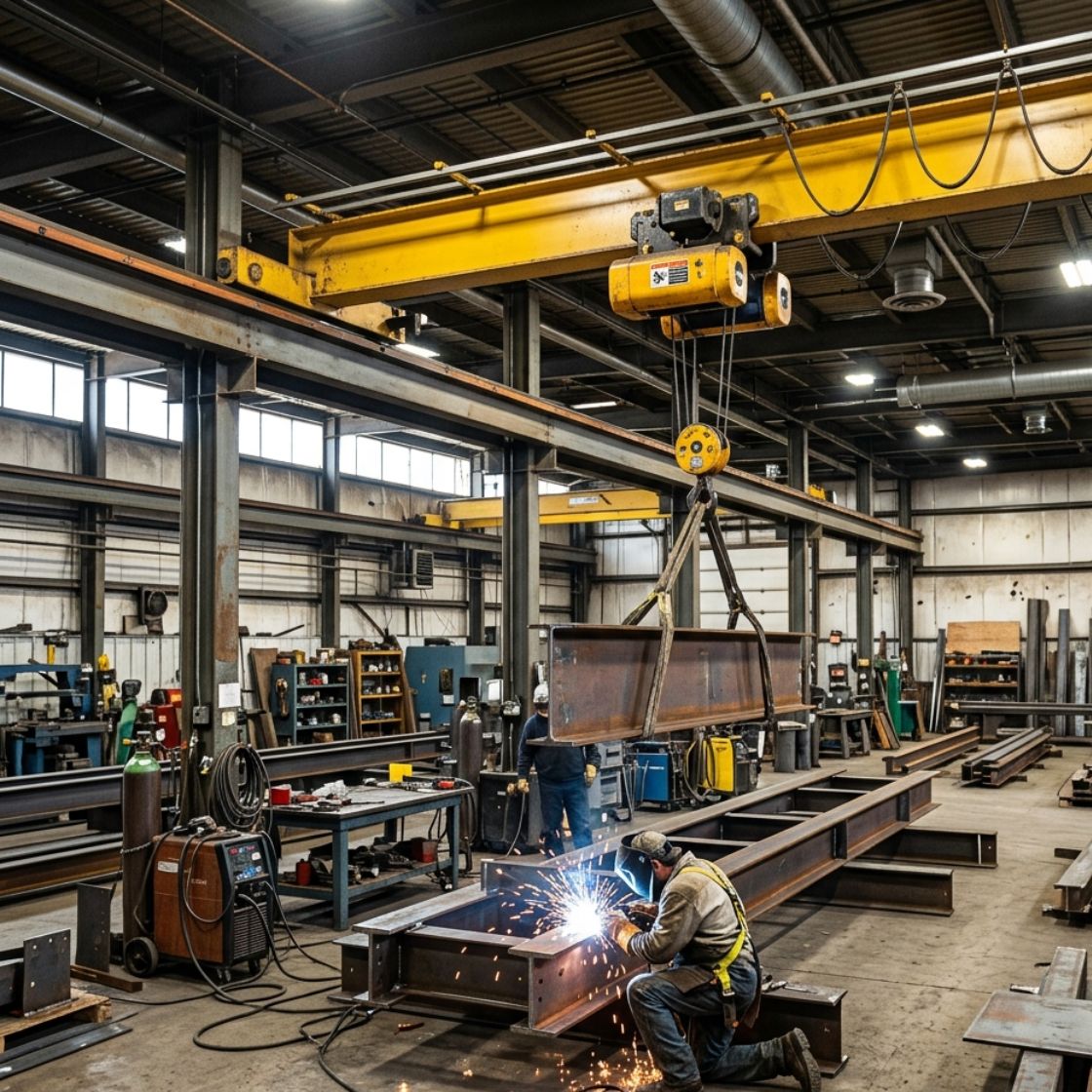
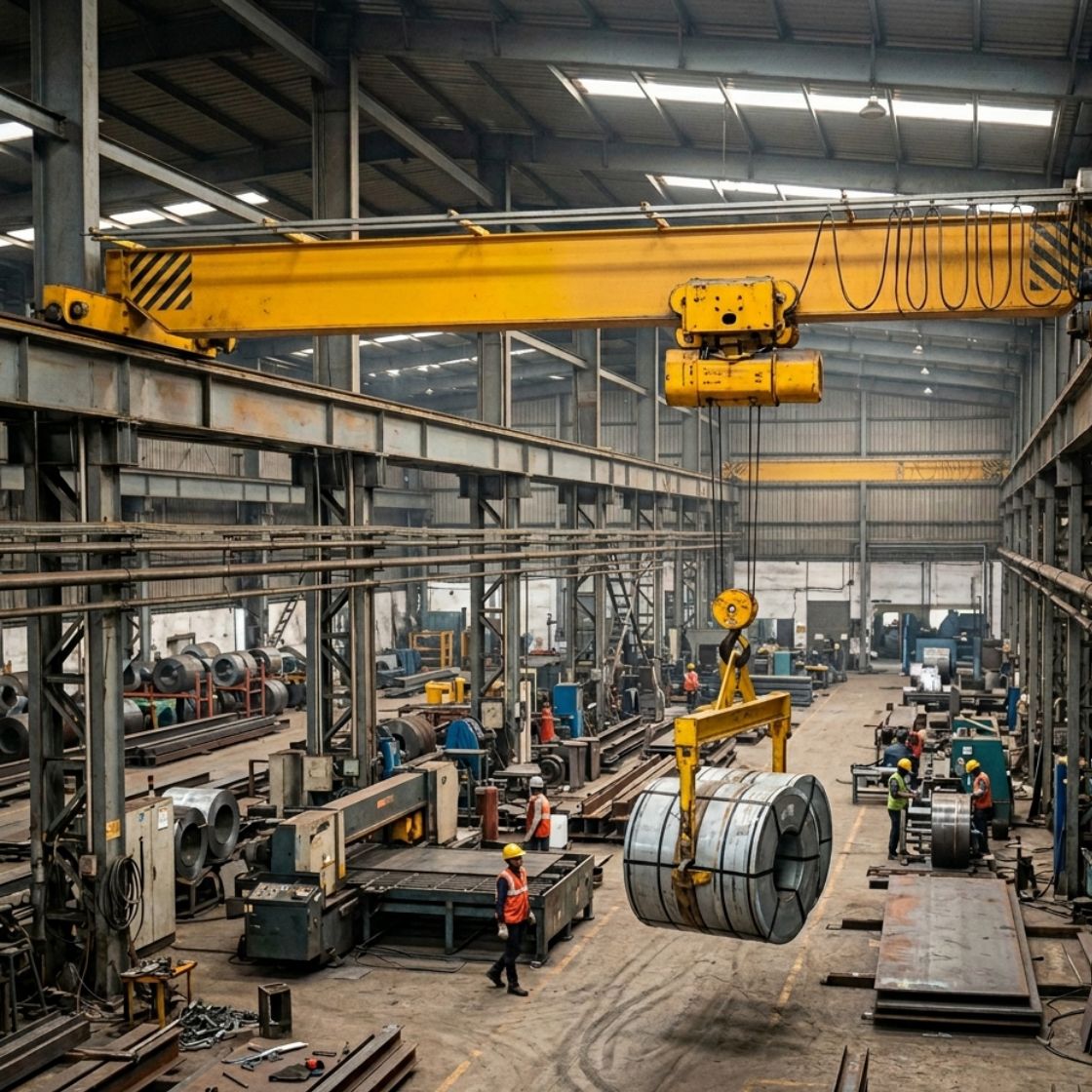
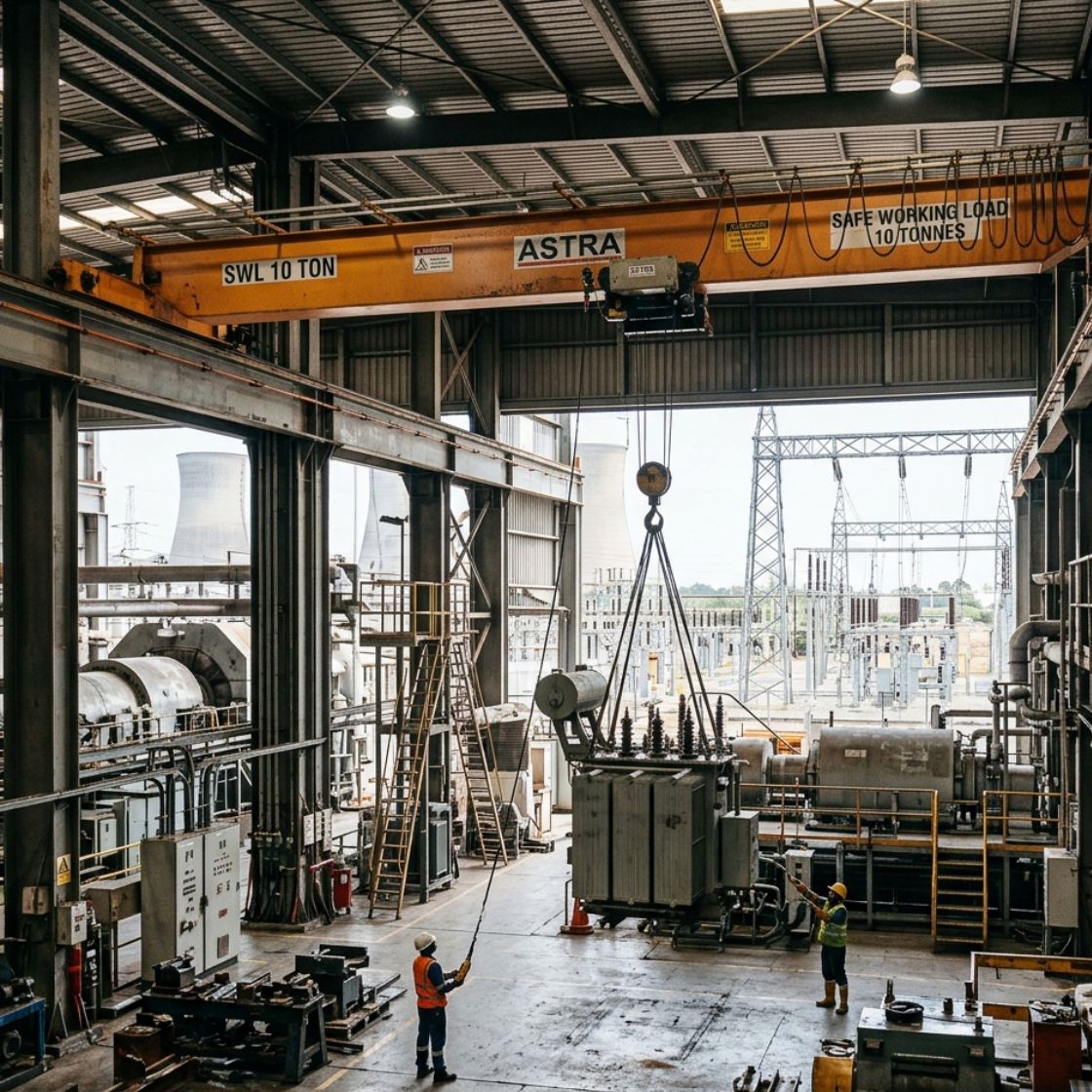
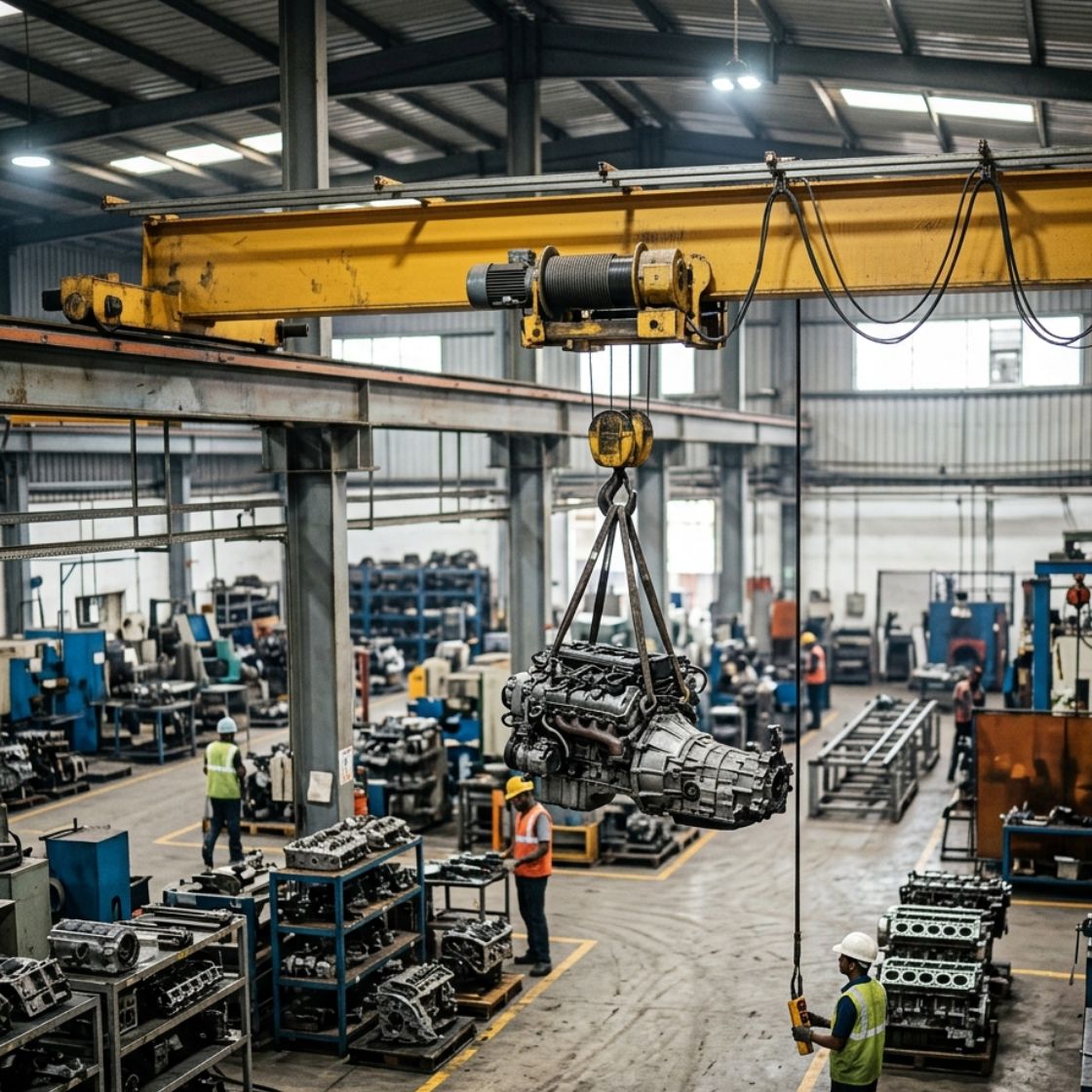
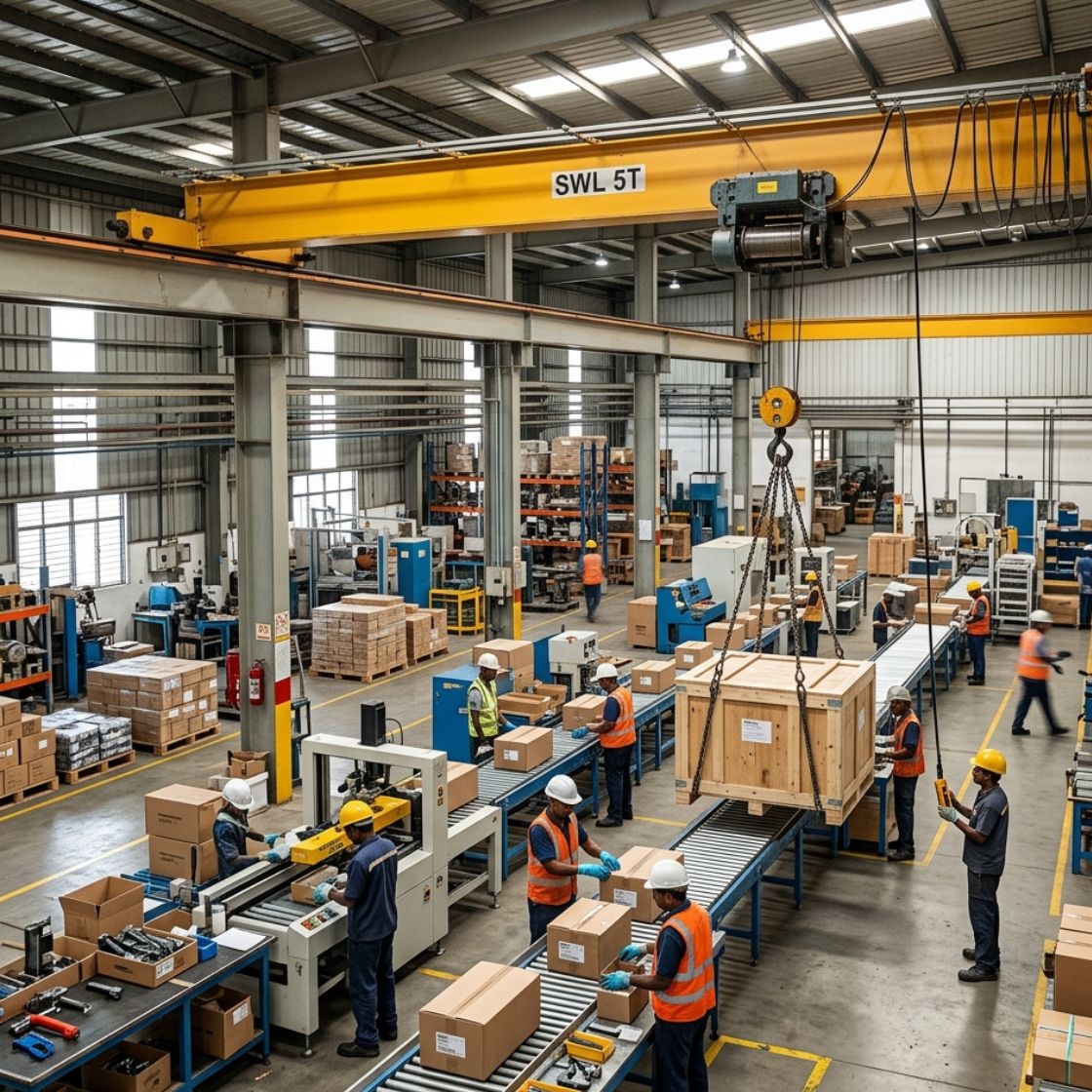
Our EOT Cranes, especially the single girder type, are widely used across different sectors for material handling tasks.
Common industries include:
Solving Real-World Problems for Industrial Buyers
When planning to purchase a new overhead crane, factory managers and owners face several practical challenges. Our custom-engineered systems solve these problems directly.
Problem 1: Low Ceilings and Limited Overhead Room
- The Challenge: Many factories have low roofs or existing overhead piping and steel structures that limit vertical space. A standard crane can severely reduce your actual lifting height.
- Our Solution: We use a compact, low-headroom hoist design that sits high up on the bridge girder. This allows your hook to lift loads higher, giving you maximum clearance without having to raise your factory roof.
Problem 2: Worrying About Overloading Existing Building Columns
- The Challenge: Many factory owners hesitate to install an overhead crane because they fear their existing building columns and gantry rails aren’t strong enough to bear the additional wheel load. Reinforcing the structure adds significant, unplanned cost and construction time.
- Our Solution: Our single girder design uses significantly less structural steel than a double girder crane, which keeps the overall deadweight — and therefore the wheel load transferred to your columns — to a minimum. Our engineering team calculates the exact wheel loads for your span and capacity before manufacturing, so the crane can often be installed in your existing pre-engineered building (PEB) without any additional structural reinforcement.
Problem 3: Damaged Products Due to Load Swing
- The Challenge: When traditional cranes start or stop suddenly, the suspended load swings. This can damage expensive machinery, injure operators, and make precise alignment on assembly lines very difficult.
- Our Solution: Every Konex crane comes with advanced VFD systems that provide smooth, gradual acceleration and braking. The load remains completely stable, allowing operators to position heavy components with millimeter-level precision.
Problem 4: Hard Working Environments (Dust, Humidity, and Heat)
- The Challenge: Cranes operating in dusty fabrication shops, humid locations, or high-temperature foundries can face electrical failures and rapid rust.
- Our Solution: All our steel surfaces undergo high-pressure grit blasting to clean the metal before painting. We apply a multi-layer protective coating system (including a rust-resistant zinc primer and a durable polyurethane topcoat) to a thickness of $120\text{ microns}$. Electrical panels are completely sealed (IP55 rated) to keep out dust and moisture.
Easy Operator Troubleshooting Guide
What You Notice | Potential Cause | Easy Corrective Action |
The motor hums but will not lift the load. | – The load on the hook is more than 10 tons. – There is a phase loss in your power line. – The electromagnetic brake is not releasing. | – Verify the load weight; reduce the load if it is over 10 tons. – Check your main factory fuses and electrical lines. – Check the brake wiring and rectifier connections. |
There is a loud squeaking noise during travel. | – The gantry rails are dirty or out of alignment. – The travel gears are running dry. | – Clean the runway tracks of any debris or obstructions. – Apply heavy-duty grease to the open drive gears. |
The hoist brake slips after stopping. | – The brake disc is worn out. – The internal brake spring has lost its tension. | – Replace the worn brake disc with genuine Konex parts. – Replace the internal compression spring. |
The crane only moves in one direction. | – A limit switch is stuck or damaged. – An electrical contactor in the panel is damaged. | – Inspect the limit switch arm and clean any dust from the contacts. – Have your plant electrician inspect and replace the faulty contactor. |
Step-by-Step Site Measurement Guide
To help our engineering team calculate precise wheel loads, design your girder, and provide a fast, accurate technical proposal, please check the following dimensions in your factory:
 [SITE SPECIFICATION CHECKLIST]

     |<----------------------- SPAN (S) ----------------------->|
     ============================================================  <- Runway Rail
     |                                                          |
     | <-- L1 -->                                  <-- L2 -->   |
     | (Left Hook Approach)                        (Right Hook Approach)
     |                                                          |
     |                                                          ^
     |                                                          |
     +-------------------- LIFT HEIGHT (H) ---------------------+
     |                                                          |
     v                                                          v
  ======================= FACTORY FLOOR LEVEL =======================
- Clear Span (S): The horizontal distance between the centerlines of your two runway rails (measured in millimeters).
- Total Runway Length: The overall length of travel along your factory building (measured in meters).
- Height of Lift (H): The vertical distance from your factory floor to the highest point the hook needs to reach.
- Clear Overhead Space: The vertical space available from the top of the runway rail to the lowest part of your roof truss or ceiling obstruction.
- Hook Approaches The minimum distance the hook must reach on both the left and right sides of your factory bay.
- Estimated Working Hours: The approximate number of lifts per hour and your average load weight, which helps us determine the best duty cycle class for your operations.
- Environmental Conditions: Let us know if your space has high dust, high humidity, extreme heat, or corrosive chemical vapors.
Working with Konex Material Handling System LLP
As an established single girder eot crane manufacturer in india, Konex Material Handling System LLP is dedicated to providing high-quality, trouble-free material handling solutions. By combining robust structural designs, simple engineering, and top-tier components, we deliver equipment that is reliable, safe to operate, and incredibly easy to maintain.
Our engineering team manages your entire project from start to finish:
- Custom Layout & Design: We design the bridge girder, wheel loads, and hoist system to fit your factory’s exact layout.
- Precision Manufacturing: We use only certified structural steel and high-grade materials, with rigorous quality testing throughout the production process.
- Professional Installation: Our experienced technicians supervise the mechanical alignment, electrical integration, and system commissioning.
- On-Site Proof Load Testing: We perform full-capacity load testing on-site to verify structural deflection and safety limits.
- Reliable After-Sales Support: We offer preventative maintenance contracts, operator training, and keep a full inventory of genuine spare parts on hand to minimize your downtime.
Request Your Technical Proposal & Drawings
Optimize your factory’s lifting efficiency with a custom-engineered crane from Konex Material Handling System LLP. Contact our technical team today to review your layout and receive a comprehensive proposal.
Get a detailed technical proposal, layout drawings, pricing, and project timelines customized for your facility.
FAQs
A Single Girder EOT (Electric Overhead Traveling) Crane is an overhead lifting system that uses one bridge girder and an electric wire rope hoist to lift, move, and position heavy materials inside industrial facilities. It is commonly used in manufacturing plants, warehouses, fabrication workshops, engineering industries, automobile plants, machine shops, and steel processing units.
Single girder cranes are ideal for lifting loads up to 10 tons while offering lower installation costs, reduced building loads, efficient floor space utilization, and reliable daily operation.
The standard lifting capacity ranges from 1 ton to 10 tons, although customized designs can be manufactured based on application requirements.
Konex Material Handling System LLP manufactures 10 Ton Single Girder EOT Cranes engineered according to IS 3177, IS 4137, and IS 807 standards, ensuring safe operation, structural reliability, and long service life.
A Single Girder EOT Crane is the best choice when your lifting capacity is up to 10 tons and you want an economical, lightweight, and space-efficient solution.
Benefits include:
- Lower initial investment
- Reduced structural load on the building
- Faster installation
- Lower maintenance costs
- Lower power consumption
- Better hook approach for maximum workspace
- Easy operation and servicing
For medium-duty industrial applications, a single girder crane delivers excellent performance while minimizing ownership costs.
Single Girder EOT Cranes are widely used in:
- Steel fabrication workshops
- Engineering industries
- Automobile manufacturing
- Machine tool industries
- Heavy fabrication units
- Warehouses
- Power plants
- Cement plants
- Logistics centers
- Equipment manufacturing facilities
- Maintenance workshops
- Industrial assembly lines
They are suitable wherever safe and efficient overhead material handling is required.
Modern Single Girder EOT Cranes include multiple safety systems to protect operators, equipment, and loads.
Common safety features include:
- Digital overload protection
- Dual-stage limit switches
- Emergency stop system
- Electromagnetic fail-safe brake
- VFD-controlled smooth movement
- Anti-load swing operation
- Buffer protection
- IP55 protected electrical panels
- Low-voltage pendant controls
- High-strength wire rope and hook assembly
These features improve workplace safety while reducing equipment damage.
A Variable Frequency Drive (VFD) controls the speed of crane travel and hoisting by providing smooth acceleration and deceleration.
Its advantages include:
- Eliminates sudden jerks
- Reduces load swing
- Improves positioning accuracy
- Minimizes motor stress
- Reduces gearbox wear
- Extends crane lifespan
- Increases operator safety
- Saves electrical energy
VFD technology is highly recommended for industries requiring precise material handling.
Yes. Every factory has different dimensions, lifting requirements, and operating conditions.
A customized crane can be designed based on:
- Lifting capacity
- Span
- Height of lift
- Runway length
- Building clearance
- Duty class
- Operating environment
- Control type (Pendant or Radio Remote)
- Hoisting speed
- Travel speed
- Power supply
Custom engineering ensures maximum efficiency and safe crane operation.
For an accurate crane design and quotation, manufacturers generally require:
- Required lifting capacity
- Span between runway rails
- Height of lift
- Runway travel length
- Available headroom
- Hook approach dimensions
- Working hours per day
- Number of lifts per hour
- Type of material being handled
- Indoor or outdoor installation
- Environmental conditions such as dust, heat, or humidity
Providing complete site details helps engineers design the most suitable crane.
A Single Girder EOT Crane requires routine preventive maintenance to ensure safe and reliable performance.
Typical maintenance includes:
- Wire rope inspection
- Brake adjustment
- Gear lubrication
- Wheel inspection
- Bearing lubrication
- Electrical panel inspection
- Limit switch testing
- VFD diagnostics
- Hook safety inspection
- Bolt tightening
Regular maintenance reduces unexpected breakdowns and extends equipment life.
A high-quality Single Girder EOT Crane should comply with recognized Indian engineering standards, including:
- IS 3177 – Code of Practice for Electric Overhead Travelling Cranes
- IS 4137 – Crane Design and Construction Requirements
- IS 807 – Design, Manufacture, Erection and Testing of Cranes
Compliance with these standards ensures structural safety, reliable performance, and industry-approved manufacturing practices.
The delivery timeline depends on crane capacity, customization, project size, and installation conditions.
Typically:
- Engineering and design: 1–2 weeks
- Manufacturing: 3–6 weeks
- Installation and commissioning: 2–7 days
- Load testing and handover: 1 day
Project schedules may vary depending on site readiness and custom requirements.
Konex Material Handling System LLP provides complete overhead lifting solutions backed by engineering expertise, quality manufacturing, and dependable after-sales support.
Key advantages include:
- Custom-designed cranes for your facility
- Compliance with IS safety standards
- Certified structural steel construction
- Low-headroom wire rope hoists
- VFD-controlled smooth operation
- Professional installation and commissioning
- Proof load testing before handover
- Preventive maintenance support
- Genuine spare parts availability
- Technical assistance throughout the crane lifecycle
Konex focuses on delivering safe, efficient, and long-lasting material handling systems that improve industrial productivity while minimizing downtime.